What Is a Research Proposal?
What your committee needs to see before they approve your research


The 30-second summary
A research proposal is the document that sells your study before you start it, written for the supervisor or committee who has to approve it.
- The what: A specific research topic, plus your aims and questions.
- The why: The research gap your study fills, and why filling it matters.
- The how: An outline of your methodology, and a plan you can deliver.
- What happens next: It’s approved, approved with changes or sent back, and ethics review often follows.
If you want a head start on yours, our free research proposal template gives you the structure, with prompts for every section.
Navigate
Your research proposal is the first thing your supervisor or committee judges before they let you start your dissertation or thesis. If it doesn’t convince them, it comes back for revision, and every rewrite eats into the time you have for the research itself.
We’ve worked with 10,000+ students, and the proposals that get sent back usually fall short on the same few points. In this post, I’ll explain what a research proposal is, what goes into it, how it’s structured, and what your reviewers look for in each part.
What is a research proposal?
Simply put, a research proposal is a structured, formal document that explains what you plan to research (your research topic), why it’s worth researching (your justification), and how you plan to investigate it (your methodology).
Its job is to convince your supervisor, committee or university that your research is suitable for your degree and manageable within the time and resources you have. Proposals that don’t usually come back with a request to revise and resubmit.
You’ll meet the term in two places. If you’re applying for a PhD, the proposal is part of your application: a short document that shows your idea. It helps the university judge whether you’re suited to a research degree and whether it has someone who can supervise you. Once you’re enrolled, it’s the plan your supervisor or committee approves before you start your dissertation or thesis. This post focuses on the proposal you write once you’re enrolled, but the what, why and how apply to both.
The SAGE Encyclopedia of Educational Research, Measurement, and Evaluation puts it more formally. Pay close attention to the three things it lists:
Notice that only the first of those is about your idea. The other two are about you and your plan, which is why a strong idea with a vague method still gets sent back. Give all three the same care when you write yours. The sections below come back to each one.
What goes into a research proposal?
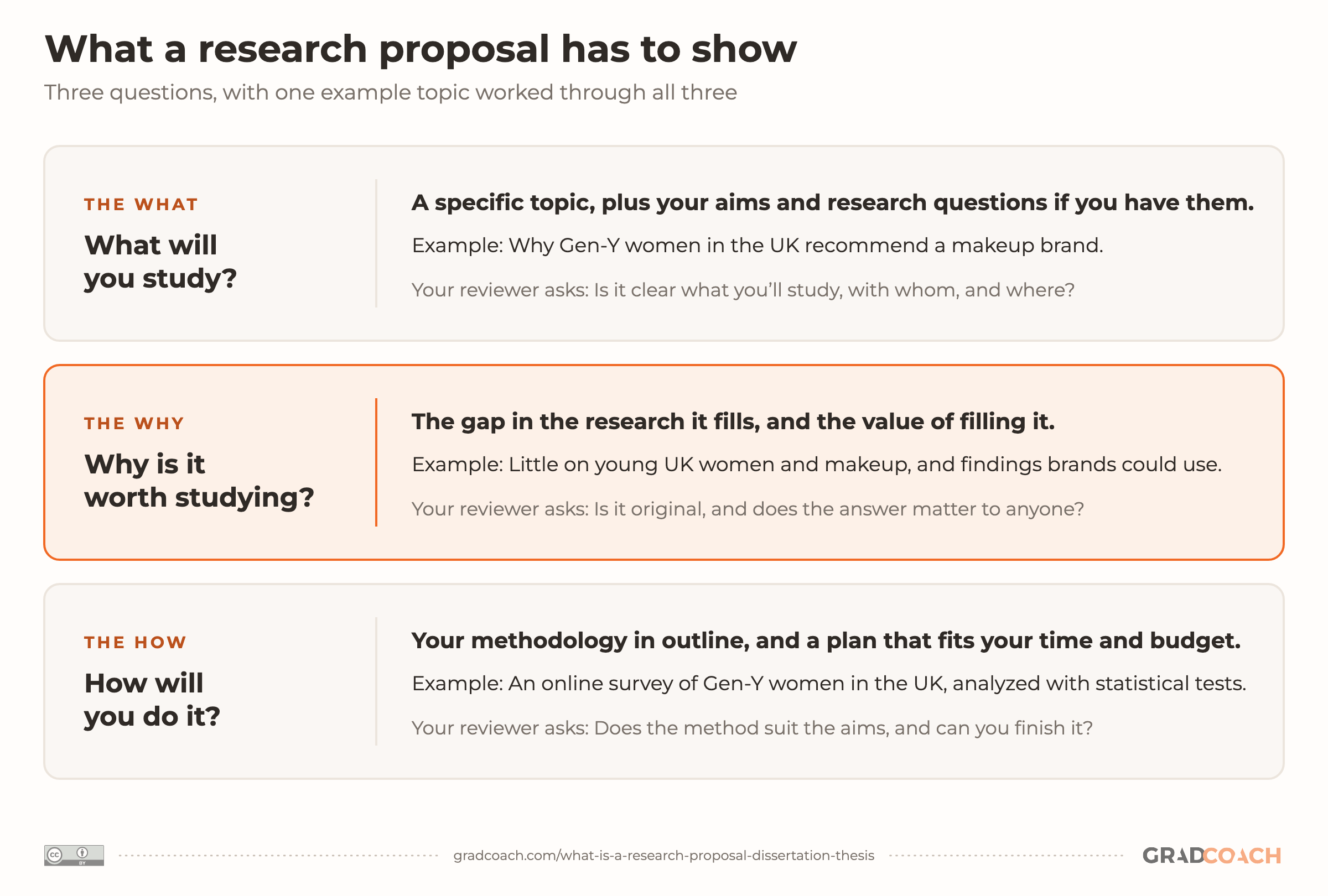
A good dissertation or thesis proposal answers the three questions from the simple definition at the top: what, why and how. The figure below runs one example topic through them, so you can see what each part asks of you before I go through them one by one.

The WHAT
Your proposal needs to state your research topic clearly. It should be specific and unambiguous, so a reader can see exactly what you plan to research and in what context. Here’s an example of a well-defined topic:
From this one line, you can see exactly:
- What’s being investigated: The factors that make people recommend a particular makeup brand
- Who it involves: Female Gen-Y consumers
- Where it’s set: The United Kingdom
If a stranger can picture the study from your topic alone, it’s specific enough. Your proposal should then explain the topic in more detail and, where you can, set out your research aims and objectives and your research questions. Some programs don’t expect firm research questions until later. Either way, don’t start writing until you have a clear topic in mind. Without one, the proposal drifts, and your reviewers will notice.
The WHY
A clear topic is only the start. You also need to show that it’s original: what gap in the current research does it fill? How original it needs to be depends on your level. At Master’s level, applying known ideas to a new context or population can be enough, while a doctorate needs a clearer contribution to what’s known.
Originality alone isn’t enough, though. You also need to show that the study is important: what value will it add if you achieve your aims?
In my experience, the why is where proposals most often come back. A common version: the draft describes a real problem in the student’s workplace or field but never shows the gap in the research, or shows the gap but not why it matters. Your problem statement, the short passage that sets out the problem your study tackles, needs both. The video below explains what a research problem is and how to write a problem statement around one.
Take the makeup-brand topic as an example. Suppose your literature review (your survey of what’s already been published) finds that most studies of brand recommendation treat Gen-Y consumers as one group, with little on young British women and cosmetics. That’s your gap. And if the research uncovers what drives those women to recommend a brand, cosmetics marketers could use the findings, so the study has commercial value too. The gap and the value together make a clear justification.
So, when you write your proposal, show that the topic is both new and worth knowing about, and say so explicitly rather than leaving your reader to work it out. If you’re still hunting for a topic like that, browse our database of research topic ideas.
The HOW
A great topic that’s original and valuable still won’t get approved if you don’t clearly communicate the practicalities:
- How will you actually carry out your research (your methodology)?
- Is your methodology appropriate for your research aims?
- Is your approach manageable, given your time, money and other constraints?
At this stage, you usually don’t need a complete research methodology, just a short outline of it. For the makeup-brand topic, that might be an online survey of Gen-Y women in the UK, analyzed with statistical tests. The exception is a program where your proposal doubles as the first three chapters of your dissertation, which I cover near the end.
Whatever your study, your proposal should answer these questions:
- Will you take a qualitative, quantitative or mixed-methods approach?
- What sampling strategy will you use?
- How will you collect your data (for example, interviews or surveys)?
- How will you analyze your data (for example, descriptive and inferential statistics, or content or discourse analysis)?
- What are the limitations of your methodology?
You don’t need final answers to all of these, but you do need a basic plan before you draft this section.
Your reviewers will also want to see that you can actually do it. That’s point (b) in the SAGE quote: the skills, knowledge and resources to carry out the project. Say how you’ll reach your participants or data, and mention any training or experience your method needs. For example, if you’ll be using an analysis technique that’s new to you, say how you’ll learn it. If the choices feel intimidating, the video below introduces research methodology and the key decisions you’ll need to make.
How to structure a research proposal
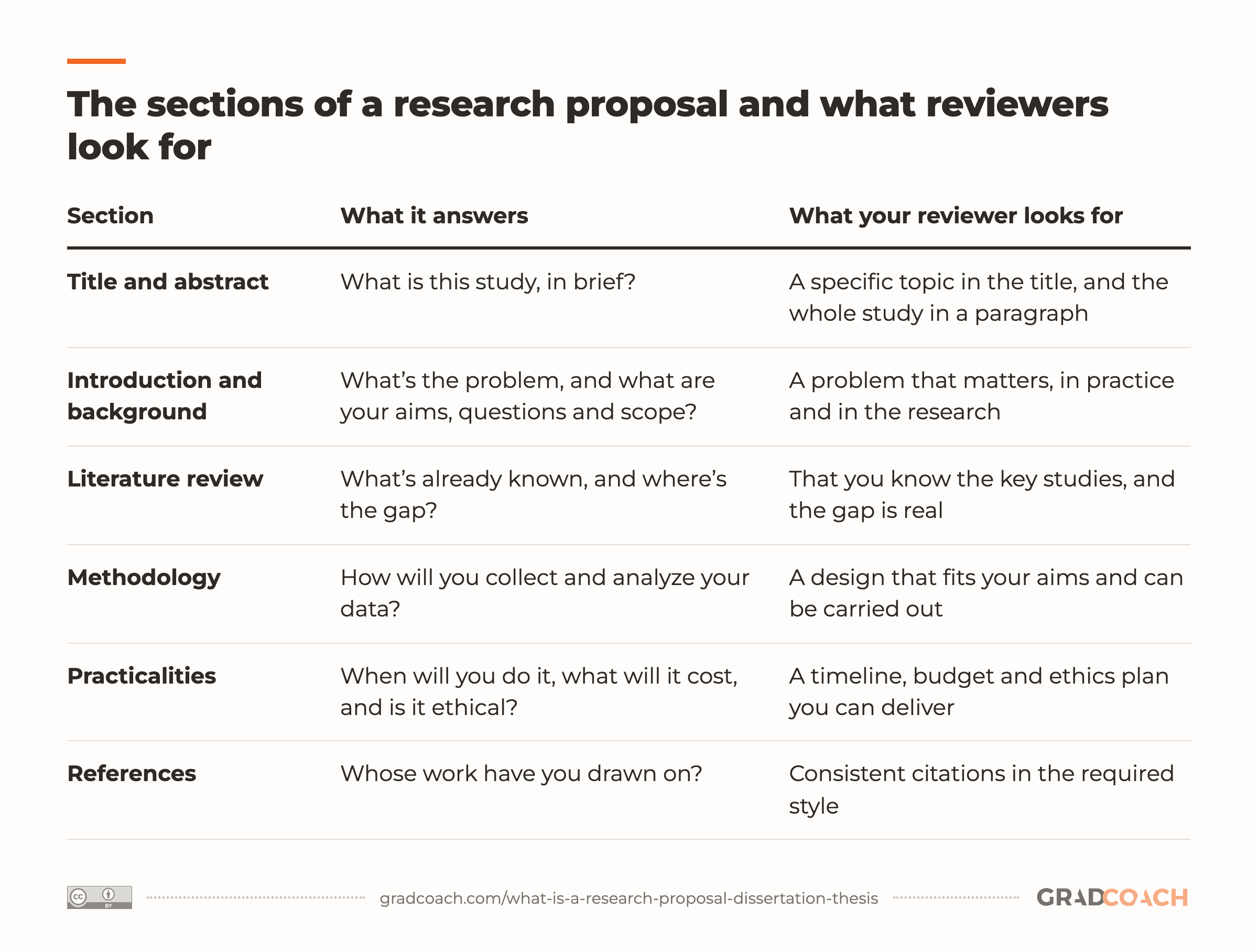
The exact structure varies between universities, so your handbook or template is always the final word. That said, most proposals are built from the same core sections, and each one has a job to do. The table below shows what each section answers and what your reviewer looks for in it.
| Section | What it answers | What your reviewer looks for |
|---|---|---|
| Title and abstract | What is this study, in brief? | A specific topic in the title, and the whole study in a paragraph |
| Introduction and background | What’s the problem, and what are your aims, questions and scope? | A problem that matters, in practice and in the research |
| Literature review | What’s already known, and where’s the gap? | That you know the key studies, and the gap is real |
| Methodology | How will you collect and analyze your data? | A design that fits your aims and can be carried out |
| Practicalities | When will you do it, what will it cost, and is it ethical? | A timeline, budget and ethics plan you can deliver |
| References | Whose work have you drawn on? | Consistent citations in the required style |
Notice how the sections map onto the three questions: the what lives mostly in your title and introduction, the why in your introduction and literature review, and the how in your methodology and practicalities.
Not every proposal has all six, and in our experience the names and order vary too. Many don’t ask for an abstract, some fold the literature review into the introduction, and others give scope (what your study covers and what it leaves out) its own section. If your university gives you no template or rubric at all, which is one of the most common problems students bring to us, start from our template and adapt it to your field.
Research proposal examples/samples
The fastest way to see how all of this comes together is to read a few proposals that got approved. Our post on research proposal examples walks through two of them, one at Master’s level and one at PhD level, with comments on what each does well. As you read them, check whether the title, aim and research questions use the same key words, because that alignment is one of the first things reviewers test. The video below covers the same two proposals.
What happens after you submit it?
Once you submit, your proposal is reviewed. Depending on your university, this step might be called proposal approval or a proposal defense, and the proposal itself is sometimes called a prospectus. A defense means presenting your proposal to your committee and answering their questions. Who reviews it varies too. At Master’s level it’s sometimes your supervisor alone, especially in the UK, while in many US doctoral programs it’s your full committee.
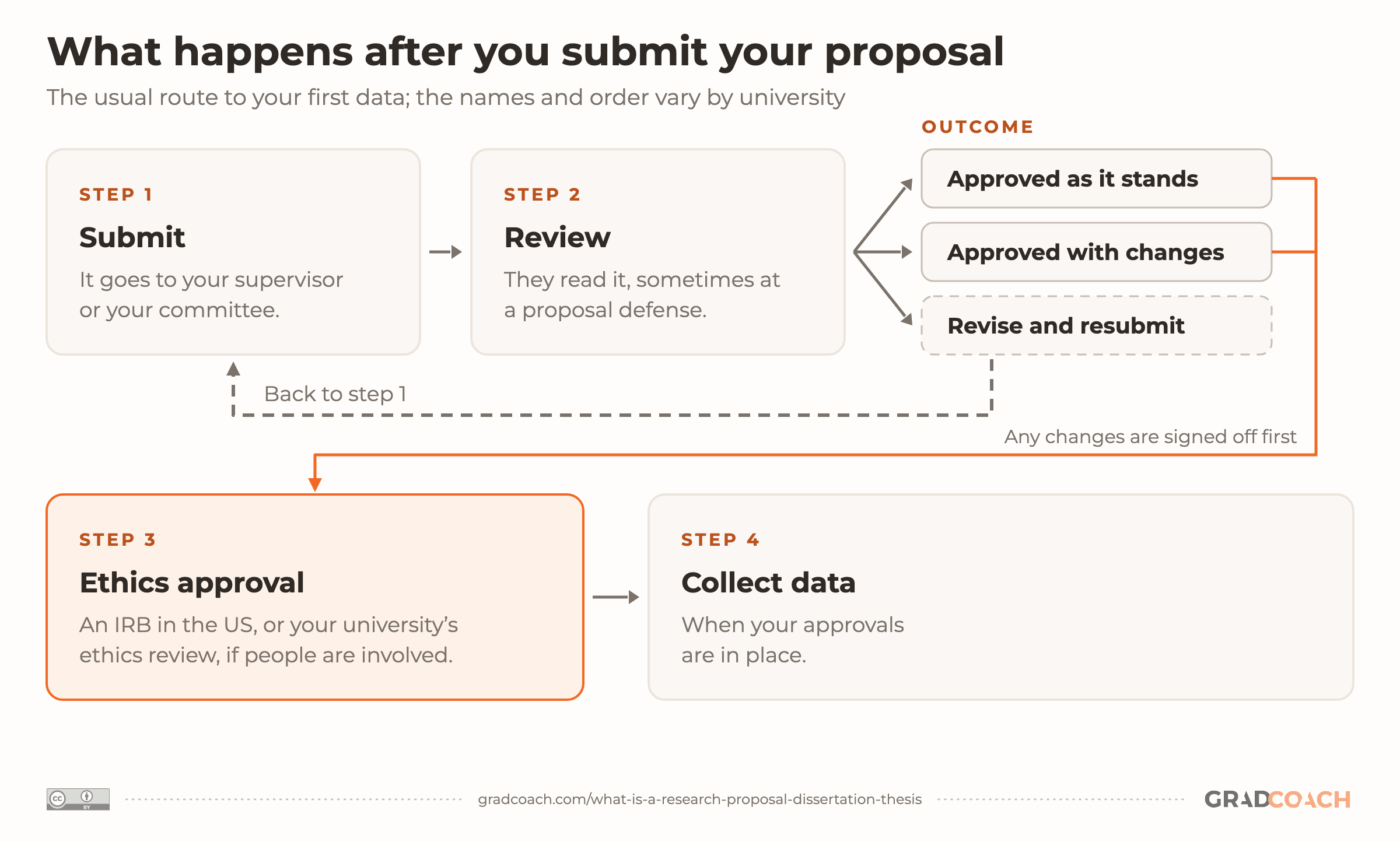
The figure below shows the usual route from submitting your proposal to collecting your first data.

The outcome usually falls into one of three groups, though the labels vary between universities. The University of Michigan’s School of Kinesiology, for example, records a proposal outcome as pass, pass with revisions, or repeat the proposal. Whatever your university calls them, each outcome tells you what to do next:
- Approved as it stands: Move on to ethics approval, if your study needs it, and then your research.
- Approved with changes: Make the changes, and get them signed off before you continue.
- Revise and resubmit: Rework the proposal, then submit it for review again.
A request for changes is normal, so don’t read it as failure. My advice is to treat the feedback as a to-do list, and to confirm with your supervisor what “done” looks like before you rewrite anything. If the feedback is hard to decode, that’s a common reason students come to us, and our proposal coaching is built for it.
Even after your proposal is approved, you usually can’t start collecting data yet. If your study involves people, you’ll also need ethics approval, which in the US comes from an institutional review board (IRB). Some universities want an ethics form even when your study doesn’t involve people.
In many programs, you apply for ethics approval only after the proposal is approved. A doctoral program guide at the University of Tennessee at Chattanooga puts the rule plainly: “Data collection may not begin until the Dissertation Proposal has been successfully defended and the study has received IRB approval.”
In the UK, who reviews the ethics side depends on your university and how risky the study is. For a taught Master’s project, your supervisor or course team may handle it. The University of Huddersfield’s business school, for one, says your research will normally be approved by your supervisor. The rule on timing is the same, though: no collecting data from people until approval is in place.
If you want to understand what ethics reviewers look for, check out our research ethics explainer, and if you’re in the US, our step-by-step guide to IRB approval walks you through the application.
Proposal vs. dissertation: what changes?
A proposal is a plan, and your dissertation or thesis is the finished study. In many US doctoral programs, the line between them is thinner than you’d expect: the proposal is essentially the first three chapters of your dissertation (introduction, literature review and methodology), written in the future tense. Elsewhere, the proposal is a shorter, separate document that you build the dissertation from.
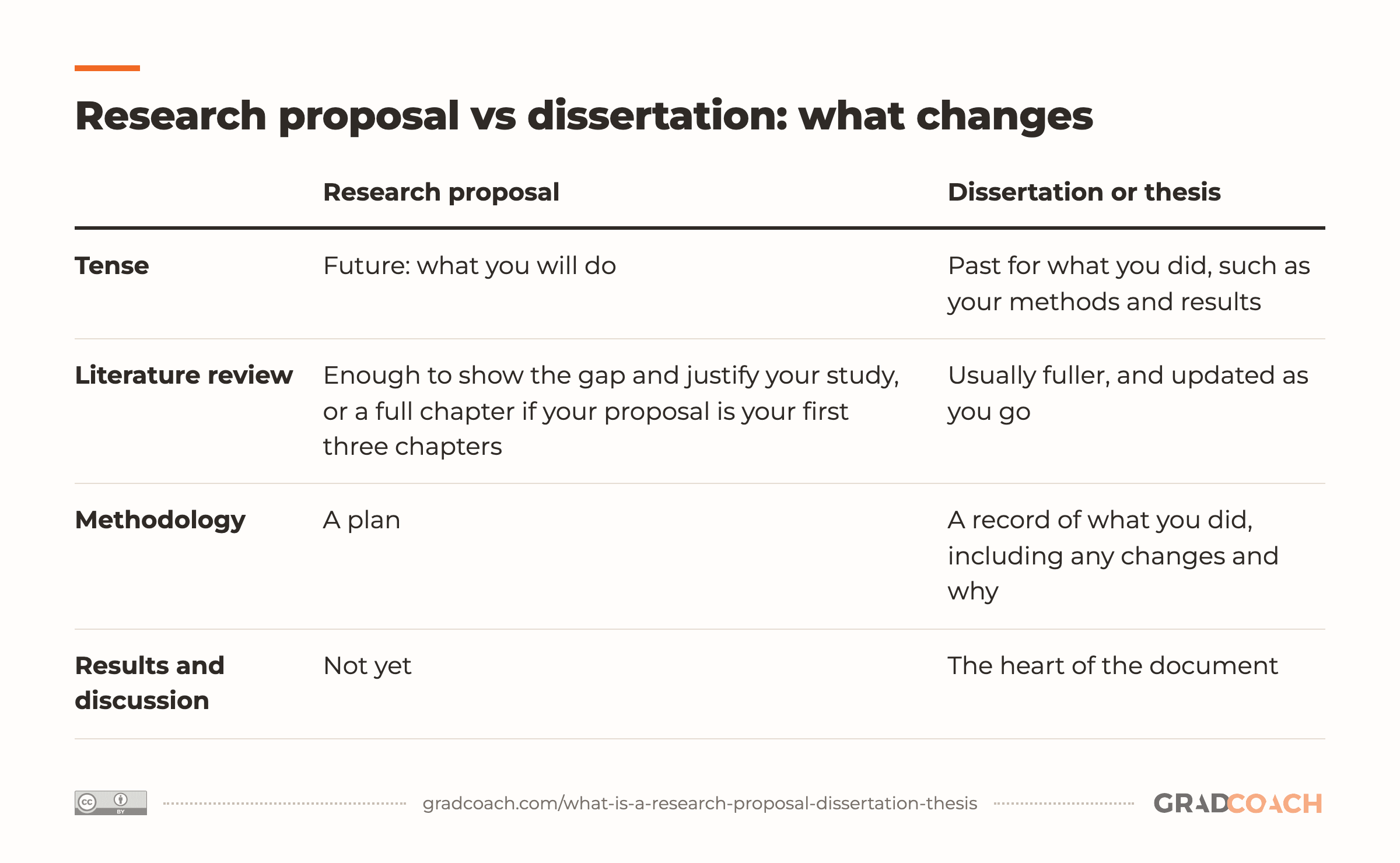
Either way, a few things change between the two. The table below sets them side by side; watch the tense and methodology rows, because those are the parts you’ll rewrite.
| Research proposal | Dissertation or thesis | |
|---|---|---|
| Tense | Future: what you will do | Past for what you did, such as your methods and results |
| Literature review | Enough to show the gap and justify your study, or a full chapter if your proposal is your first three chapters | Usually fuller, and updated as you go |
| Methodology | A plan | A record of what you did, including any changes and why |
| Results and discussion | Not yet | The heart of the document |
The tense shift is easy to miss. Proposals are written in the future tense because you haven’t done the study yet, and when you turn proposal chapters into dissertation chapters, your methods move into the past tense (Walden University’s writing guidance covers exactly this case).
Bringing it together
It’s a lot to hold in your head at once, but every proposal comes back to the same three questions:
- What will you study?
- Why is it worth studying?
- How will you do it?
Answer those clearly, in the format your university asks for, and you’ll have covered what your reviewers check first.
Still have questions?
How long should a research proposal be?
It depends on your university, level and type of proposal, so check your handbook first. Master’s requirements range from a 500-word outline to several thousand words. A UK PhD application proposal runs from about 500 to 5,000 words, depending on the department, and the University of Manchester says typical proposals range between 1,000 and 1,500 words. A US doctoral proposal can run from a handful of pages to 60 pages or more where it forms the first three chapters of the dissertation.
Does a research proposal need an abstract?
Only if your university asks for one. Some doctoral programs require a one-page abstract or a short summary at the start of the proposal, while many PhD application guidelines don’t mention one at all. If your template includes an abstract, write it last, once the rest of the proposal is settled.
Can I use “I” in a research proposal?
Often, yes. APA Style allows the first person when you describe your own research steps (“I will interview…”), and Purdue OWL’s guide to APA style says so directly. Some UK departments still prefer the third person in academic writing, though, so check your department’s guidance before you decide.
Can I change my research after my proposal is approved?
Usually, yes, within reason. Studies often change once data collection starts, for example when recruitment falls short or an instrument doesn’t work as planned. Get any significant change approved by your supervisor or committee before you make it, and check whether your ethics approval needs an amendment too.
Which referencing style should I use in a research proposal?
Use the style your university or department specifies, and keep it consistent throughout. If no style is given, use the one your field’s journals use. APA is common in education and psychology, for example.
What are the most common mistakes in a research proposal?
The most common ones are a topic that’s too broad, aims and research questions that don’t align, a weak justification, and a research design that isn’t explained well enough. Poor planning and ignoring your university’s specific requirements also get proposals sent back. Our post on research proposal mistakes covers each one with examples.
Can’t find your answer here? Ask a Grad Coach directly – the initial chat is free.
Speak with a friendly coach →