The Research Gap (Literature Gap)
The four gap types, with real examples from published dissertations


The 30-second summary
A research gap is a clear, unanswered question or problem in the existing academic literature. It’s the “missing piece” your study can help address. There are four common types:
- Classic gap – the topic hasn’t been studied much
- Disagreement gap – existing studies don’t agree
- Contextual gap – research is missing in a specific setting or group
- Methodological gap – the methods used so far have limitations
You’ll usually find gaps by reviewing recent studies and looking for what they say is still unknown or needs more research.
Navigate
Your proposal needs a research gap, and your field already holds thousands of studies. None of them look obviously unfinished. So where exactly is the hole you’re supposed to find?
Having spent the last 10 years helping students find and defend their gaps, we’ve found the hunt usually stalls because you’re looking for a blank space. A gap doesn’t have to be untouched territory, and usually isn’t. More often it sits inside research that already exists, which makes it both easier to find and easier to defend.
What (exactly) is a research gap?
A research gap is an unanswered question or unresolved problem in a field, which reflects a lack of existing research in that space. It can also exist where there’s already a fair deal of research, but where the findings of the studies pull in different directions, making it difficult to draw firm conclusions.
Types of research gaps
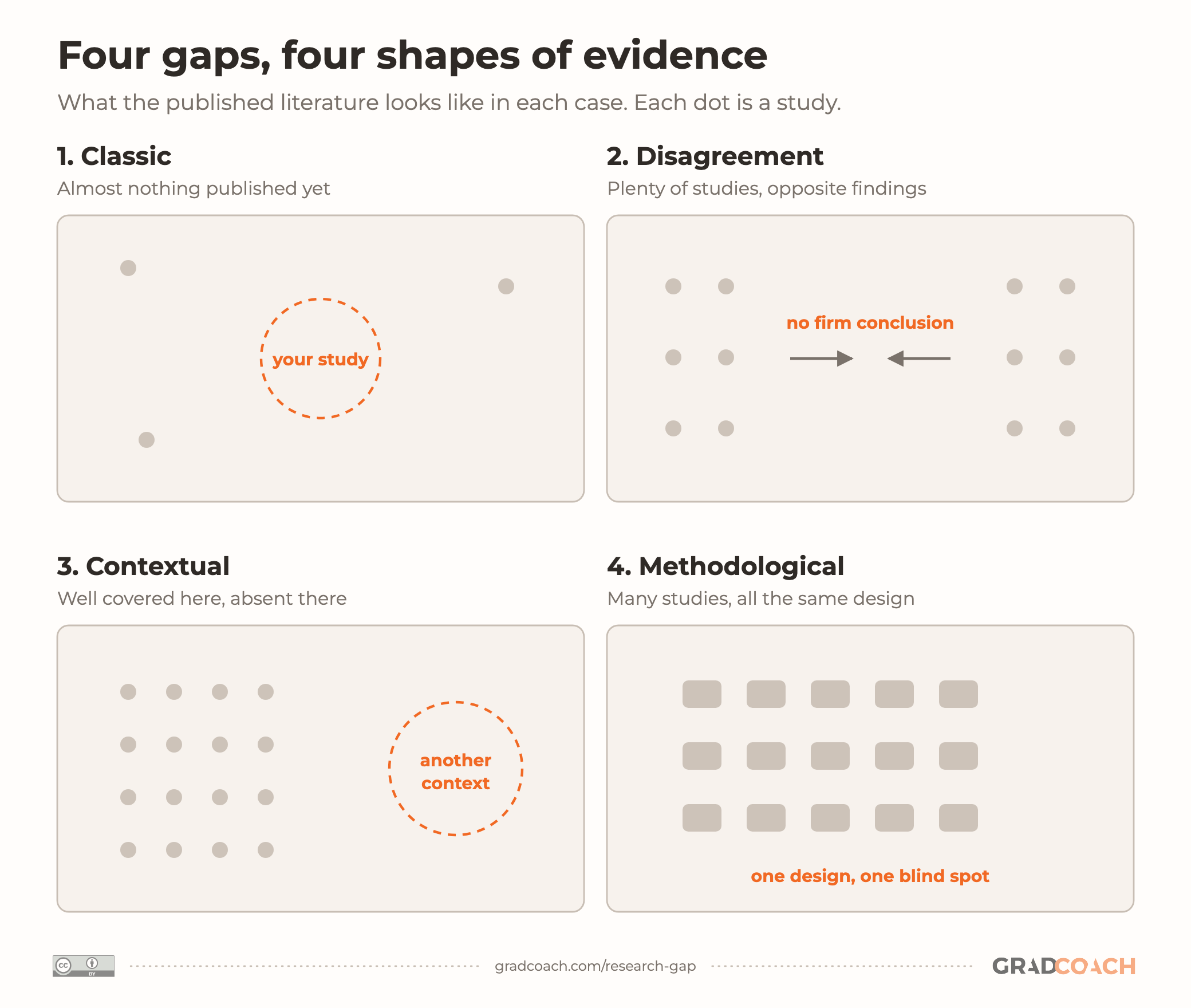
There are many ways to slice this, but four types cover most of what we encounter when helping students at Grad Coach:
They are not four flavors of the same thing. Each one is a different pattern in the published literature, which means each one is found by looking for something different.

Let’s take a look at each of them in a bit more detail.
1. The classic literature gap
This type of research gap emerges when there’s a new concept or phenomenon that hasn’t been studied much, or at all. When a social media platform launches, there’s an opportunity to explore its impacts on users, how it could be leveraged for marketing, its effect on society, and so on. The same applies to new technologies, and to new modes of communication and transportation.
Classic gaps present genuinely exciting opportunities, but there’s a drawback you need to be aware of: you’ll be exploring completely new territory. You’ll have to draw on adjacent literature (that is, research in neighboring fields) to build your literature review, since there naturally won’t be many existing studies that relate directly to your topic. That’s manageable, but it’s harder than it sounds for a first-time researcher, so be careful not to bite off more than you can chew.
Here’s a real-world example from a computer science master’s thesis:
Notice what Shao does not claim. Not that machine learning in intrusion detection is unstudied, which would be false and easy to disprove. The claim is narrower: one specific choice inside a well-studied field, encoding the IP address as a feature, hasn’t been addressed. A classic gap doesn’t require an empty field, only an unexplored corner of one. Write yours the same way: name the corner, not the field.
2. The disagreement gap
As the name suggests, a disagreement-based research gap emerges when there are contrasting or contradictory findings in the existing research regarding a specific research question (or set of questions). The hypothetical example we looked at earlier, regarding the causes of a disease, reflects a disagreement gap.
For this type of research gap, there needs to be a relatively balanced set of opposing findings. A situation where 95% of studies find one result and 5% find the opposite wouldn’t constitute a disagreement in the literature. It’s hard to quantify exactly how much weight to give each study, but you’ll need to show at least that the opposing findings aren’t a corner-case anomaly.
Here’s how a psychology thesis stated its version of the same problem:
This is the disagreement gap in two sentences: the effect is settled, the explanation is not, and “numerous different models” is the polite way of saying they don’t agree. The thesis title says the rest. So before you claim a disagreement, work out what the field does agree on. A contradiction only reads as a gap against a settled background.
3. The contextual gap
A contextual research gap exists when there’s already a decent body of research on a topic, but an absence of research in specific contexts. For example, there could be a lack of research on:
- A specific population, such as a certain age group, gender or ethnicity
- A geographic area, such as a city, country or region
- A certain time period, where the bulk of the studies took place years or even decades ago and the landscape has changed since
The contextual gap is a popular option for dissertations and theses, especially for first-time researchers, since it lets you build on a solid foundation of existing literature and potentially even reuse existing survey measures.
If you’re going to take this route, you need a plausible reason why you’d expect different results in the context you’ve chosen. If there’s no reason to expect a difference between the existing context and yours, the gap isn’t well justified.
This is where we see the most proposals wobble. The context is genuinely new, but nothing explains why that newness should change the findings. Being new is not the same as being different, and only the second one justifies a study.
Here’s a real-world example from a public health thesis:
Antenatal depression is heavily researched worldwide, so the gap isn’t the topic. It’s the country. Note that the sentence sits directly after a paragraph of prevalence figures from a meta-analysis: the author establishes that the wider evidence exists before pointing at where it runs out. Do the same in your own proposal, and in that order.
4. The methodological gap
A methodological research gap emerges as a result of the research methodology or design of existing studies. Taking this approach, you’d argue that the methodology of existing studies is lacking in some way, or that it misses a certain perspective.
You might argue that the bulk of the existing research has taken a quantitative approach, and therefore lacks the rich insight and texture that a qualitative study could provide. Or that existing studies have primarily taken a cross-sectional approach, and so have only provided a snapshot view, whereas a longitudinal approach could reveal how constructs or variables have evolved over time.
And here’s an entomology thesis making the point in a single sentence:
The hypothesis is that the architecture of a bumble bee nest shapes how disease moves through the colony. Theory says it should; nobody has gone and measured it. One sentence, and the study design follows from it. If you can’t state your own gap that plainly yet, you probably haven’t found it yet.
How to find a research gap
We cover the full process in a separate post on finding research gaps. Here’s the short version: two steps, and most of the work sits in the first.
Step 1: Map what already exists.
Find as many literature reviews, systematic reviews and meta-analyses as you can, covering your area of interest, then add the most recent journal articles to see where the field has got to. Recent dissertations and theses are worth just as much, especially doctoral ones, because a doctoral candidate has already run this search and written up what they found missing.
Stick to recent work, ideally from the last year or two. A gap identified five years ago has often been filled by someone since, and discovering that after you’ve written your proposal is an expensive way to learn it.
Step 2: Read the sections where authors admit what they couldn’t do.
Two sections usually pay off. The first is titled “further research opportunities” or “further research is needed”, where researchers state outright where more studies are required. The second is the limitations section, which is the single best source of methodology-based gaps, because a limitation is a methodological gap written from the other side.
EBSCO Open Dissertations and CORE are both free to search, and your university library likely provides access to ProQuest.
Work through those two steps and you’ll orient yourself with the current state of research, which is the foundation for spotting a gap in it. From there you can draw up a shortlist and evaluate the entries as candidate topics. And once your gap is approved, there are a few first moves worth making before you start writing.
Still have questions?
What’s the difference between a research gap and a research problem?
The gap is what’s missing from the literature; the problem is why that absence matters. “No one has studied burnout among rural nurses” is a gap. “Rural clinics are losing staff and nobody knows which pressures to address first” is the problem the gap leaves unsolved. Most proposals need both, and they usually sit in consecutive paragraphs, with the gap first.
Are there only four types of research gap?
Four is a practical grouping, not a fixed taxonomy. Other frameworks split them differently: some separate theoretical and conceptual gaps from methodological ones, some add an evidence or practical-application gap, and Müller-Bloch and Kranz’s framework derives its categories from an analysis of 40 literature reviews. If your program prescribes a particular typology, use that one. The labels matter far less than being able to show what’s missing and why it’s worth addressing.
What’s another word for a research gap?
You’ll see literature gap, knowledge gap, gap in the literature and research lacuna used for roughly the same idea, and this post uses research gap and literature gap interchangeably. Some fields distinguish a knowledge gap (nobody knows) from a practice gap (it’s known but not applied), so check how your own discipline uses the terms before adopting one.
How long should a research gap statement be?
In a proposal, one to three sentences is usually enough, placed at the end of your literature review or the start of your problem statement. Three of the four examples above are a single sentence. The length that matters is the argument leading up to it: a one-line gap statement only lands if the preceding pages have shown what does exist.
What if someone publishes on my gap while I’m writing?
It happens, and it’s rarely fatal. A new study on your topic usually narrows your gap rather than closing it, because it will have its own context, sample and method, all of which yours can differ from. Read it properly, then position your study against it explicitly. If it genuinely answers your exact question, your advisor (supervisor) can help you pivot, which is a conversation worth having early rather than at submission.
Can’t find your answer here? Ask a Grad Coach directly – the initial chat is free.
Speak with a friendly coach →


Found this helpful?
Keep us near the top of your Google results.