Research Proposal Examples
Two approved proposals, Master's and PhD, with comments


The 30-second summary
- Example 1 is the golden thread in a Master's proposal: the title, aim, questions, objectives and chapter headings all repeating the same words.
- Example 2 is a problem statement in two halves: a real-world problem, then the gap in the research. Most drafts write only one of them.
- Example 3 is a gap that gets counted. Two studies existed. They read both, found the flaw in one, and built their design out of it.
- Example 4 is a method justified by naming what was rejected and why. There are no rules in methodology, only justifications.
Navigate
A research proposal is the only academic document you’ll write that gets marked pass or fail before you’re allowed to start. Most people read an example to see what a proposal looks like. Read these two to see what got them past the committee.
Here are two that did, annotated with the same comments we’ve given thousands of students in proposal coaching. Both are real proposals, both were approved, and you can download either one in full:
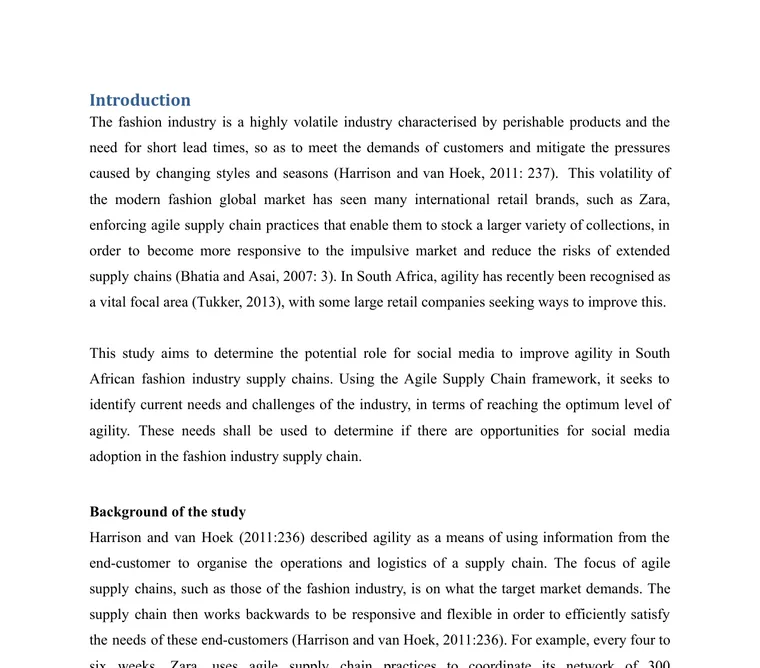 Master's levelSocial media and supply chain agilityA quantitative study in the South African fashion industry.PDF or Word · 26 pages
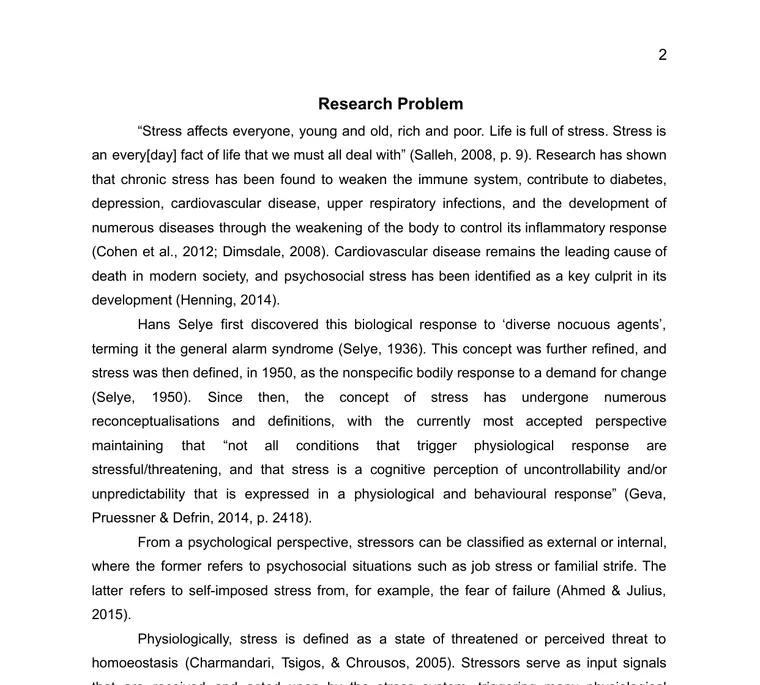 PhD levelGreen and blue space and stressAn experimental study of how urban, green and water landscapes affect stress.PDF or Word · 20 pages
Both were anonymized by their authors before we published them. Everything else is as submitted.
Example 1: The golden thread
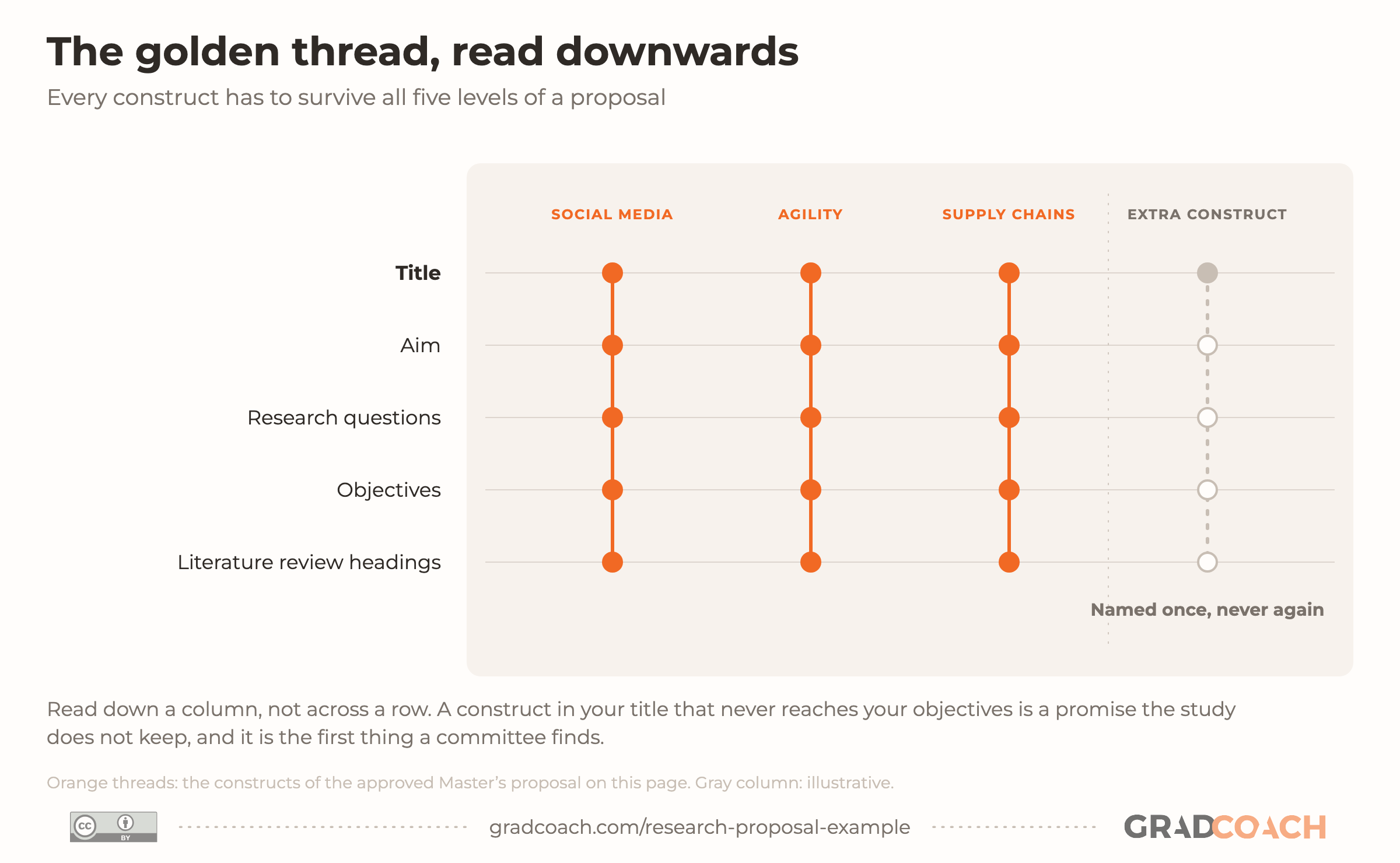
This is the first thing our coaches check on any proposal, and it takes about five minutes. Read the title, then the aim, then the research questions, then the objectives, and see whether they’re using the same words.
Here’s the golden thread in action on the Master’s proposal example, top to bottom.
Three statements, one line each, and they are almost word for word identical.
That might look like padding to the untrained eye. It isn’t. The wording is the only evidence a committee has that the study you designed is the study you named.
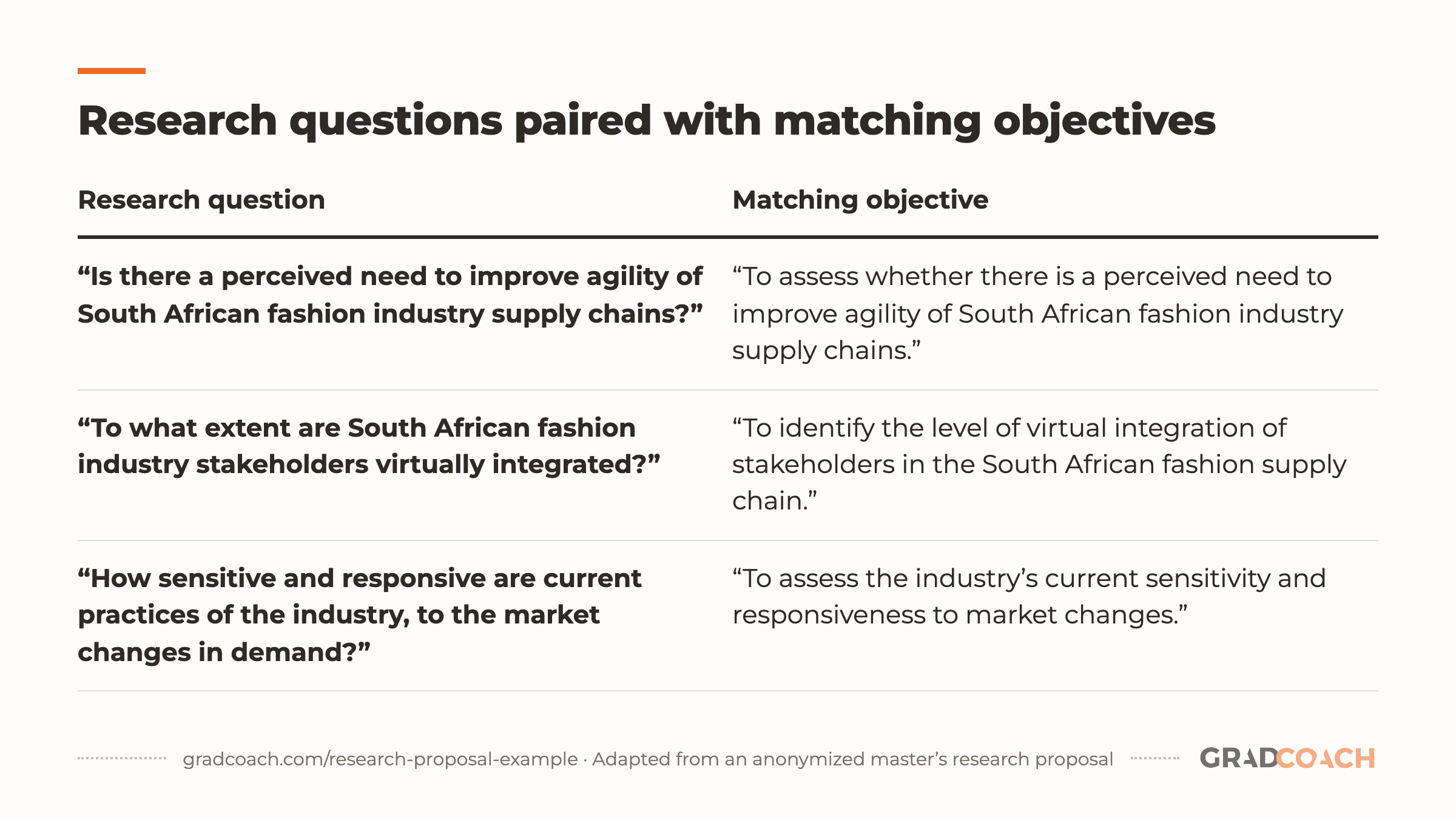
The thread then runs down into the questions and objectives, which pair off one to one:
| Research question | Matching objective |
|---|---|
| “Is there a perceived need to improve agility of South African fashion industry supply chains?” | “To assess whether there is a perceived need to improve agility of South African fashion industry supply chains.” |
| “To what extent are South African fashion industry stakeholders virtually integrated?” | “To identify the level of virtual integration of stakeholders in the South African fashion supply chain.” |
| “How sensitive and responsive are current practices of the industry, to the market changes in demand?” | “To assess the industry’s current sensitivity and responsiveness to market changes.” |
Six questions, six objectives, same order, same nouns. The only thing that changes is the grammar: a question becomes an infinitive verb. In a parallel structure like this one, that is the whole difference between an objective and a research question, and I end up explaining it most weeks.
Look at where those questions came from.
Four areas in the framework. Questions two to five are those four areas, one each, turned into questions. And the literature review’s four subheadings are those same four areas again.
So the thread runs: framework → questions → objectives → literature review headings, with the title and aim sitting over all of it. Nothing in the proposal appears in only one place. That’s what a supervisor means by “tighten the alignment”, and it’s the argument for choosing your framework early. A good one writes your headings for you.

Repetition this tight would read badly in a finished chapter, and you will loosen it when you write the thing up. At proposal stage it’s what gets you through.
Example 2: The problem statement
Almost every rejected problem statement I read has the same fault. It describes a real problem in the world, movingly and at length, and never says what’s missing from the research. Or it does the reverse: it establishes a gap in the literature and never says why anyone outside the field should care.
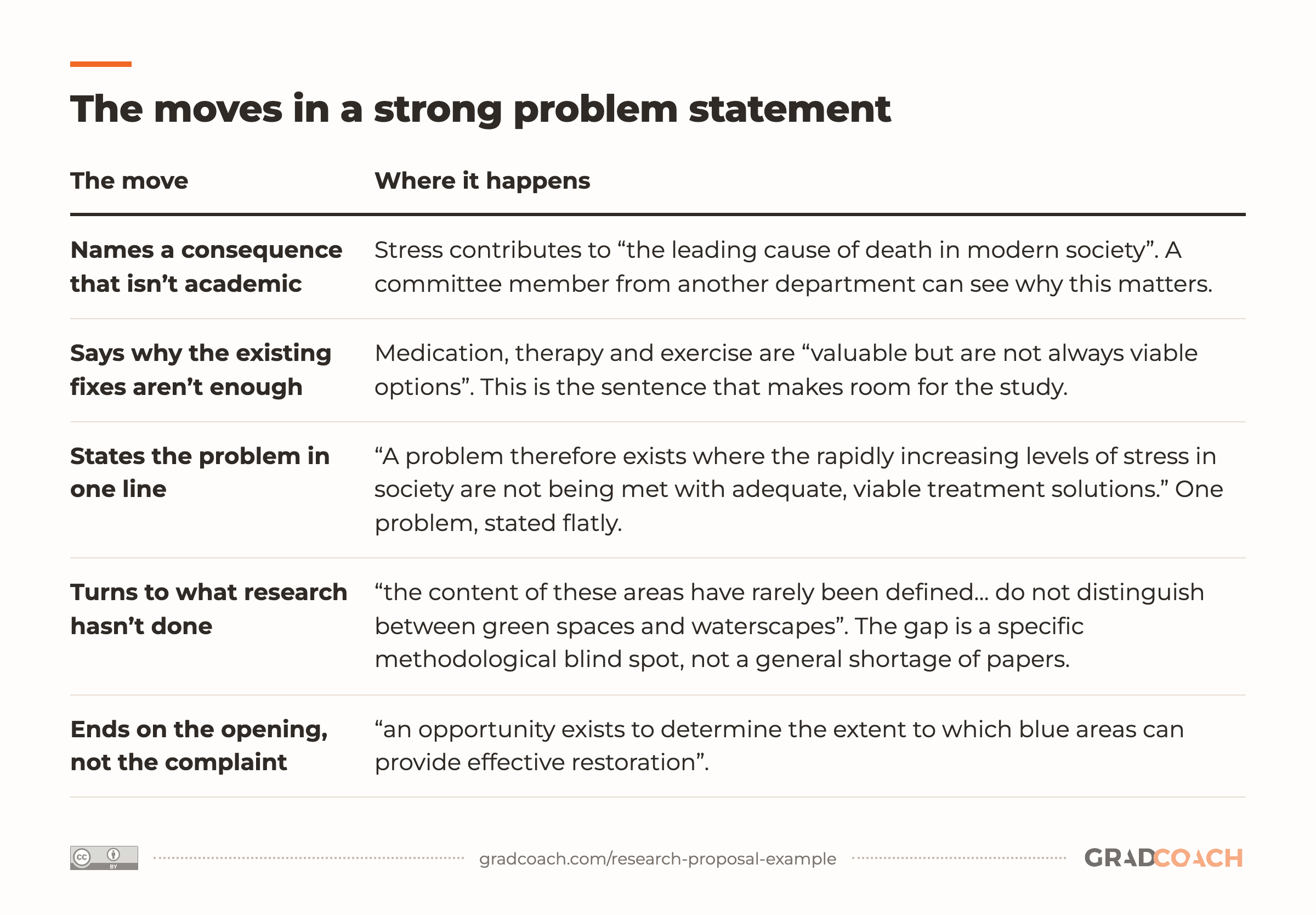
A problem statement needs both halves. Here’s the PhD proposal doing it.
| The move | Where it happens |
|---|---|
| Names a consequence that isn’t academic | Stress contributes to “the leading cause of death in modern society”. A committee member from another department can see why this matters. |
| Says why the existing fixes aren’t enough | Medication, therapy and exercise are “valuable but are not always viable options”. This is the sentence that makes room for the study. |
| States the problem in one line | “A problem therefore exists where the rapidly increasing levels of stress in society are not being met with adequate, viable treatment solutions.” One problem, stated flatly. |
| Turns to what research hasn’t done | “the content of these areas have rarely been defined… do not distinguish between green spaces and waterscapes”. The gap is a specific methodological blind spot, not a general shortage of papers. |
| Ends on the opening, not the complaint | “an opportunity exists to determine the extent to which blue areas can provide effective restoration”. |
The real-world half runs longer than the academic half here, which is about right for most disciplines. The order matters more: the real-world problem first, because it’s what buys you the reader’s attention for the gap.
One more thing, and it’s rarer than it should be. The proposal stops and defines its terms, out loud, inside the problem statement:
The proposal defines urban space, green space and blue space before using them, and says why it has to: nobody else has settled on a definition yet. If your topic sits between two established fields, that paragraph is not optional.
Example 3: The justified research gap
The most common misconception I meet at proposal stage is that a research gap means nobody has ever done this. Students search, find a paper that looks close to their idea, and conclude the topic is dead. Or they find nothing at all and conclude the topic has no substance.
Neither is what a gap is.
Two. Not “limited research exists”. Two, and the proposal then spends a page on both of them, because when your field is that small you’re expected to know it completely.
Then it does the thing I’d want you to copy. Reading the more recent of the two studies, in which participants walked for thirty minutes in each type of environment, the author notices something:
That second sentence does more work than the rest of the chapter.
The heart-rate measure didn’t show anything, and the explanation offered is that the walking drowned it out. That is a criticism of a published study, made politely, with a reason.
And then the study’s own design removes it. Participants sit still and watch a five-minute video of each landscape instead of walking through it, so the same measure can be taken with nothing else moving. The gap they found and the method they chose are the same fact.
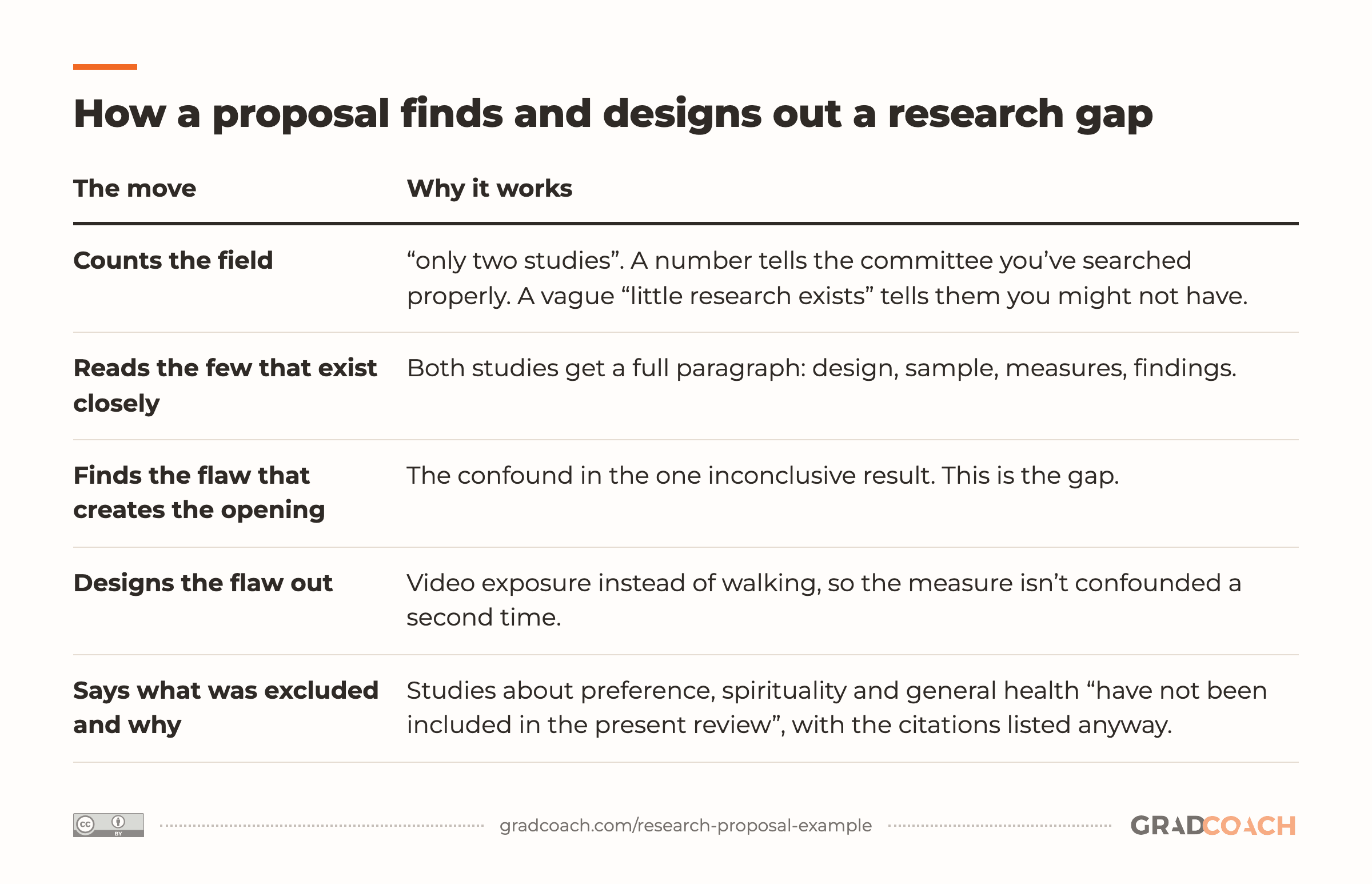
| The move | Why it works |
|---|---|
| Counts the field | “only two studies”. A number tells the committee you’ve searched properly. A vague “little research exists” tells them you might not have. |
| Reads the few that exist closely | Both studies get a full paragraph: design, sample, measures, findings. |
| Finds the flaw that creates the opening | The confound in the one inconclusive result. This is the gap. |
| Designs the flaw out | Video exposure instead of walking, so the measure isn’t confounded a second time. |
| Says what was excluded and why | Studies about preference, spirituality and general health “have not been included in the present review”, with the citations listed anyway. |
If you take one thing from this example: a gap is usually a limitation of existing work, not an absence of it. Population, context, method, theory, contradiction, application. Any of those can be your opening, and all of them are easier to defend than “nobody has studied this”, which invites the obvious question of whether you looked hard enough.
Example 4: The methodology justification
Methodology is where most proposals get sent back. Usually the method was fine. It just never got explained.
There are very few hard rules in research design. There’s a standard of transparency instead: you can make almost any reasonable choice, as long as you say what it was, why you made it, and what it costs you. This proposal does all three in one paragraph.
This proposal chose the weaker sampling method. It says so, in those words, and the paragraph is stronger for it.
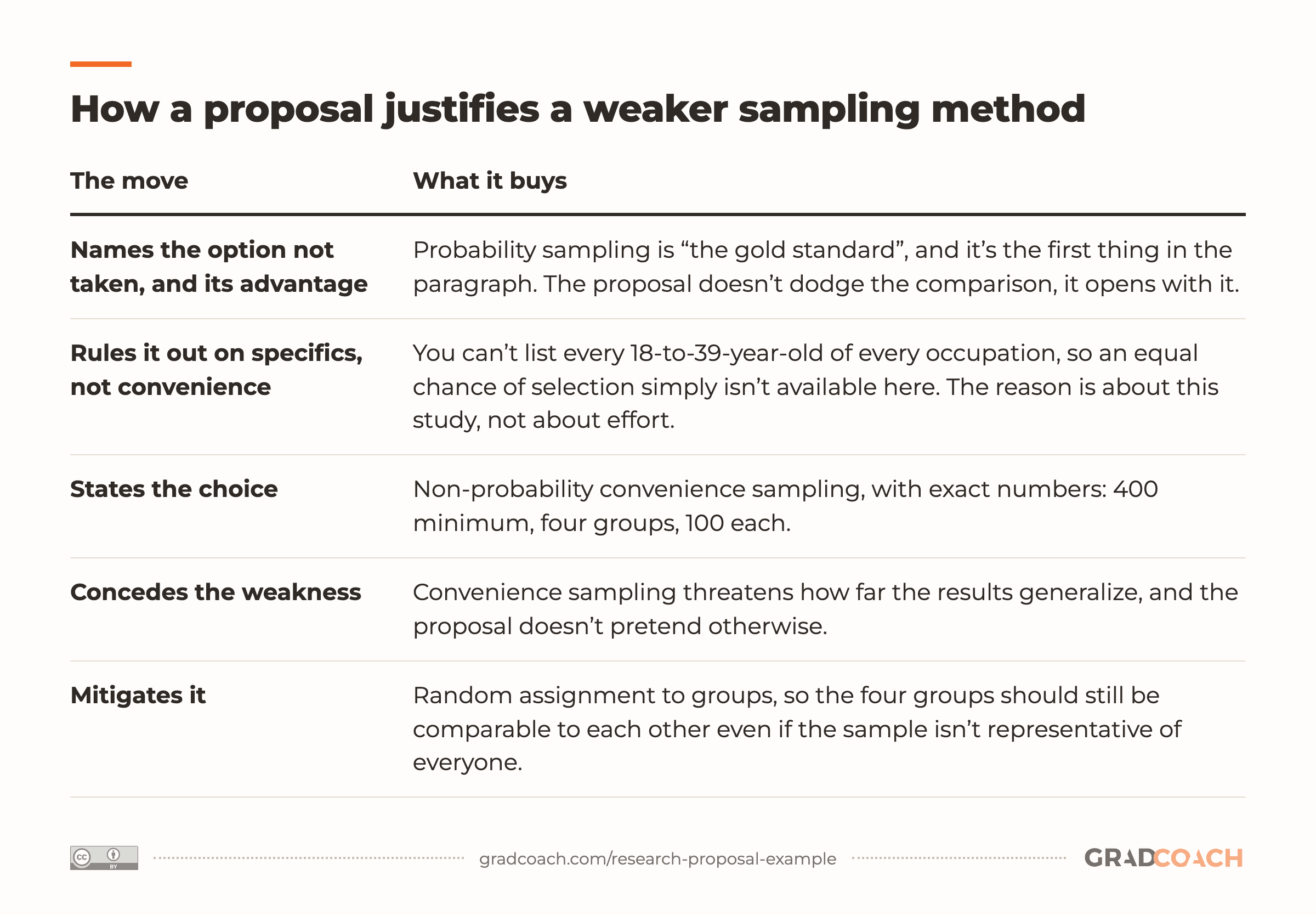
| The move | What it buys |
|---|---|
| Names the option not taken, and its advantage | Probability sampling is “the gold standard”, and it’s the first thing in the paragraph. The proposal doesn’t dodge the comparison, it opens with it. |
| Rules it out on specifics, not convenience | You can’t list every 18-to-39-year-old of every occupation, so an equal chance of selection simply isn’t available here. The reason is about this study, not about effort. |
| States the choice | Non-probability convenience sampling, with exact numbers: 400 minimum, four groups, 100 each. |
| Concedes the weakness | Convenience sampling threatens how far the results generalize, and the proposal doesn’t pretend otherwise. |
| Mitigates it | Random assignment to groups, so the four groups should still be comparable to each other even if the sample isn’t representative of everyone. |
Every subsection of a methodology chapter can follow that shape: state the choice, define it with a citation, justify it against your aims, and say what it does to your results. It works the same way for design, instruments and analysis.
Two smaller details in that section are worth copying. Participants are screened out for heart conditions and medications that would affect the measurements, which shows real thought about what could contaminate the data.
And the sample is over-recruited: at least 450 people to end up with 400, because some will be excluded. Recruiting your exact target number is how projects end up under-powered.
Run the alignment test on your own proposal
Five minutes with your own draft. You don’t need any software for it.
- Copy your title, your aim, your research questions and your objectives onto one page, in that order. Nothing else.
- Read down the page. Circle every noun that appears in one row and not the others.
- For every circled word, one of two things is true: it belongs everywhere, or it belongs nowhere.
Concepts that appear in only one place are where proposals fail.
A construct in your title that never reaches your questions is a promise your study doesn’t keep. A variable in your method that isn’t in your aim means you’re measuring something you never said you’d measure, and that one usually surfaces at the viva.
The other check takes ten seconds: count the constructs in your title. Three is comfortable, four is a lot, five means you have two studies and should be running one of them.
What examiners are actually checking
The alignment test above is a proxy for something simpler. A proposal argues three things, and every section on the page is evidence for one of them:
- This study is worth doing. The problem statement and the gap.
- It hasn’t already been done. The literature review.
- You can actually do it, and the results will mean something. The methodology, plus the timeline, budget and ethics sections that most students treat as paperwork.
A proposal that gets sent back has usually made two of those three cases well and left the third to the reader’s imagination. Work out which one you’ve under-argued before the committee does it for you. If you’d like a second opinion before it reaches your committee, that’s exactly what private coaching is for.
More proposal examples
Start with your own department. Requirements vary more than students expect, and half an hour spent asking your supervisor for two approved proposals from previous students in your program is worth more than anything below.
Beyond that:
- The Grad Coach Research Toolkit. Start here. It’s our free collection, and it includes a sample library of real, complete dissertations and theses. A proposal is a plan for the study; the dissertation shows you what the plan turned into.
- ProQuest Dissertations & Theses. The largest collection there is, though it’s a subscription database. Check whether your library already gives you access.
- CORE. Over 200 million open access research outputs from repositories worldwide, including a large number of full theses.
- Your university’s research repository. Most institutions publish completed theses, and some publish approved proposals. This is the only source that matches your actual requirements.
One caution on the university “sample research proposal” pages that dominate the search results. Most are lists of links, and a good number of those links are to proposals from a single department, written to that department’s template. They’ll give you a feel for the shape of a proposal, but don’t read their rules as yours.
Still have questions?
Are these research proposal examples real?
Yes. Both were written by real students and approved by their universities, one at Master’s level and one at PhD level. They were anonymized by their authors before publication, which is why the institution and names read as XXX. Everything else is as submitted, including the UK spelling and the original reference formatting.
What are the main components of a research proposal?
Four, whatever your university calls them: the problem you’re addressing and why it matters, the literature that shows what’s already known and what isn’t, the aim, questions and objectives that state exactly what you’ll find out, and the methodology that says how. Most templates then add practicalities such as ethics, timeline and budget. Both examples on this page contain all four, in that order.
How long should a research proposal be?
Master’s proposals typically run 1,500 to 3,000 words; doctoral proposals are often 5,000 or more, and some universities ask for a full three chapters. Both examples here are around 6,000 words. Your institution’s requirements override any rule of thumb, so find the rubric before you plan the length.
Can I copy one of these proposals for my own research?
No, and it wouldn’t work anyway. Every proposal is shaped by its university’s requirements and by the nature of the research itself. Use these for the structure and the moves, not the content, and check your own institution’s guidelines before you finalize anything.
What is the difference between a research question and a research objective?
In the simplest structure, grammar. An objective is the same statement as its question, rewritten as something you will do: “Is there a perceived need to improve agility?” becomes “To assess whether there is a perceived need to improve agility.” Example 1 pairs them one to one like this. Some theses nest several objectives under each question instead, so the counts needn’t match, but every question still needs at least one objective behind it. Our guide to research aims, objectives and questions shows both structures with real examples.
How do I get the research proposal template?
It’s here, free, and it’s built on the same four sections these two proposals use. There’s also a proposal checklist for the final read-through before you submit.
Where can I learn more about writing a proposal?
Start with our guide to writing a research proposal, which covers the four sections in detail. If you’d rather watch than read, the video at the top of this page walks through both examples.
Can’t find your answer here? Ask a Grad Coach directly – the initial chat is free.
Speak with a friendly coach →


Found this helpful?
Keep us near the top of your Google results.