Thematic Analysis 101
A plain-English guide for first-timers, with a real study as the example


The 30-second summary
Thematic analysis is a method for finding patterns of meaning (themes) across qualitative data to help answer your research question.
- It's a family, not one method. Reflexive, codebook and coding reliability thematic analysis work differently, so name the one you followed.
- Six phases in the reflexive approach: get to know your data, code it, then generate, review, name and write up your themes.
- In reflexive thematic analysis, a theme is a claim. "Barriers to wellbeing" is a topic. A theme says something about those barriers.
- Inductive or deductive is a choice, and most analyses combine the two, leaning one way.
When you get to the write-up, our free results chapter template gives you the structure for reporting your themes.
Navigate
Thematic analysis oftentimes looks like the easy option. You read your transcripts, spot what keeps coming up and write it up. Then your committee asks which thematic analysis you followed, or sends your themes back as “just topics”, and the easy option turns out to have rules nobody told you about.
We’ve helped 10,000+ students through their dissertations, and we’ve seen the same mistakes many times over in their thematic analyses. In this post, I’ll explain what thematic analysis is, which version you need to use, and how to work through all six phases, using a real published study as the example along the way.
What is thematic analysis?
Thematic analysis is a method for finding patterns of meaning across qualitative data: interview transcripts, focus group recordings, open-ended survey answers, diaries or similar text. Those patterns become your themes. Virginia Braun and Victoria Clarke, whose 2006 paper is the standard citation for the method, sum up its purpose in one line:
Notice the last four words.
A theme isn’t just any recurring pattern in your data. It’s a pattern that helps answer your research question, which is why two researchers with the same transcripts and different questions can end up with different themes.
In practice, you get to those themes in two moves. First you label your data with codes, then you build themes out of the codes. The six phases below are built around these two moves, so it’s worth being clear on the difference:
- A code is a short label for what a piece of your data is about. For example, “Educators rely on common sense when attending to wellbeing issues” is a code from the study we’ll work through below.
- A theme is a broader pattern of shared meaning built from many codes, organized around one central idea.
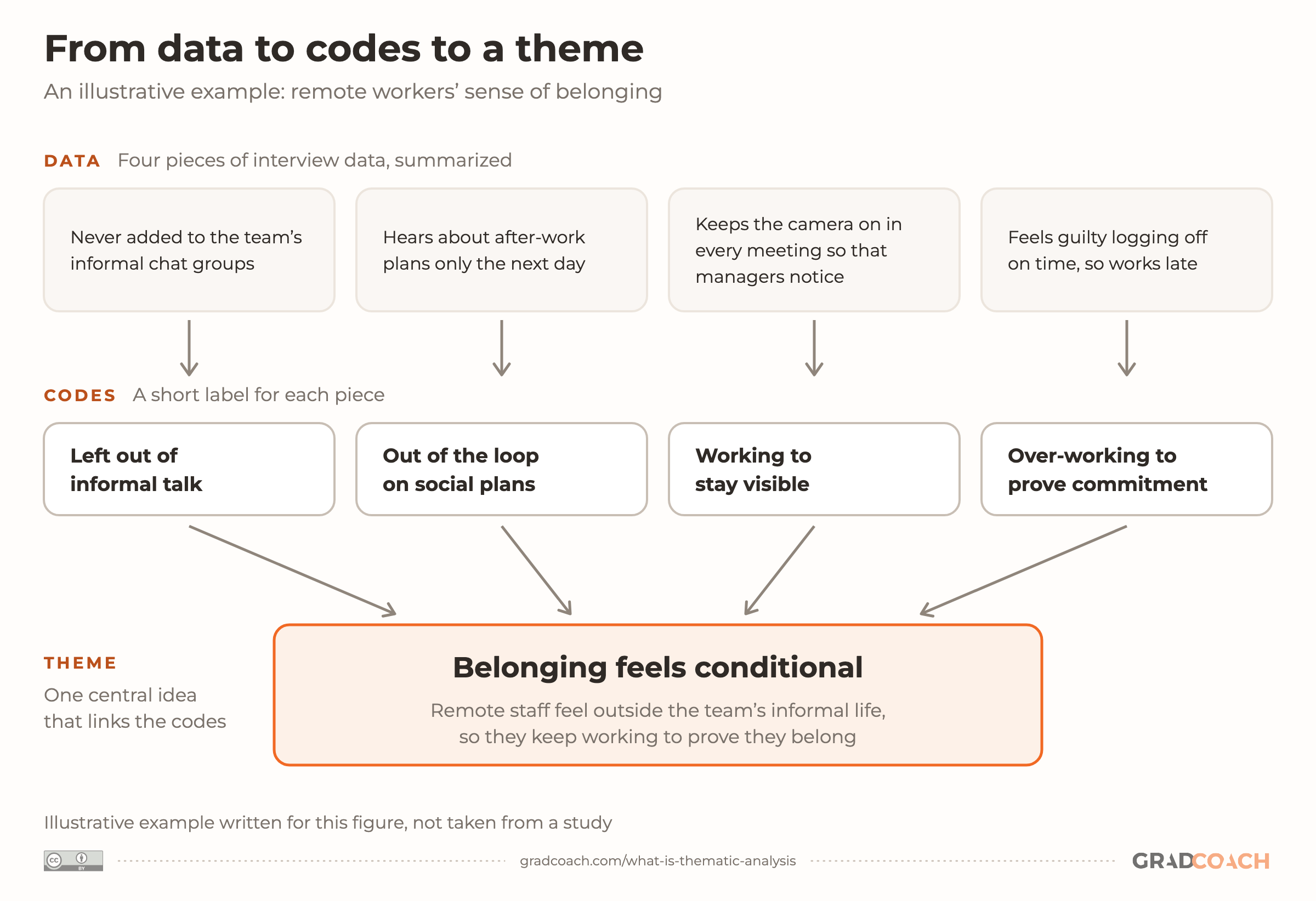
To see how the two fit together, let’s take four pieces of data from an imaginary set of interviews with remote workers. Each gets its own code, and the theme is the idea that links all four:

That second move, from codes to themes, is where most analyses go wrong. As you’ll see below, thematic analysis runs in six phases. You do your coding early on, and three of the six phases are about building themes from those codes and testing them. If you’d like more on the coding itself, including what counts as a good code, my coding guide works through an interview extract, code by code.
When should you use thematic analysis?
Thematic analysis suits research questions that revolve around what people experience, think or do, and how they make sense of it. Here are some practical examples from actual dissertations and theses:
- Experiences: “How is remote learning during the COVID-19 pandemic experienced by parents with young children registered in a nature-based kindergarten?” (University of Alberta, 2022)
- Views and perceptions: “How do public high school teachers perceive their use of culturally relevant pedagogy in the classroom?” (Baylor University, 2024)
- Influencing factors: “What factors influence teachers’ experiences in the selection processes of school leaders?” (University of KwaZulu-Natal, 2018)
If your question asks about experiences, views, perceptions or the factors behind a behavior, thematic analysis is a strong candidate.
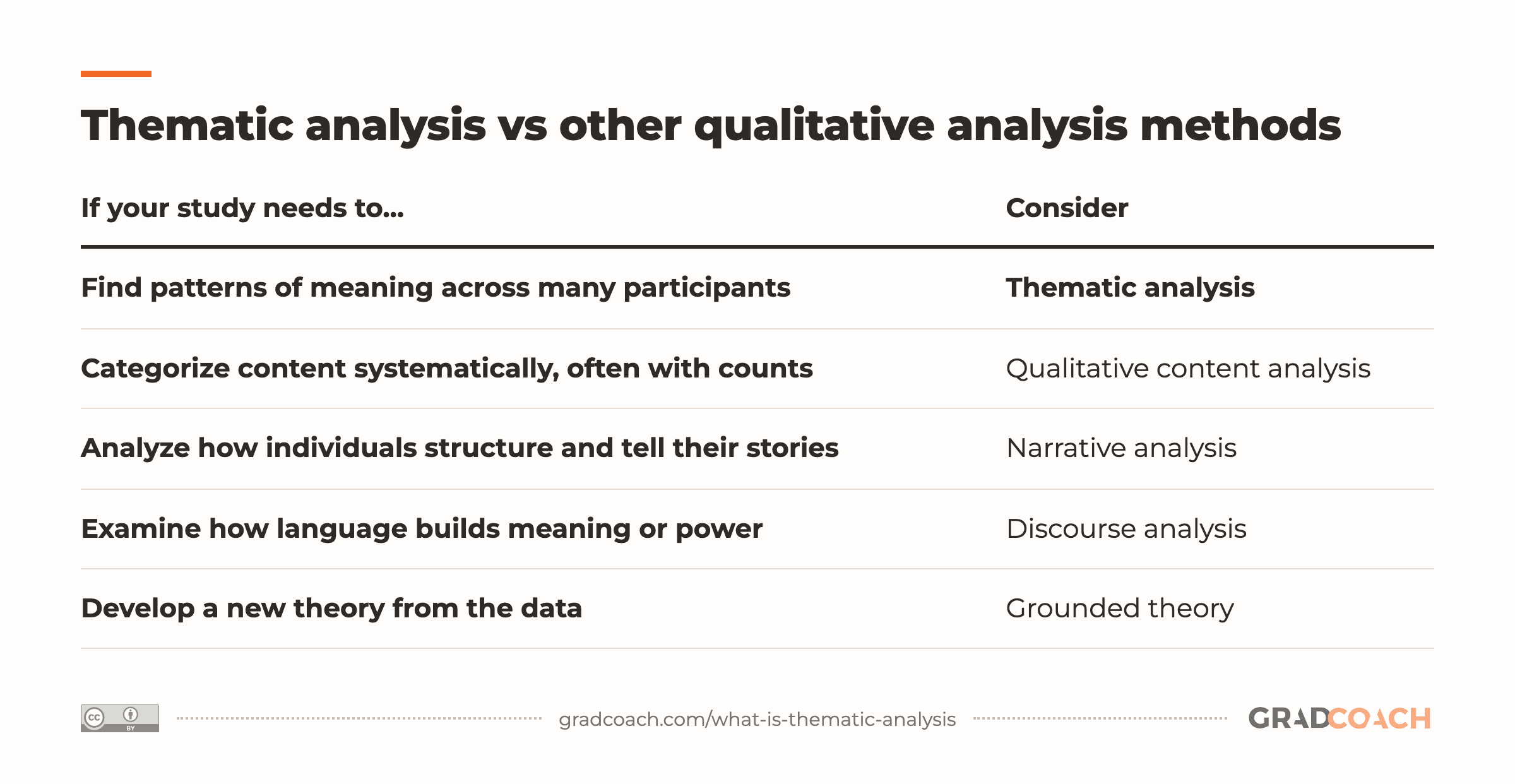
It also doesn’t tie you to one particular theory, which makes it a sensible choice for a first qualitative project. But it isn’t the right tool for every question. Here’s how it compares with the methods students most often weigh it against:
| If your study needs to… | Consider |
|---|---|
| Find patterns of meaning across many participants | Thematic analysis |
| Categorize content systematically, often with counts | Qualitative content analysis |
| Analyze how individuals structure and tell their stories | Narrative analysis |
| Examine how language builds meaning or power | Discourse analysis |
| Develop a new theory from the data | Grounded theory |
In practice, these lines can blur somewhat, and plenty of studies borrow from two methods. The point is to pick the method that fits what your research question asks for, rather than the one that sounds easiest. If you’re still deciding, our overview of qualitative data analysis methods compares seven of them side by side.
Which type of thematic analysis to use
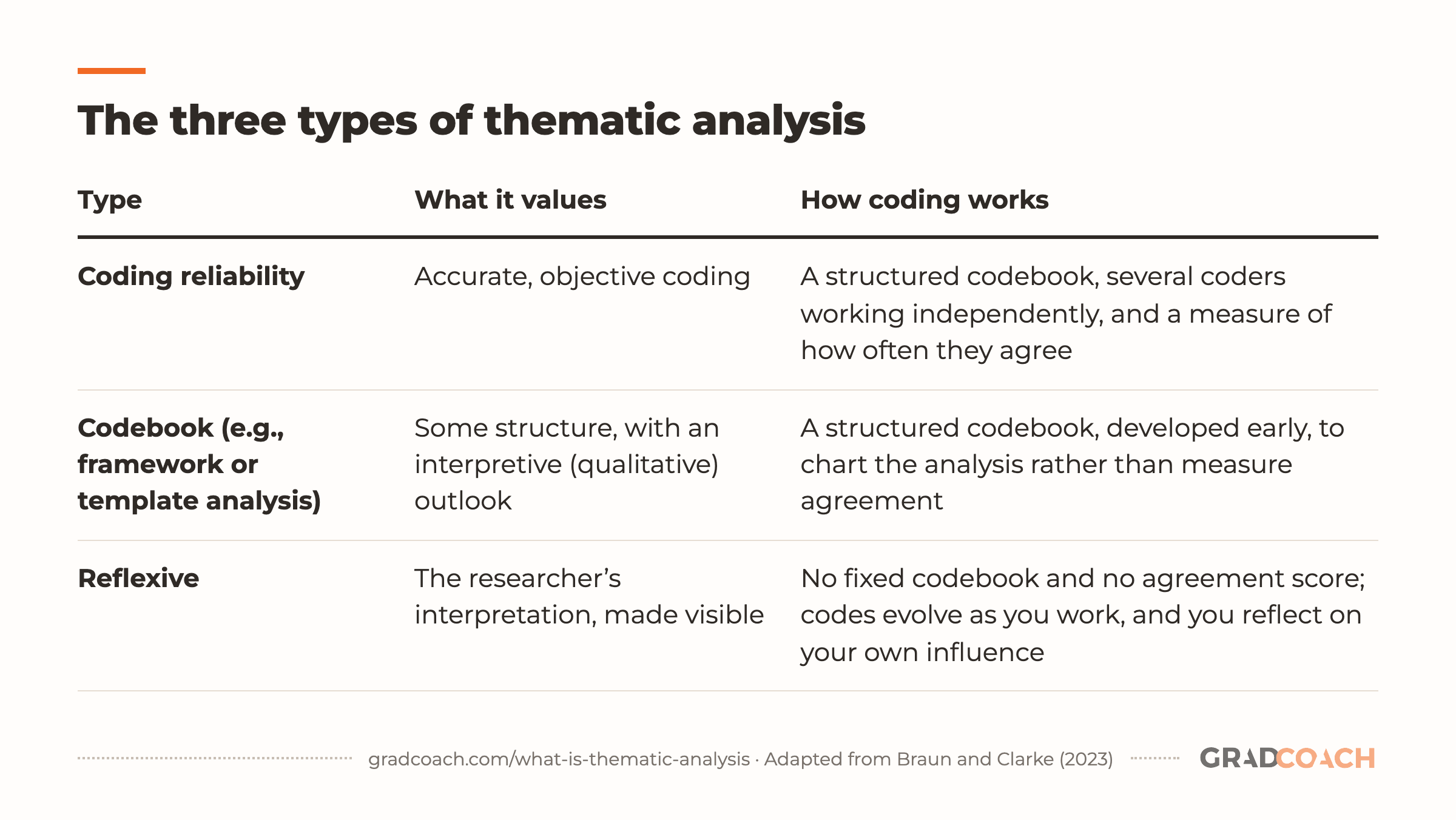
This trips up a lot of students, because it’s easy to miss that there’s more than one kind. Thematic analysis is a family of approaches, not a single method. There are three main types, and the difference that matters is what each one thinks coding is for:
| Type | What it values | How coding works |
|---|---|---|
| Coding reliability | Accurate, objective coding | A structured codebook, several coders working independently, and a measure of how often they agree |
| Codebook (e.g., framework or template analysis) | Some structure, with an interpretive (qualitative) outlook | A structured codebook, developed early, to chart the analysis rather than measure agreement |
| Reflexive | The researcher’s interpretation, made visible | No fixed codebook and no agreement score; codes evolve as you work, and you reflect on your own influence |
Braun and Clarke’s own typology adds a fourth, “thematic coding”, which borrows grounded theory’s coding procedures. You won’t often meet it in a dissertation, but if you’d like to see those procedures in action, my grounded theory guide walks through the coding stages.
If you’re working alone, which most dissertation and thesis students are, reflexive thematic analysis is usually the natural fit. Nothing in it depends on a second coder. Coding reliability does: without several independent coders, there’s no agreement to measure. Codebook approaches sit in between, so they’re an option if your advisor wants a structured codebook but not an agreement score.
Headcount isn’t the real test, though. Coding reliability assumes there’s a correct reading of the data to agree on, while reflexive thematic analysis treats your interpretation as the point. Pick the type whose assumptions match your study’s, and say so in your methodology chapter.
A question we often hear from students at this point:
“My advisor wants an inter-rater reliability score. Can I still use reflexive thematic analysis?”
Not without contradicting the method. A colleague can still read your codes and talk them through with you, which the reflexive approach welcomes. What doesn’t fit is measuring agreement, because that assumes there’s one correct coding. Braun and Clarke, who developed the reflexive approach, call consensus coding and agreement scores “conceptually incoherent additions” to it.
If your advisor (supervisor, in the UK) insists on an agreement score, choose a coding reliability approach and cite it. If they only want a second coder or a fixed codebook, a codebook approach may satisfy them. I go into this trade-off in my guide to coding qualitative data.
Inductive or deductive, semantic or latent?
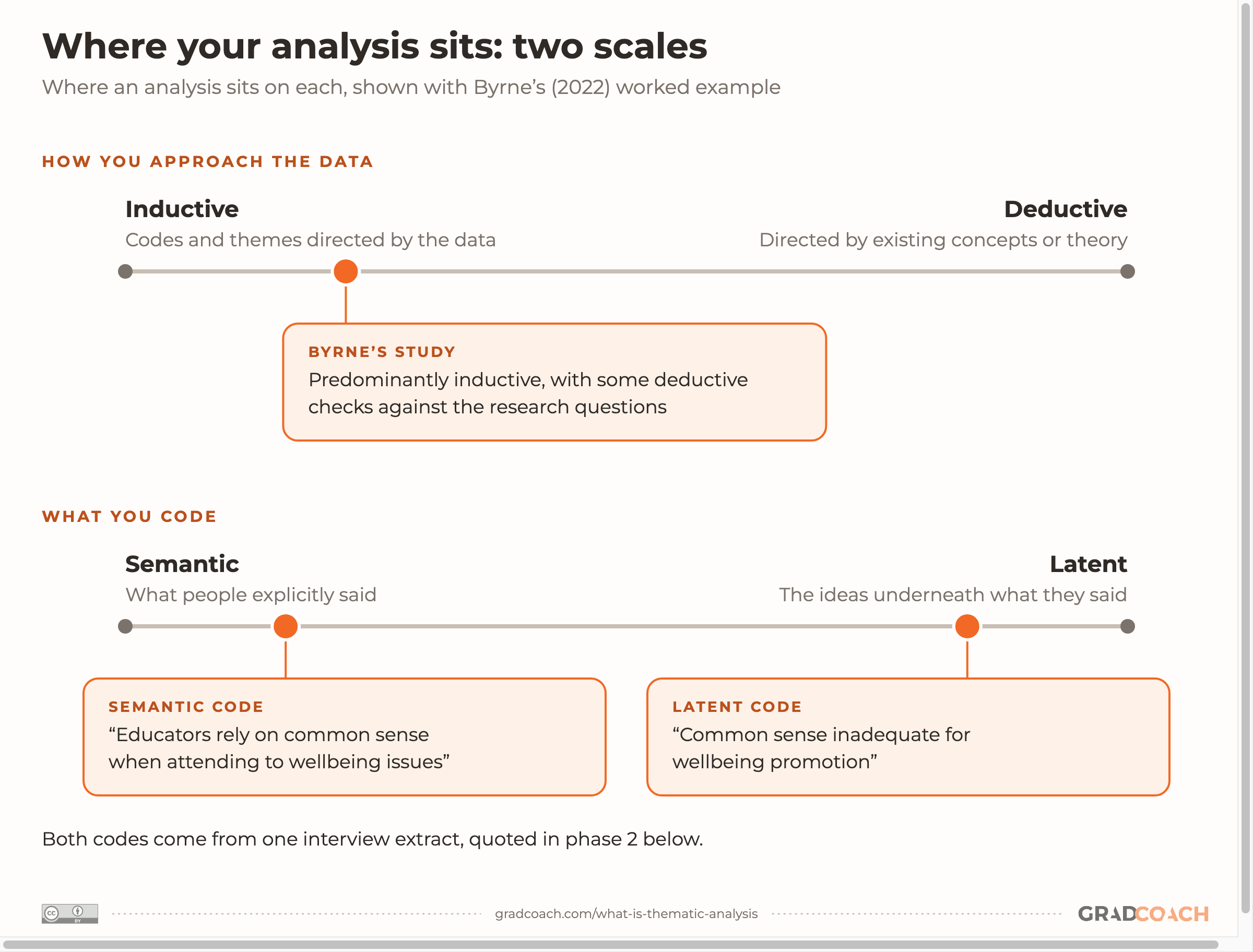
Whichever form of thematic analysis you opt for, you’ll also need to decide where your analysis sits on two scales: inductive to deductive, and semantic to latent. In practice, these are positions on a scale rather than either/or choices:
- Inductive: your codes and themes are directed by what’s in the data.
- Deductive: your codes and themes are directed by existing concepts or theory.
- Semantic: you code what people explicitly said.
- Latent: you code the assumptions and ideas underneath what they said.

A common misreading is that reflexive thematic analysis has to be inductive. It isn’t limited to the inductive end: all of these variations are open to you within it. In practice, most analyses combine inductive and deductive coding while leaning one way, as the published study I follow later in this guide points out. It leans inductive itself. So say which way yours leans and why.
How to do thematic analysis: the six phases
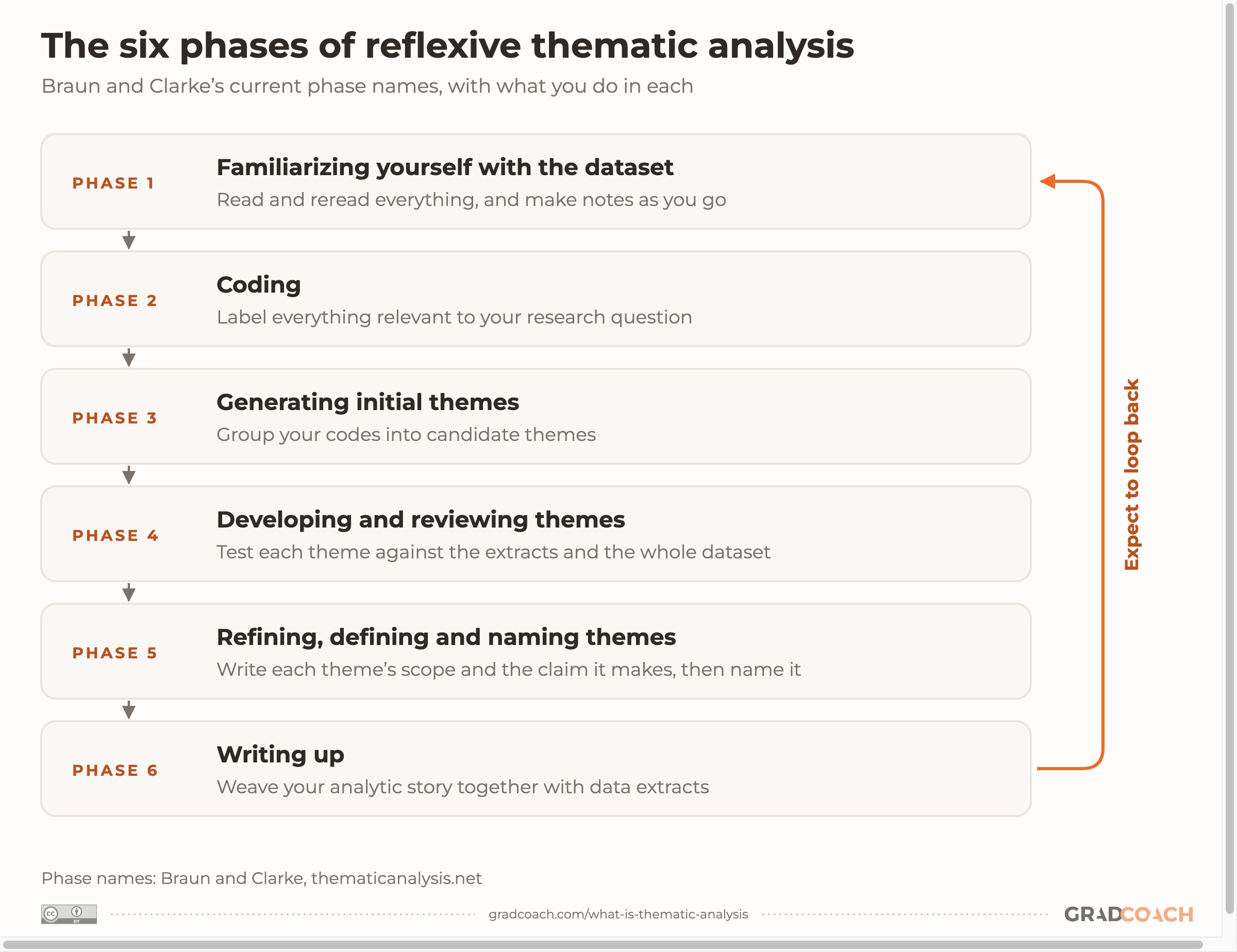
Braun and Clarke’s reflexive approach runs in six phases. Their names have changed since the 2006 paper, so you may see slightly different labels in older sources. Here they are under their current names, with what you do in each. Note the loop back on the right:

The phases build on each other, but analysis is recursive: expect to move back and forth between them. They tell you what to cover, not exactly how to do it, so the steps inside each phase are yours to decide. That’s fine, as long as your methodology chapter cites the six phases and your notes show what you actually did. If you chose a codebook or coding reliability approach, follow the steps in the source you cite for it instead.
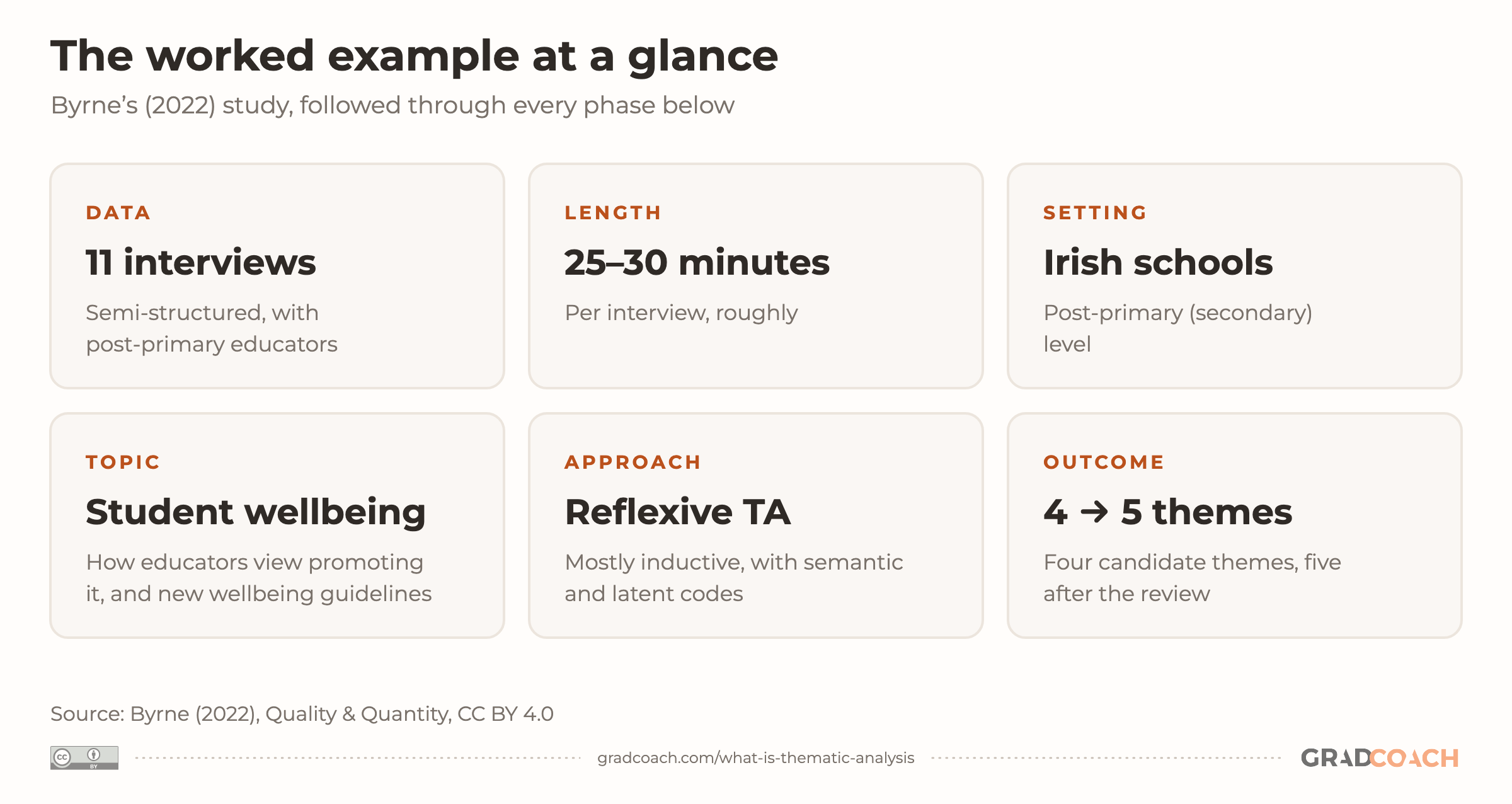
To make each phase concrete, I’ll work through a real example with you, one phase at a time. It comes from David Byrne’s published worked example of reflexive thematic analysis, which analyzed eleven semi-structured interviews with educators in Irish post-primary (secondary) schools. Each lasted about 25 to 30 minutes. The study asked how they viewed promoting student wellbeing and a new set of wellbeing guidelines. Under most phases below, you’ll see what the researcher did at that step.

Phase 1: Get familiar with your data
Read and reread everything before you code anything. Make notes as you go, both on individual transcripts and on the dataset as a whole.
You’re looking for first impressions here, not answers.
If you recorded interviews, doing your own transcription is one of the best ways to get close to the data. The worked example makes the same point: transcribing by hand “can greatly facilitate a deep immersion into the data”. If someone else transcribed for you, listen back to the recordings for tone and context you can’t see on the page.
This is also the point to start a short reflexive journal: what you expect to find, what surprises you, and where your own experience might be steering you. It becomes part of your audit trail (the record of how you got from data to themes), and it gives your methodology chapter something concrete to say about reflexivity.
Phase 2: Code the data
Coding means tagging a piece of your data (a phrase, a sentence or a longer passage) with a short label that captures what it’s saying, so you can gather similar pieces together later. Work through the whole dataset and label anything relevant to your research question. Code every transcript with the same care, and expect to do two or more rounds.
A good code makes sense on its own, without the quote beside it. And one piece of data can carry more than one code. The study shows both in a single extract:
The two codes do different jobs:
- The semantic code records what the participant said they do: rely on common sense.
- The latent code records what the researcher read underneath it: an implied doubt that common sense is enough.
When an extract works on both levels, you can give it both codes, as this study did. Expect to revise your codes as you go. These two changed later in the analysis.
The researcher also kept a spreadsheet with each data item in one column and each round of coding in the next, highlighting every code that changed. Adopt that habit. It becomes your audit trail, the record of how you got from transcripts to themes, and it’s what your committee (examiners, in the UK) will ask to see.
Phase 3: Generate initial themes
Once everything is coded, look across your codes for broader patterns that share a central idea. Group them into candidate themes, collect the data extracts that support each one, and sketch a thematic map or table showing which codes sit under which theme.
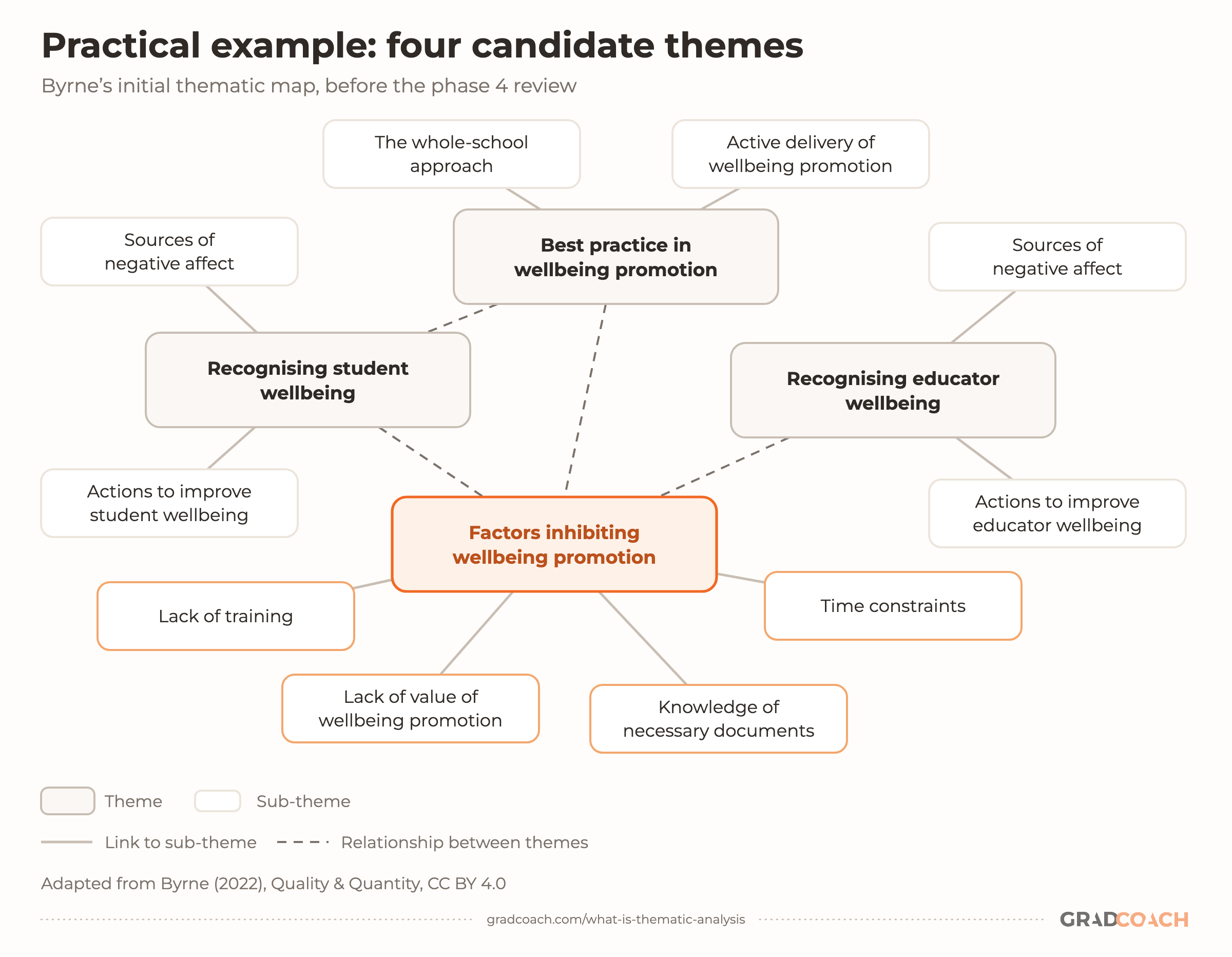
The study’s first thematic map had four candidate themes. One of them, “factors inhibiting wellbeing promotion”, gathered everything that got in the educators’ way, under four sub-themes: lack of training, time constraints, lack of value of wellbeing promotion, and knowledge of necessary documents. Even at that early stage, the study notes that it was “very dense and unwieldy”. Hold on to that theme, because phase 4 is where it falls apart.

Don’t worry about having the right number of themes yet. There’s no single one-size-fits-all correct number. Too many and the analysis becomes hard to manage; too few and you miss the depth in your data. If your code list is overwhelming you at this point, here’s what to do when you have too many codes.
Phase 4: Develop and review your themes
Now test every candidate theme against your coded extracts, then against the whole dataset. Some themes will survive. Others will need splitting, merging or dropping. The study lists five questions that Braun and Clarke (2012, p. 65) suggest for this review. They make a useful checklist:
- Is this a theme (it could be just a code)?
- If it is a theme, what is the quality of this theme (does it tell me something useful about the data set and my research question)?
- What are the boundaries of this theme (what does it include and exclude)?
- Are there enough (meaningful) data to support this theme (is the theme thin or thick)?
- Are the data too diverse and wide ranging (does the theme lack coherence)?
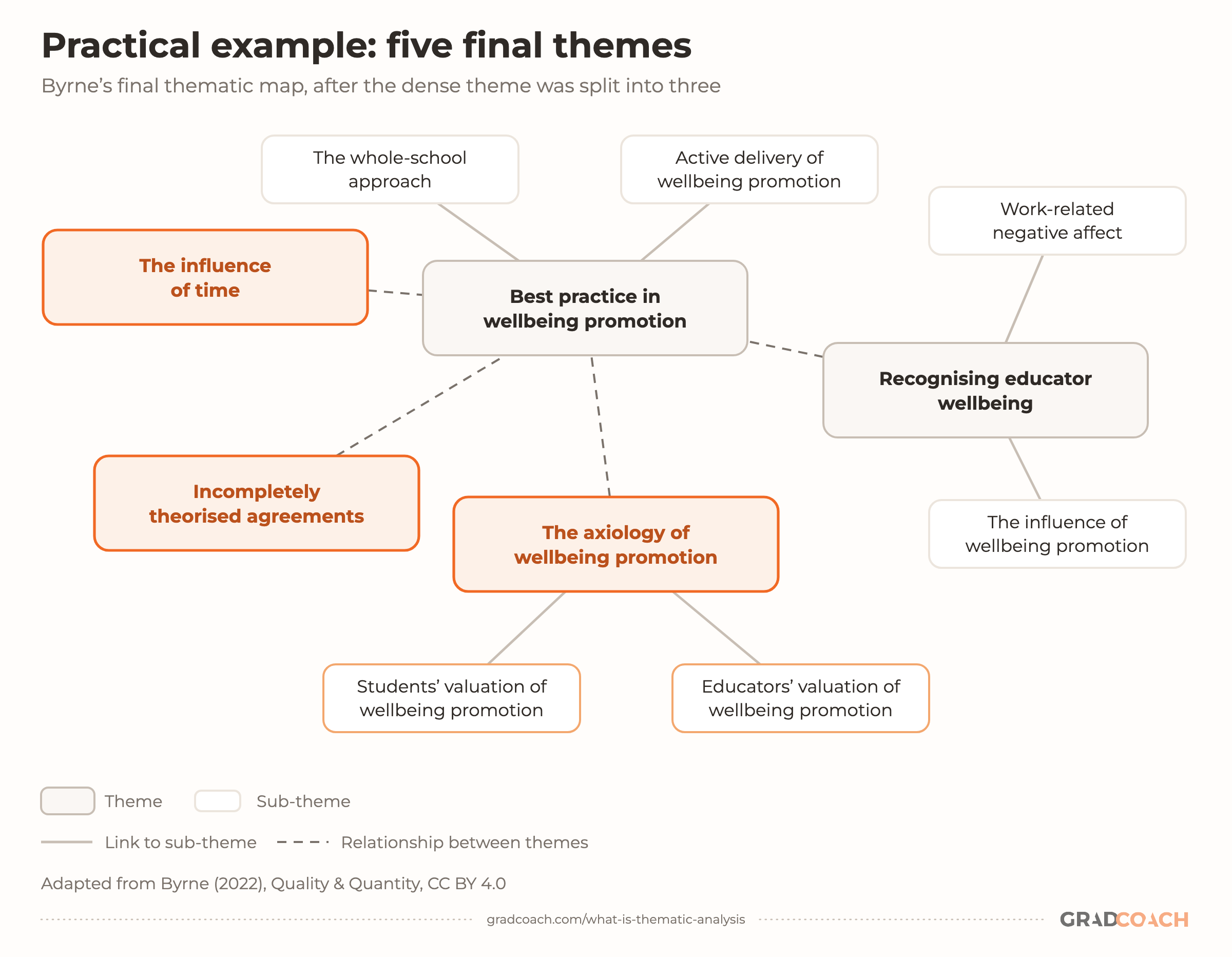
In the example study, the dense theme failed the last three: its boundaries were hard to see, it held far more than one central idea could carry (“too thick”, in the study’s words), and it was somewhat incoherent.
So the researcher split it three ways and reread the data behind each part. Time constraints became “the influence of time”. Lack of value became “the axiology of wellbeing promotion” (axiology is the study of values), once it was clear that the educators saw students and staff valuing wellbeing promotion differently.
Lack of training and knowledge of the necessary documents turned out to be “topical rather than thematic”: they named a subject without saying anything about it. The two were folded into one new theme about educators attending to student wellbeing without any theory to guide them, named “incompletely theorised agreements”.
By the end of the review, one theme had been split into three and another dropped, so the four candidate themes became five final themes. One of the original four, “recognising student wellbeing”, isn’t on the final map, and the paper doesn’t say where its data went, which is exactly the kind of gap your own audit trail should close.

When you review your own themes, lay each one’s extracts side by side and ask whether they share one idea or just one subject. Then reread two or three whole transcripts with your theme list beside you, and note anything relevant your themes miss. Be ready to let a favorite go. The video below covers more ways to check whether your themes hold up.
Phase 5: Refine, define and name your themes
For each final theme, write a short definition of its scope and the story it tells: what it covers, what it leaves out, and how it answers your research question. If you can’t write the definition in a couple of sentences, the theme probably needs more work.
Then name it. A name can be short, but the definition behind it has to make a claim. Take the time theme, which was reworked during the phase 4 review. Its starting point, “time constraints”, only named a problem. The final theme, “the influence of time”, captured a two-way pattern: existing time pressures made wellbeing promotion harder, and wellbeing promotion added new pressure on teaching time.
The name alone could pass for a topic (“Influences on…” is a pattern Braun and Clarke warn about). It’s the two-way claim behind it that makes it a theme. Where you can, put the claim in the name too, as “incompletely theorised agreements” does.
This is also the phase where you choose the extracts you’ll quote. Pick several per theme, from different participants, so your committee can see that the pattern runs across the data and isn’t one person’s view.
Phase 6: Write up your analysis
The write-up weaves your analytic story together with data extracts and places it in the context of existing research. In a dissertation or thesis, it’s often spread across three chapters:
- Methodology: name your type of thematic analysis, cite the right source, and explain how you worked through each phase. The methodology chapter guide covers what to include.
- Results or findings: present each theme with its definition and supporting extracts. Our guide to writing up qualitative findings walks through the structure.
- Discussion: connect your themes to the literature and your research questions, as in these discussion chapter examples.
Whatever you do, don’t let the quotes do the work. Every extract needs your interpretation around it: what it shows, and why it matters for your research question. A findings chapter that strings quotes together under theme headings reads as a summary, not an analysis.
Order matters too. The worked example reports its themes so that each sets up the next: best practice first, as an easy way into the analysis, then the axiology theme, then “the influence of time” and “incompletely theorised agreements”, in that order, because time pressure on training was part of what pushed educators toward those agreements. “Recognising educator wellbeing” came last. Order your themes so the story builds, not by how many codes each one holds.
If you’d like more practical pointers for the write-up and the phases before it, our six time-saving thematic analysis tips cover the whole process.
Common thematic analysis mistakes
The five we see most often, and how to avoid each one:
- Themes that are really topic summaries. In reflexive thematic analysis, a theme should tell an interpretive story. A quick check: if you could have come up with the theme before analyzing your data, or it “maps closely on to a data collection question” (in Braun and Clarke’s words), it’s probably a topic summary. Names like “Barriers to…”, “Experiences of…” or “Influences on…” are a warning sign. Even the worked example’s first map had a candidate that listed barriers, “factors inhibiting wellbeing promotion”, and phase 4 found two of its sub-themes “topical rather than thematic”.
- One theme per interview question. Organizing your themes around your interview guide is a version of the mistake above. Analyze the data on its own terms first, then show how your themes answer your research questions in the write-up.
- Mixing types without knowing it. A reflexive analysis with an inter-rater reliability score, or a coding reliability study that talks about the researcher’s subjectivity as a strength, describes two incompatible methods. Pick one type and stay consistent.
- Writing that themes “emerged”. This one is easy to fix. In reflexive thematic analysis, Braun and Clarke are blunt that themes are generated by the researcher and don’t “emerge” from the data. Say you developed or generated them.
- No audit trail. If you can’t show how your codes became your themes, your committee can’t check your analysis. Keep the spreadsheet from phase 2 and the maps from phases 3 and 4.
The first two usually come from rushing phases 3 and 4. If your themes feel thin or your committee has questioned them, go back to the phase 4 questions before you rewrite anything else.
Still have questions?
What are the six phases of Braun and Clarke’s thematic analysis?
Braun and Clarke’s current names for the six phases are: familiarizing yourself with the dataset; coding; generating initial themes; developing and reviewing themes; refining, defining and naming themes; and writing up. Their 2006 paper used slightly different labels, such as “searching for themes” and “producing the report”, for the same process. The phases are meant to be used flexibly, moving back and forth between them rather than strictly in order.
What is the difference between coding and thematic analysis?
Coding is one phase of thematic analysis. It’s the step where you label pieces of your data with short descriptions of what they’re about. Thematic analysis is the whole process: it starts with getting to know your data, uses those codes to build themes, then reviews, defines and writes up those themes.
How many themes should a thematic analysis have?
It depends on your data and your question, so there’s no fixed number to aim for. Too many themes make an analysis hard to follow, and too few can miss the depth in your data. Some themes may have sub-themes beneath them. The right number is whatever tells a clear, well-supported story in answer to your research question.
Can ChatGPT do thematic analysis?
AI tools can help you organize data or suggest possible codes, but they can’t stand in for your own analysis. In reflexive thematic analysis especially, your interpretation is the method, so handing it to a tool undermines what you’re claiming to have done. Check your university’s policy on AI use before you start, and be open about any use in your methodology chapter.
Do I need NVivo for thematic analysis?
No. Software like NVivo can help you manage a large dataset, but nothing in thematic analysis requires it. One published worked example of reflexive thematic analysis (Byrne, 2022) was first coded in Microsoft Word’s comment function, with later rounds tracked in an Excel spreadsheet. Use whatever tool lets you keep each code beside its extract and track changes between coding rounds.
How do I cite Braun and Clarke’s thematic analysis?
Most researchers cite Braun and Clarke’s original 2006 paper, “Using thematic analysis in psychology”, published in Qualitative Research in Psychology. If you’re doing reflexive thematic analysis, it’s good practice to also cite one of their more recent papers, such as “Toward good practice in thematic analysis” (Braun & Clarke, 2023, International Journal of Transgender Health), because their thinking has developed since 2006. In APA 7 style, the 2006 reference is: Braun, V., & Clarke, V. (2006). Using thematic analysis in psychology. Qualitative Research in Psychology, 3(2), 77-101. https://doi.org/10.1191/1478088706qp063oa
What is the difference between thematic analysis and content analysis?
Both look for patterns in qualitative data, but they focus on different things. Thematic analysis is mainly interpretive: it builds themes that capture meaning across a dataset. Qualitative content analysis is more rule-bound and often counts how frequently categories appear. If how often something comes up is part of your argument, content analysis may suit you better.
Can’t find your answer here? Ask a Grad Coach directly – the initial chat is free.
Speak with a friendly coach →


Cite-worthy sources
Cite this article
Jansen, D. (2021). Thematic Analysis 101. Grad Coach. https://gradcoach.com/what-is-thematic-analysis/
- Braun, V., & Clarke, V. (2006). Using thematic analysis in psychology. Qualitative Research in Psychology, 3(2), 77-101.
- Braun, V., & Clarke, V. (2012). Thematic analysis. In H. Cooper, P. M. Camic, D. L. Long, A. T. Panter, D. Rindskopf, & K. J. Sher (Eds.), APA handbook of research methods in psychology, Vol. 2. Research designs: Quantitative, qualitative, neuropsychological, and biological (pp. 57-71). American Psychological Association.
- Braun, V., & Clarke, V. (2023). Toward good practice in thematic analysis: Avoiding common problems and be(com)ing a knowing researcher. International Journal of Transgender Health, 24(1), 1-6.
- Braun, V., & Clarke, V. (n.d.). Doing reflexive TA. The University of Auckland.
- Braun, V., & Clarke, V. (n.d.). Understanding TA. The University of Auckland.
- Byrne, D. (2022). A worked example of Braun and Clarke’s approach to reflexive thematic analysis. Quality & Quantity, 56(3), 1391-1412.
Found this helpful?
Keep us near the top of your Google results.