Skip to content
Grad Coach

Real Dissertation & Thesis Examples

Complete dissertations you can download and read in full, not extracts and not summaries. We read every one and wrote a note saying which chapter you should pay attention to.

By Derek Jansen, MBA. Reviewed by Eunice Rautenbach, DTech

Updated

Dissertation examples by discipline

Or browse by degree level

Where to start

These are the dissertation examples we’d hand a student first: both degree levels, and the formats that catch people out.

Ph. D., Government

The Price of Redistribution: Local Markets and Agriculture in South Africa's Land Reform Program

Alex Dyzenhaus Cornell University 2022

The best answer in this collection to "it's only one case, so what can you generalize?", the question that stops more qualitative students than any other.

282 pages · CC BY 4.0
PhD

Undergraduate Students' Perceptions of Culturally Responsive Teaching and Their Sense of Belonging and Academic Self-Efficacy in Higher Education

Yujie Huang Purdue University 2019

If anyone has told you your research questions, your methods and your results chapter do not line up, read Table 1 on page 80 before you read anything else in this collection.

210 pages · CC BY 4.0

Doctor of Philosophy (Ph.D.)

The Lived Experience Of Nurses Witnessing End-Of-Life Dreams And Visions Of Dying Patients

Sherilyn L. Herron University of Massachusetts Amherst 2025

Read this if your supervisor has written "reflexivity?" in your margin and you do not know what a satisfactory answer looks like.

134 pages · CC BY-ND 4.0

M.S., Hotel Administration

Similar or Complementary: Brand Personality and Brand Alliance Success

Sherry Cai Cornell University 2022

Sixty pages, and the best experimental-design example here.

60 pages · CC BY 4.0

M.S., Applied Economics and Management

The Economic Returns of Decarbonizing the Global Power Sector

Yuktha Bhadane Cornell University 2025

The Master's example, and the one to read if the doctoral theses are making you despair.

122 pages · CC BY 4.0

PhD

Understanding and Mitigating Hallucination of Language Models in Software Engineering

Bonan Kou Purdue University 2026

The best golden thread in the collection, and you can see the whole of it in about five minutes.

162 pages · CC BY 4.0

Don’t read three hundred pages

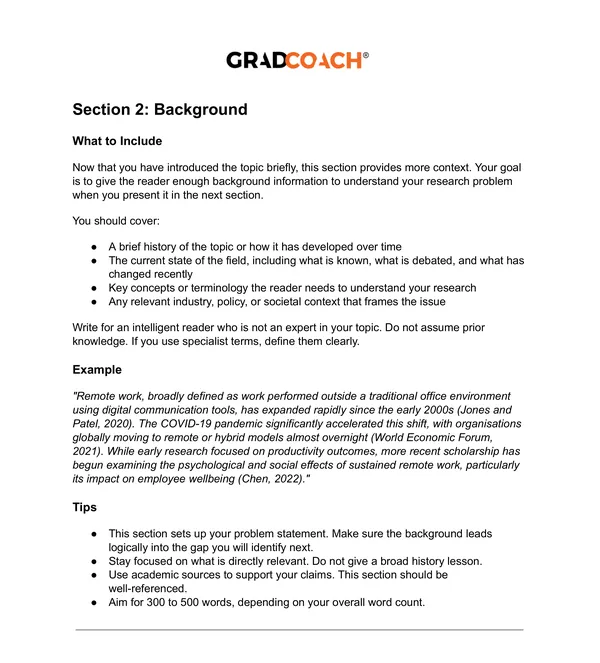
You don’t need to read three hundred pages to get the gist of a dissertation. Read these three chapters instead, in this order.

  1. 1 2 Introduction How the gap is argued, and how the question follows from it
  2. 2 Literature review
  3. 3 1 Methodology The chapter students find hardest, where a worked example saves most
  4. 4 Results
  5. 5 3 Discussion How findings get tied back to the gap you were shown in chapter 1

The two without a number are worth skimming later. They are rarely where the help is.

What you should pay attention to

  • How the chapters carry an argument
  • How a research question turns into an analysis
  • The sentences that signpost where a reader is
  • How a limitation is stated without apology

Don’t spend too much time on

  • Their words
  • Their ideas
  • Their data
  • Their reference list

Copying any of those is plagiarism whatever the license says, and your university will find it. Quoting one is fine, so long as you cite it like any other source.

Frequently asked questions

Are these real dissertations?

Yes. Every one is a completed dissertation or thesis that passed examination, downloaded from the university repository that published it. Each one links back to that original record, so you can check the provenance rather than take our word for it.

Why are they free to download?

Because their authors published them under an open license: Creative Commons Attribution, Attribution-NoDerivatives, or a public domain dedication. Those licenses permit anyone to redistribute the work as long as the author is credited, which is why every entry names its author, institution and license.

Can I cite these in my own dissertation?

Yes, and you should if you use one. Cite it as you would any thesis: author, year, title, degree, institution. Each entry links its repository record, which carries the permanent link and the version of record your reference list wants.

Can I copy the structure of one?

Structure, yes. Words and ideas, no.

Learning how a methodology chapter is organized, how a gap is argued, or how findings are signposted is exactly what an example is for, and no examiner objects to it. Lifting sentences or arguments is plagiarism regardless of the license, and it is the thing university text-matching software is built to catch. If you want the line drawn properly, we wrote about it in is dissertation help cheating?

How were these chosen?

We read them. Each one was read end to end before it was written up, and picked for what it teaches rather than for its topic: a clean methodology chapter, a well-argued gap, an honest limitations section, a null result handled well. The note under each says what that document is a good model of and which chapter to open first.

My field isn’t here yet. What should I do?

Pick the nearest discipline by method rather than by topic. If you are running a survey and a regression, a business or education example will teach you more than a document from your own field using a method you are not using. Structure and argument travel between fields far better than subject matter does.

We are adding disciplines as we find documents that are both openly licensed and genuinely worth reading, which is a smaller pool than it sounds.

Stuck on your own dissertation?

Book a free initial consultation and we’ll talk through where you are and whether we can help.

15-minute chat. No cost. No pressure.

Let's chat

Tell us what's going on, and a real person on the team will get back to you ASAP.

Alternatively, book a quick call here.

David Phair, Operations Manager at Grad Coach
David Phair (PhD) Operations Manager

Book a free consultation to discuss how we can move your research forward.

  • 15 minute chat with a doctoral-qualified coach
  • 100% personalized guidance
  • No cost or obligation