What Is Narrative Analysis?
The four types of narrative analysis, with practical examples


The 30-second summary
Narrative analysis is a qualitative analysis method that studies the stories people tell, keeping each story whole so you can see how someone makes sense of what happened to them.
- A story is your unit of analysis, not a line of transcript. You look at how the events are put together and what the teller makes of them.
- There are four main types: thematic (what is told), structural (how it’s told), dialogic or performance (how it’s shaped for an audience) and visual.
- You can work inductively or deductively, letting the stories lead or reading them through an existing theory. Your lens can change partway, as long as you report it.
- Samples are small, often one person to a few dozen, so it suits questions about how individuals make sense of something, not how common it is.
Want a head start on your methodology chapter? Our free methodology chapter template walks you from design to analysis, with space to justify each choice, including why narrative analysis fits.
Navigate
Stories are some of the richest data you’ll ever collect, and some of the easiest to wreck. Chop a two-hour life story into coded fragments and what made it a story can vanish: the order of events and what the teller thought they meant.
In our work with 10,000+ students, we’ve seen plenty of projects labeled “narrative” that were really something else. Committees notice.
In this post, I’ll explain the four main types of narrative analysis and how to do one step by step, plus how to tell whether yours is the real thing. Then I’ll walk you through a published study that used it.
What is narrative analysis?
Narrative analysis is a qualitative analysis method that interprets the stories people tell to understand how they make sense of their experiences. Instead of coding a transcript line by line, you treat each story as a whole and ask how it’s put together.
What makes a piece of talk or writing a story, rather than a description? In a short encyclopedia entry on the method, Catherine Kohler Riessman puts it in one sentence:
Notice the four verbs at the end. Selecting, organizing, connecting and evaluating are all things the teller does, and those choices are your data. They aren’t neutral, either. As the same entry puts it, narratives “do not speak for themselves”; they “require interpretation when used as data in social research”. That interpretation is your job.
Your data could come from interviews, diaries, letters, memoirs or social media posts, so the method works on primary and secondary data alike.
What counts as one story depends on the field. In sociolinguistics it’s often a short account given in answer to one interview question; in anthropology it can be a whole life story; in much of psychology and sociology it’s long stretches of talk about a life in context.
The method also works on fiction. Say you wanted to understand how novels of the 1950s pictured women’s work. You might trace the characters, plotlines and turning points across a set of novels, then read them against the backdrop of their time. In most social science dissertations, though, the stories come from participants, and that’s the case I’ll focus on from here.
The two overarching approaches
As with most qualitative methods, you can come at your stories inductively or deductively. The choice shapes what you look for and the kind of conclusions you can draw, so decide where you’ll start, and expect to report it if that changes.
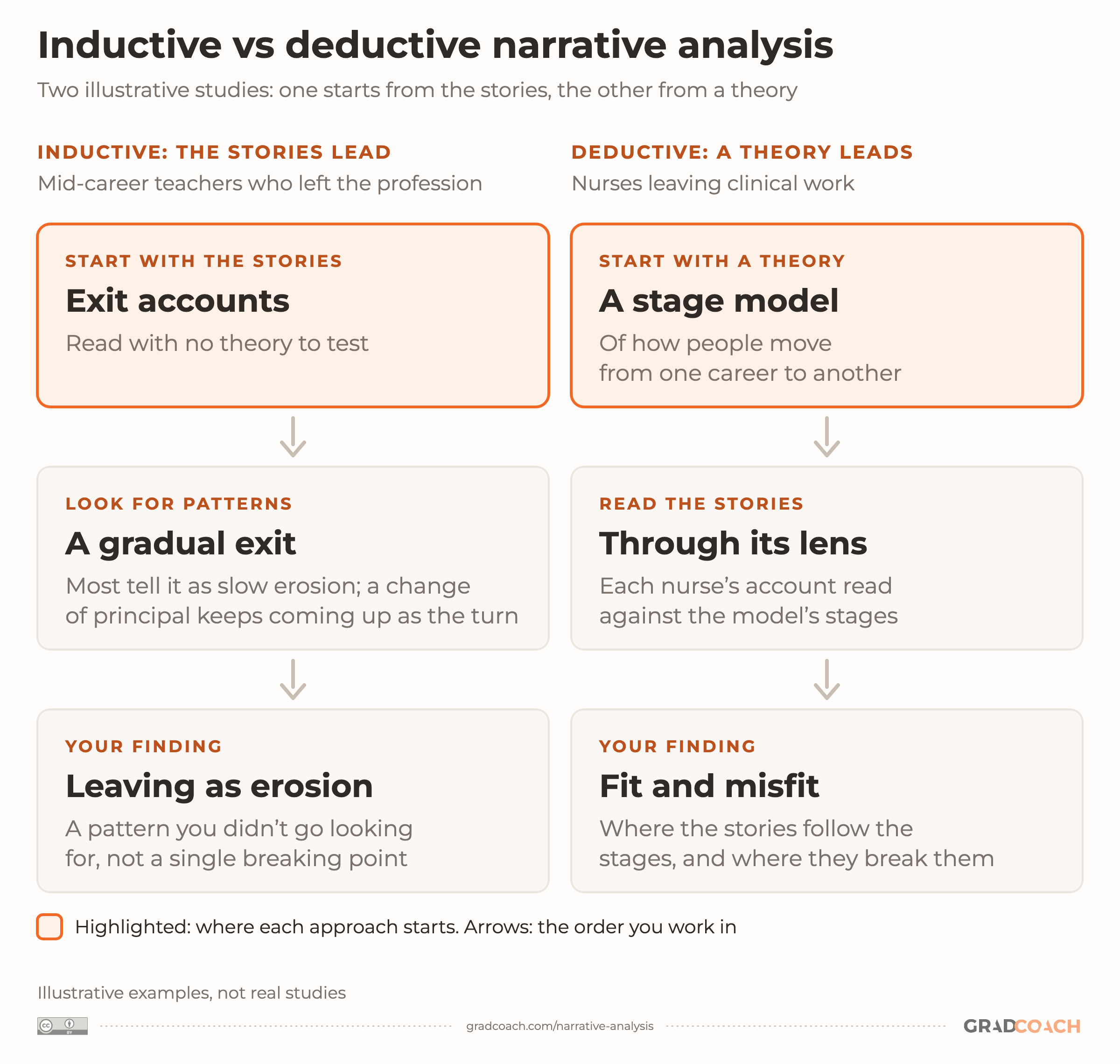
The inductive approach lets the stories lead. You start without a theory to test and build your interpretation from the patterns you find. Imagine you interviewed mid-career teachers who had left the profession. Reading their accounts, you might find that most of them tell their exit as a slow erosion rather than a single breaking point, and that a change of principal keeps appearing as the turning point. That pattern, which you didn’t go looking for, becomes your finding.
The deductive approach starts from an existing theory. You read the stories through that theory’s lens and look for evidence that supports, refines or challenges it. You might read nurses’ accounts of leaving clinical work against a stage model of career transition, asking where their stories fit the stages and where they break them.
Here are the two examples side by side. Notice where each one starts, and where the stories come in:

In practice, your lens can change mid-analysis. For example, a study from a physics education PhD project followed one student, given the pseudonym Nicole, as she transferred from a two-year college to a four-year university. The researchers first coded her journals and interviews against an existing theory, self-efficacy (roughly, a person’s belief that they can succeed at a task). Then they changed course:
The authors name the theory they started with and the framework that replaced it, and they tell readers where to find the detail. That’s the trail your committee or examiners want to see. If your own analysis shifts as you go, don’t hide it. Report the shift and the reason, the way this study does.
So which should you start with?
It depends on what your research questions ask. If they’re exploratory (“how do first-generation students describe their first year?”), you’ll likely work inductively. If they’re theory-led (“how well does a model of career transition explain nurses’ accounts of leaving the ward?”), you’ll likely work deductively.
Four types of narrative analysis
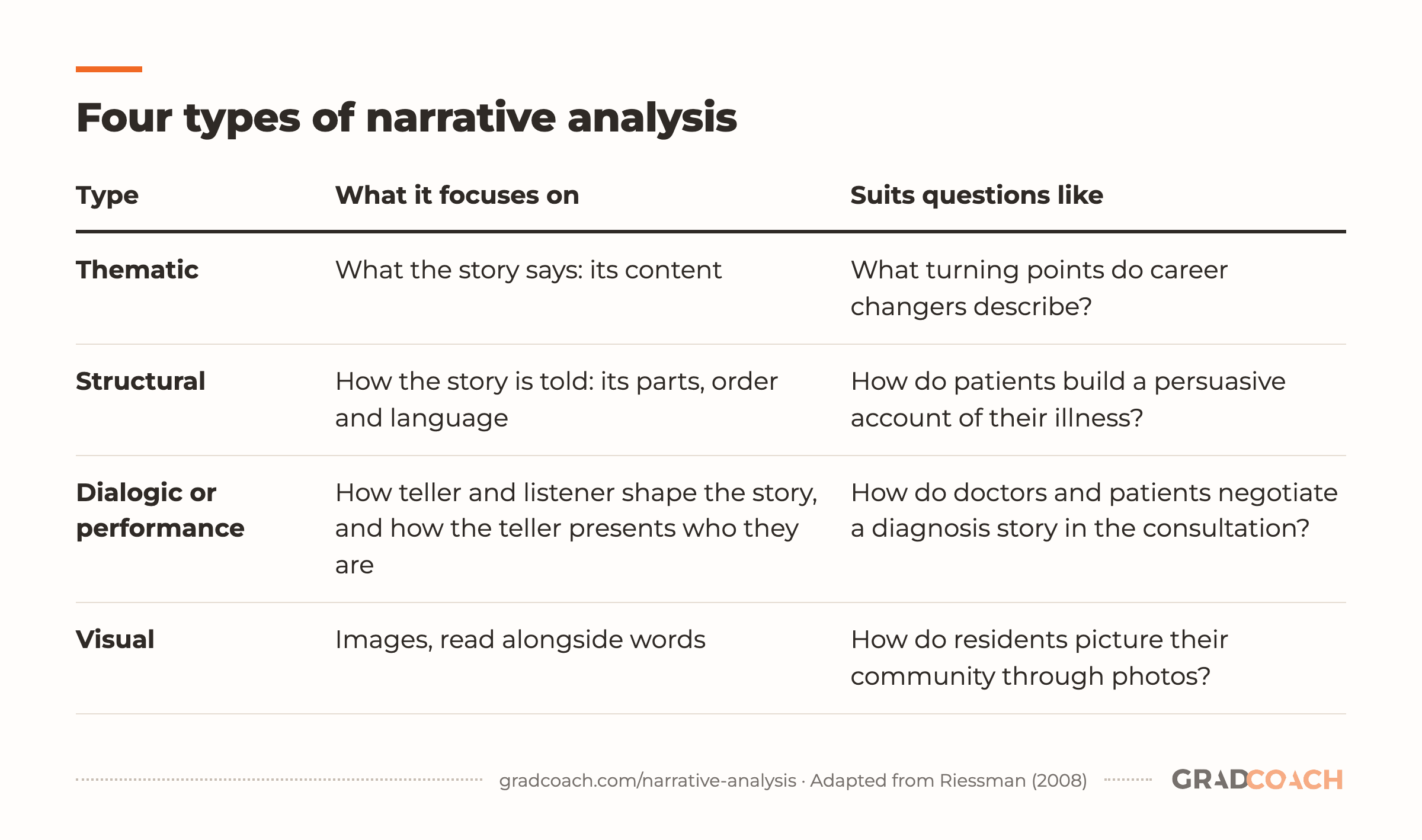
Narrative analysis is a family of approaches. This post follows the four-type grouping in Catherine Kohler Riessman’s 2008 textbook, summarized in this review. The table sets them side by side. Read across each row for what the type pays attention to and the kind of question it suits:
| Type | What it focuses on | Suits questions like |
|---|---|---|
| Thematic | What the story says: its content | What turning points do career changers describe? |
| Structural | How the story is told: its parts, order and language | How do patients build a persuasive account of their illness? |
| Dialogic or performance | How teller and listener shape the story, and how the teller presents who they are | How do doctors and patients negotiate a diagnosis story in the consultation? |
| Visual | Images, read alongside words | How do residents picture their community through photos? |
The types overlap. Riessman wrote that approaches “can be combined; they are not mutually exclusive”. That was in an earlier version of her grouping, which treated interactional and performative analysis as two separate types. A study might lead with one and borrow from another.
They also need different levels of transcript detail. A thematic reading can work from a clean transcript, but structural and dialogic analysis need far more, such as pauses, false starts and the interviewer’s questions. So let your research question pick the type, then transcribe to suit it. If your question is about what happened to people, not how they tell it, thematic is the usual choice, and it’s also the lightest on transcription.
Thematic narrative analysis is also the type most easily confused with ordinary thematic analysis. Both look for themes. Thematic analysis codes every transcript and then gathers extracts from across the dataset into themes, so an individual account is broken up by design. Narrative analysis, on the other hand, keeps it whole. In Riessman’s words, narrative scholars “keep a story ‘intact’ by theorizing from the case, rather than from component themes (categories) across cases” (2008, p. 53, as quoted in this PLoS ONE study).
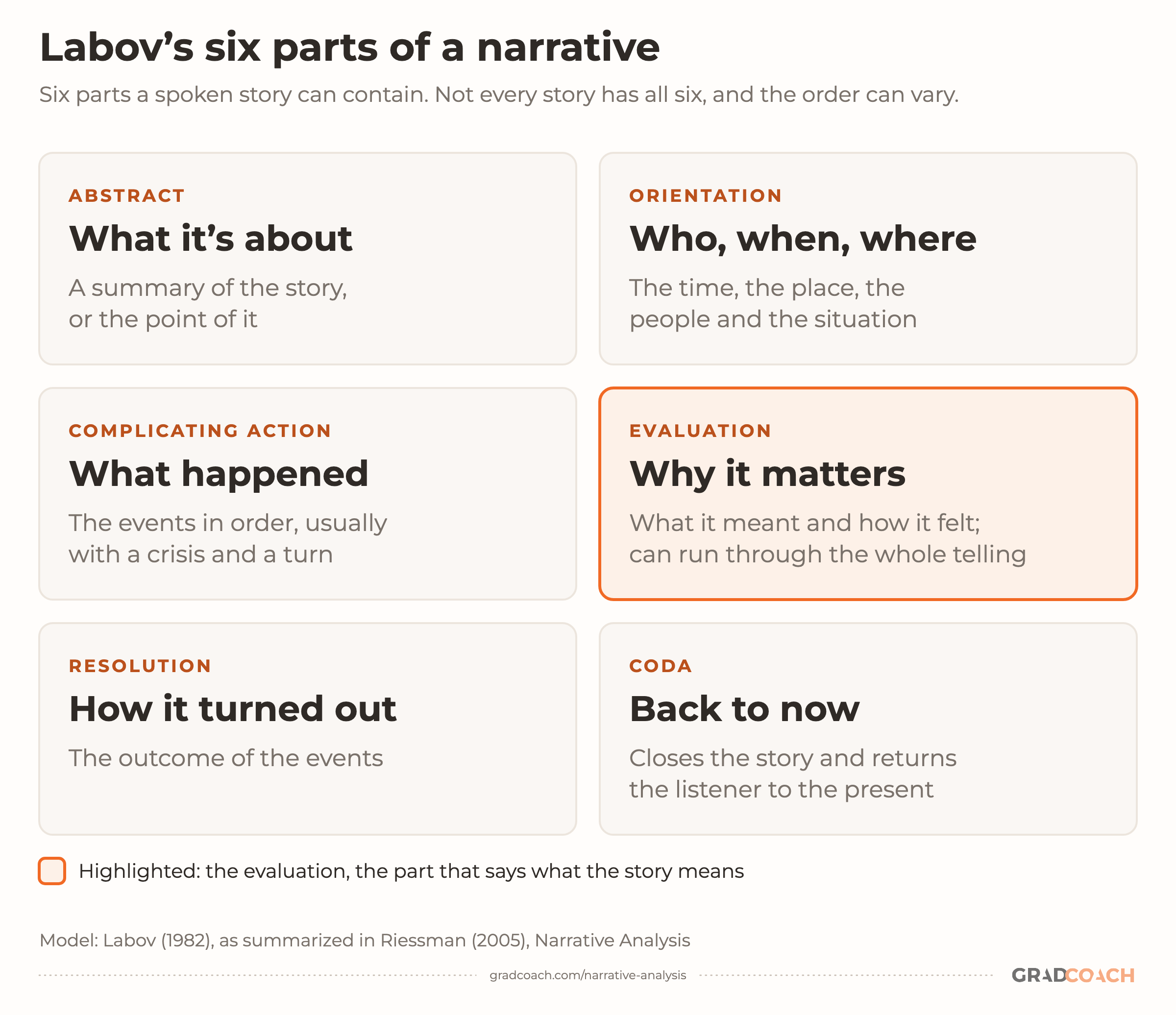
Structural analysis has its own classic framework, from William Labov and colleagues, and arguably the first method of narrative analysis. It breaks a spoken story into six parts, each doing a different job for the teller:

The evaluation is the heart of the story, and it often shows you most clearly what the teller thinks. It doesn’t always sit in one place, either: one study of 55 women medical educators’ written accounts of career change describes evaluation as “integrated throughout” the story. Not every story has all six parts, and they don’t always come in this order.
Labov built the model for short stories told in answer to a single question, so it fits an episode better than a whole life history. If your stories are long, apply it to the key episodes within them.
Visual narrative analysis is the newest of the four. Riessman’s earlier grouping left it out and treated images as a recent turn in the field. A Purdue PhD on community organizers in Appalachia shows a neighboring approach, photovoice. Participants took photos and wrote short reflections over six months, and the researcher connected repeated patterns in the photos with the stories in their writing, interviews and focus groups. If your participants are making images, or your sources are visual, this is the type to read up on.
How to do a narrative analysis
There’s no single official procedure. Riessman’s textbook teaches each type through published examples, not a fixed recipe, so treat what follows as one workable sequence. Loop back where you need to:
- Decide what counts as a story in your data. A whole life history, an episode told in answer to one question, or a written account? Write your definition down, because it decides which parts of your transcripts you analyze.
- Transcribe at the level of detail your type needs: a clean transcript for a thematic reading, much more for structural and dialogic ones.
- Read each account whole before you code anything. Write a short summary of each story in your own words: who’s in it, what happens and how it ends.
- Analyze each story through your chosen lens. That might be Labov’s six parts, plot elements such as characters, setting and problem, or the themes within that one account.
- Then compare across stories. Look for shared turning points, contrasting endings or different ways of telling the same kind of event, and note the accounts that don’t fit. Some studies use thematic analysis for this cross-story step, and say so in their methods.
- Write up your findings. Narrative studies can organize their findings by story, scene or character instead of by theme, as the example below does, and quote enough of each account for your reader to follow it.
The order is the point.
Within each story first, across stories second. Skip the first half and you risk doing thematic analysis with a narrative label. If you’re building your findings chapter now, the template below gives you a structure to work into.
A real example: one student’s story
Nicole’s study, from the approaches section above, shows what this looks like in a published paper. The researchers gathered more than 100 pages of field notes (not all about Nicole), around three hours of interviews with her and about 10 pages of her journal entries.
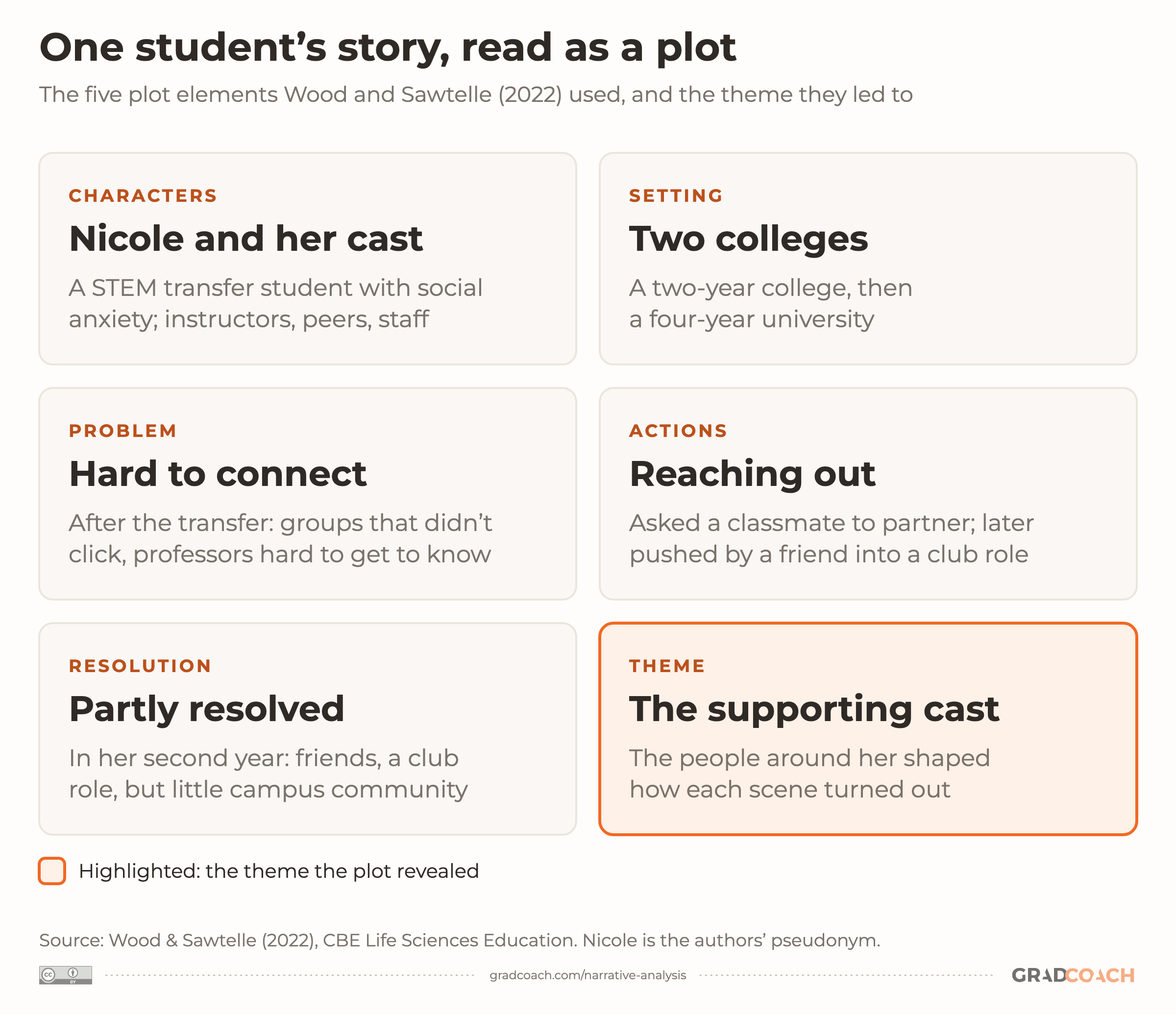
They read all of it through five plot elements: characters, setting, problem, actions and resolution. They also used three “commonplaces” from narrative inquiry, a closely related research design I’ll come back to below: time, place and sociality (her inner state and the people around her). Here’s her story laid out on those five elements, with the theme they led to:

Here’s how the study maps onto the six steps above, and where having one participant changes them:
- What counts as the story (step 1): Nicole’s move from one college to the next, followed from spring 2019 to spring 2021 through field notes, interviews and her journals.
- Reading through a lens (steps 3 and 4): The plot elements and the commonplaces, applied to her account as a whole and written up as four short scenes, or vignettes.
- Comparing (step 5): With one participant, the comparison runs across scenes instead of across people. Her first college and her new university are set side by side.
- Writing it up (step 6): The results headings include “Story Conflict”, “The Plot Thickens” and “Resolution”, and each scene quotes Nicole at length.
The paper doesn’t describe its transcription in detail, so step 2 is the one you can’t see here. What you can see is how open the authors are about their own position, including what each brought to the study and how their relationship with Nicole colors their reading. That openness matters more when a whole study rests on one account.
One participant is a defensible sample for a journal article like this, which reports a single case from a larger dissertation project. A whole dissertation built on one person is rarer. If you’re considering it, agree it with your advisor (supervisor, in the UK) first and justify it against your research question.
Strengths & weaknesses
The method has real strengths and real costs, and your committee will ask about both.
Its main strength is depth. Because you keep each story whole, you can see how someone links events and judges their own part in them. That’s exactly what gets lost when a transcript is broken into codes, and it’s often what your research question is really about.
It also gives participants’ own interpretations weight. The analysis starts from how people make sense of their lives, which suits fields such as health and education, where research often aims to hear the people most affected.
The first drawback is interpretation. Stories can be read in more than one way, and your reading is shaped by your background. You’ll need to understand the teller’s context and say how your own position shapes what you see, which is what reflexivity means in practice.
The second is generalizability. Narrative samples are small. In one review of 51 highly cited qualitative studies in education and the health sciences, the narrative inquiry studies that reported a sample ranged from one participant up to 24 in education and up to 52 in the health sciences. You can’t claim your findings hold for a population. You can still build or extend theory from close readings of a few cases.
The third is time. Long-form data takes long-form reading, and you’ll often need background on each story’s context too. Budget generously for the analysis stage, and start it before your last interview if your design allows.
When to use it (and when not to)
Narrative analysis is usually the right fit when your research question is about how individuals make sense of something over time.
Say you wanted to understand the experiences of people facing social marginalization. You could analyze the stories they tell about it: how they say it started, who they hold to account and what changed for them. The wording of your question is a good test. “How do people tell the story of…” and “how did their experience of… change” both point toward narrative analysis.
If your question is about broader patterns across many people (what most participants think, or how often something comes up), another method will serve you better. Thematic analysis suits shared patterns of meaning, and content analysis suits categorizing and counting. If you care about how language itself constructs reality, look at discourse analysis.
A common mix-up is between the design and the method. Narrative inquiry is usually treated as a research design: it shapes who you recruit and how you work with participants over time. Narrative analysis is how you analyze the stories. The line isn’t always kept, though. Nicole’s study analyzes with a narrative inquiry framework and calls it narrative analysis.
We often meet students who read up on narrative analysis when the decision in front of them was really their research design. Their methodology chapter then blurs the two. If you use both, name both, and say which one did which job.
If you’re still weighing narrative analysis against the alternatives, here’s our walkthrough of the main qualitative methods and how to choose between them:
Whichever approach you choose, your examiners will be looking for the same thing: a clear line from what you counted as a story, through the lens you read it with, to the findings you report. If you can explain each of those choices in a sentence or two, and point to where the evidence sits, your analysis will hold up. If you can’t yet, that’s the gap to close before you write the chapter.
Still have questions?
What is the difference between narrative and thematic analysis?
Both look for themes, but narrative analysis keeps each person’s story whole and interprets it as a case before comparing across people. Thematic analysis codes all the transcripts and builds themes across the whole dataset, so individual accounts are broken up. If your question is about how individuals make sense of events over time, narrative analysis fits. If it’s about shared patterns across many participants, thematic analysis usually fits better.
What are the four types of narrative analysis?
In Riessman’s 2008 grouping, the four types are thematic (what a story says), structural (how it’s told, often using Labov’s six parts), dialogic or performance (how teller and audience shape it, and how the teller presents themselves) and visual (images read alongside words). The types overlap, and one study can combine several.
Is narrative inquiry the same as narrative analysis?
Not quite. Narrative inquiry is usually treated as a research design or methodology that shapes how you recruit, interview and work with participants. Narrative analysis is the analysis method you apply to stories, and you can use it within other designs too. Some published studies use the two terms interchangeably, so define yours in your methodology chapter.
How many participants does narrative analysis need?
There’s no fixed number. Narrative studies are usually small because each story is read closely: in one review of highly cited studies, narrative inquiry samples ranged from one participant to about 50. Choose a number you can analyze in depth, justify it against your research question, and agree it with your advisor.
Is a narrative review the same as narrative analysis?
No. A narrative review is a type of literature review that summarizes published studies in prose, without pooling their results statistically. Narrative analysis studies the stories people tell as research data. The shared word causes a lot of confusion in database searches, so check which one a paper means.
Can’t find your answer here? Ask a Grad Coach directly – the initial chat is free.
Speak with a friendly coach →


Cite-worthy sources
Cite this article
Al-Saraf, E. (2023). What Is Narrative Analysis?. Grad Coach. https://gradcoach.com/narrative-analysis/
- Carlson, E. B. (2019). “There is wealth in the struggle”: Unearthing and embracing community knowledges through organizing work in Appalachia [Doctoral dissertation, Purdue University].
- Duque, R. L. (2010). Review: Catherine Kohler Riessman (2008). Narrative methods for the human sciences. Forum Qualitative Sozialforschung / Forum: Qualitative Social Research, 11(1), Article 19.
- Eghosa-Aimufua, O., Boam, A., Webb, K. L., & Browne, J. (2022). ‘I felt forced to find an alternative’: A qualitative analysis of women medical educators’ narratives of career transitions. BMJ Open, 12(9), e059009.
- Guetterman, T. C. (2015). Descriptions of sampling practices within five approaches to qualitative research in education and the health sciences. Forum Qualitative Sozialforschung / Forum: Qualitative Social Research, 16(2), Article 25.
- Riessman, C. K. (2005). Narrative analysis. In Narrative, memory & everyday life (pp. 1–7). University of Huddersfield. (Original work published 2003)
- Ross, L. E., Gibson, M. F., Daley, A., Steele, L. S., & Williams, C. C. (2018). In spite of the system: A qualitatively-driven mixed methods analysis of the mental health services experiences of LGBTQ people living in poverty in Ontario, Canada. PLoS ONE, 13(8), e0201437.
- Wood, L. A. H., & Sawtelle, V. (2022). Narrative analysis of a woman’s experience transferring from a TYC reveals impact of supporting characters. CBE Life Sciences Education, 21(3), ar53.