
Free download
Research Questionnaire Template
A complete example survey, from consent page to codebook. Free to download. Instant access.
Your template is ready
It opens in a new tab, so this page stays right where it is.
Open your template


Developed by Grad Coach's Doctoral-Qualified Team20 Million Downloads · Used by 500+ Universities
4.9 Stars
Client Satisfaction
10,000+
Students coached
100%
Client Pass Rate
20 Million
Video Lesson Downloads
What it covers
Most questionnaire templates online were built for customer feedback. This one is built for a dissertation or thesis. It’s a complete example survey in Word that takes one study from the first page to the last, with notes on each part from the survey work we do with students. You get:
- Participant information and consentA checklist of what your ethics board will expect, ready for your university's wording
- Screening questionsTo check each person fits your sample
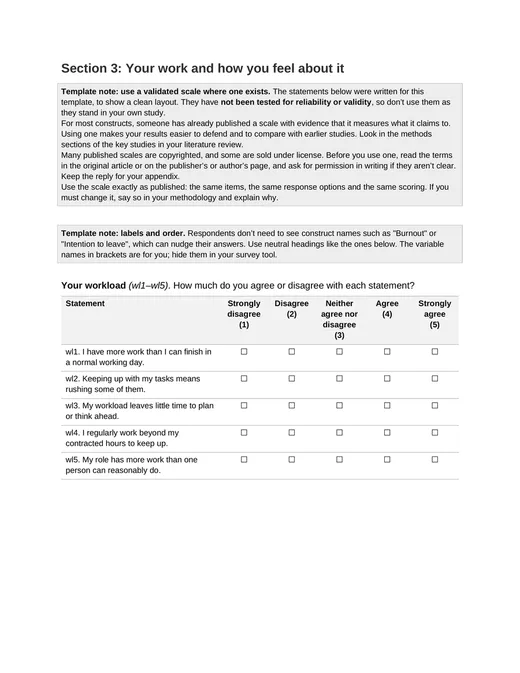
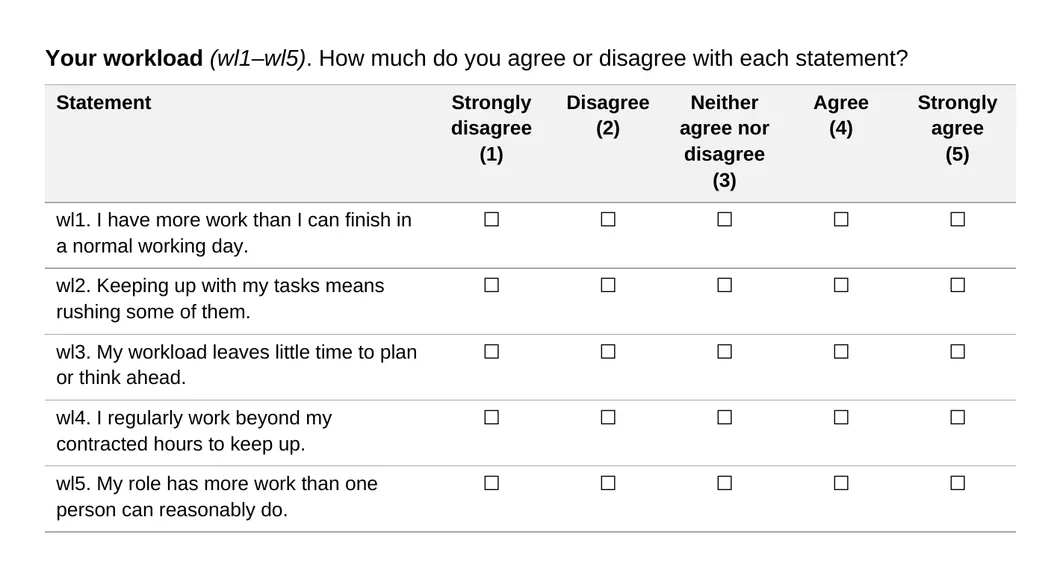
- Rating scalesFive-point agreement scales, laid out cleanly
- A reverse-worded itemAnd how to score it
- An attention checkTo flag people clicking without reading
- A placeholder for a published scaleWith what to check before you use one
- DemographicsWith "Prefer not to say" built in
- A codebookEvery variable, how it's coded and how it's scored
Short gray notes explain each part. Delete them, swap in your own questions, and you have a draft to take to your supervisor.
See a sample page
The example study surveys employees in their first three years in a role, about their workload, autonomy, support at work, burnout and plans to leave. It’s the same study behind our APA 7 tables template, so you can follow it from the questionnaire to the finished results tables.
One thing to know before you start: the rating-scale statements were written for this template, to show the layout. They haven’t been tested for reliability or validity, so don’t use them as they stand. Where a published scale exists for what you’re measuring, use that instead, with permission. You can see the whole questionnaire in a PDF preview before you download the Word file.
Frequently asked questions
Can I use these questions in my own study?
You can use the structure, but not the rating-scale statements as they stand. They were written to show the layout and haven’t been tested. If a published scale exists for what you’re measuring, use it, because a scale with evidence behind it is much easier to defend in your methodology chapter.
How do I find a published scale for my topic?
Start with the key studies in your literature review. Their methods sections will name the scales they used and cite where each one comes from. Scales that come up again and again in your field are usually the safest choice.
Do I need permission to use a published scale?
Often, yes. Many published scales are copyrighted, and some are sold under license. Read the terms in the original article or on the publisher’s or author’s page, and if they aren’t clear, ask the author in writing. Keep the reply for your appendix.
Does my university’s consent form replace Section 1?
Yes. If your university or ethics board gives you a participant information sheet and consent form, use those. Section 1 is a checklist of what they usually cover, so you can check nothing is missing. For more on what ethics boards look for, see our guide to research ethics.
Can I build this in Google Forms or Qualtrics?
Yes, and for most studies you should. Use the Word file to draft your questions and agree them with your supervisor, then build the final survey in your tool. Set up the routing the notes describe, so that anyone who doesn’t consent or doesn’t qualify goes straight to the end.
How long should my questionnaire be?
As short as it can be while still answering your research questions. Every question should earn its place against one of them. Time yourself and a few test respondents, and put the honest time on your information page.
Should I pilot my questionnaire first?
Yes. Ask a few people like your participants to complete it and tell you where they hesitated, misread a question or wanted an answer you didn’t offer. Fix those before you launch, and mention the pilot in your methodology.
How many people need to complete my survey?
It depends on your analysis. A power analysis tells you how many responses you need to detect the effect you’re looking for. Our guide to power analysis walks through it.
Can I share this template with my friends/colleagues?
Yes, you’re welcome to share it in its original format. If you want to post about it on your blog or social media, all we ask is that you reference this page as your source.
Do you have templates for the other dissertation chapters?
Yes, we do. You can find our full collection of templates here.
Get your copy, now.
Your template is ready
It opens in a new tab, so this page stays right where it is.
Open your template