How Long Is a Dissertation?
We measured 19,762 dissertations across 17 universities to find out


The 30-second summary
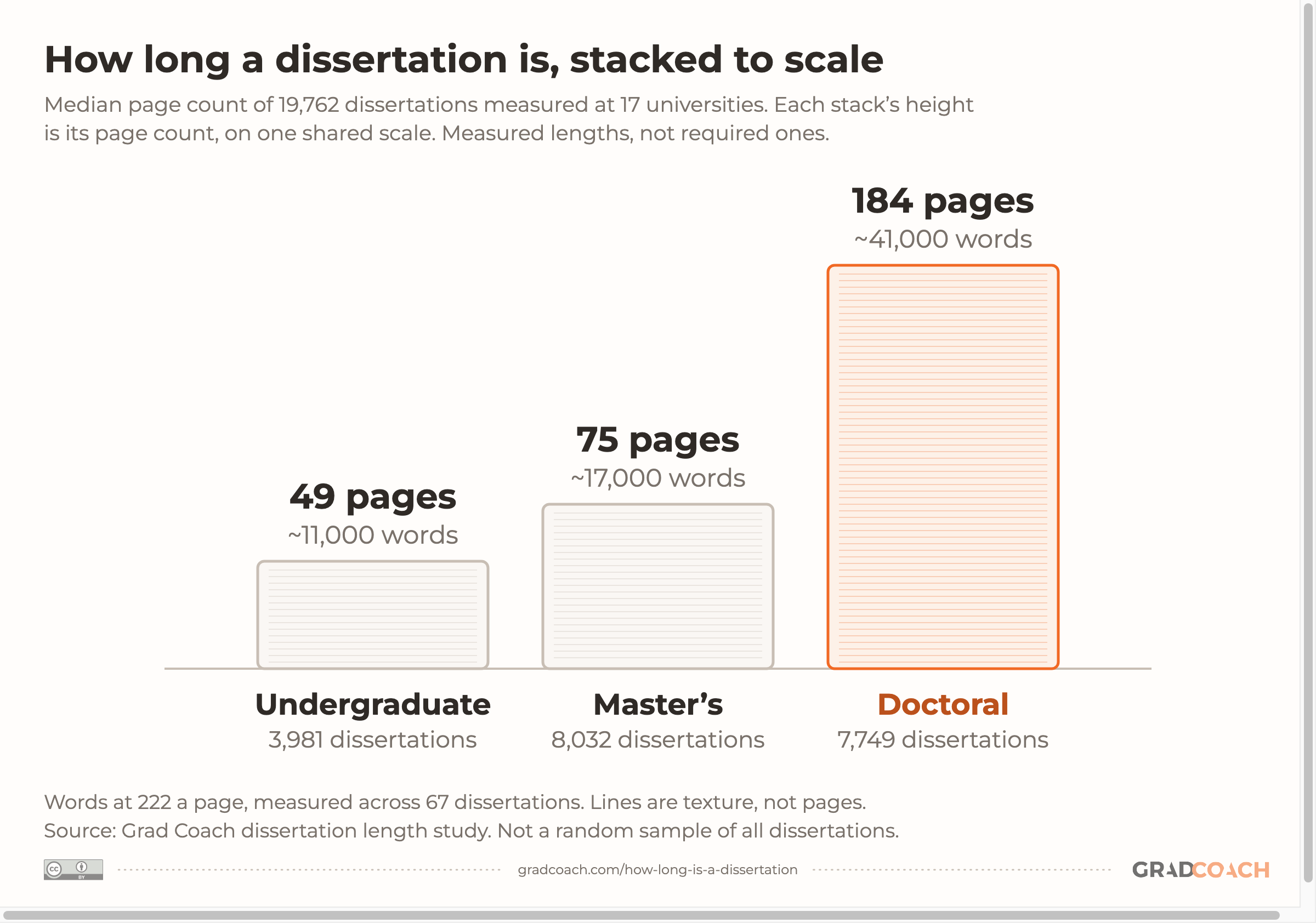
Across 19,762 dissertations we measured at seventeen universities, the median doctoral thesis runs 184 pages, or roughly 41,000 words. The median master's is 75 pages, about 17,000 words, and the median undergraduate 49 pages, about 11,000 words. None of those is the number that binds you.
- Your handbook beats every figure on this page. It sets the limit you are marked against, and it is usually in words rather than pages.
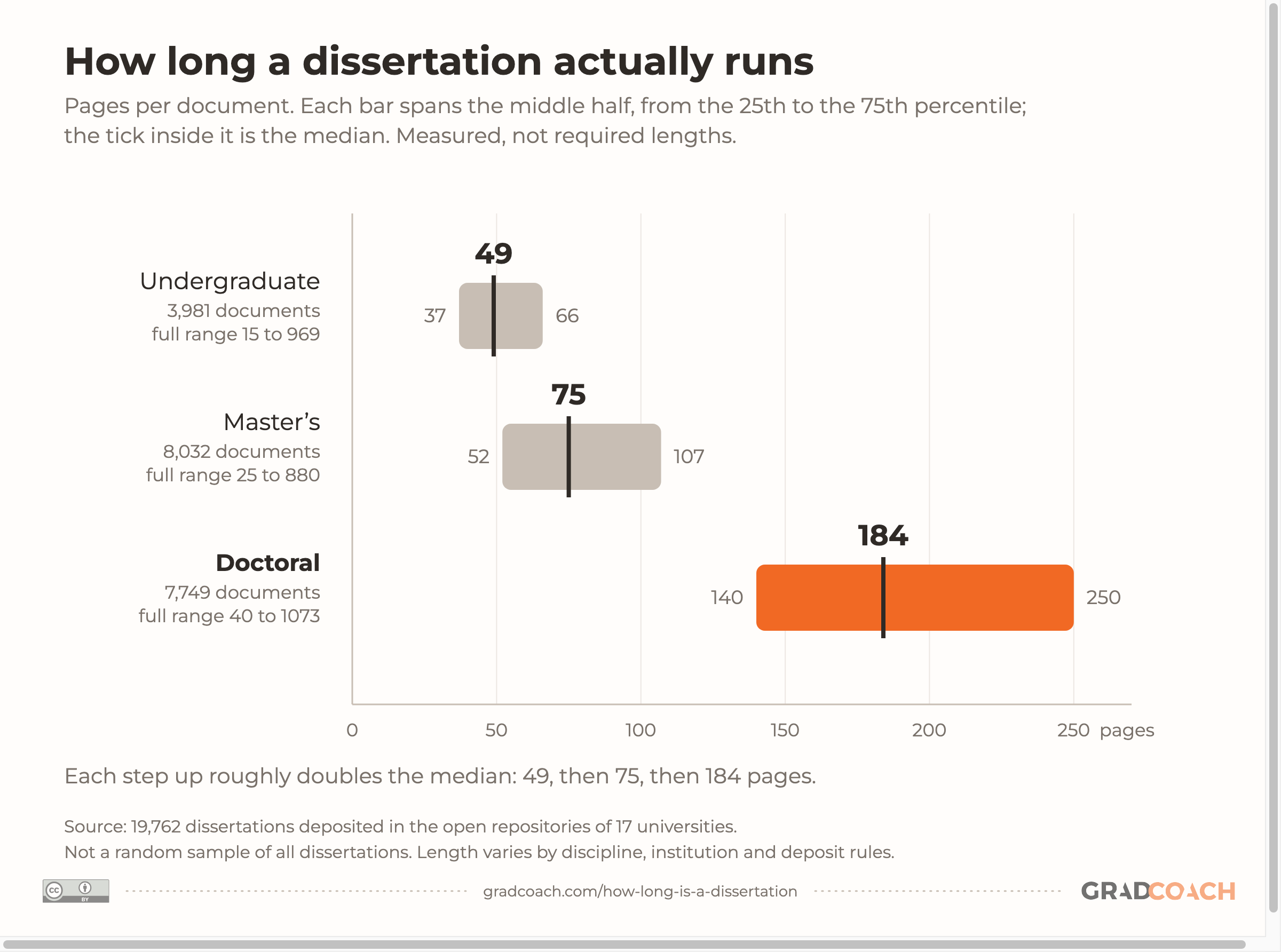
- The spread matters more than the median: half of the doctoral theses fall between 140 and 250 pages, and the longest runs to 1,073.
- Doctoral length is remarkably consistent. Master's length is not: seven universities all land between 159 and 215 pages on the doctorate, while their master's medians run from 59 pages to 91.
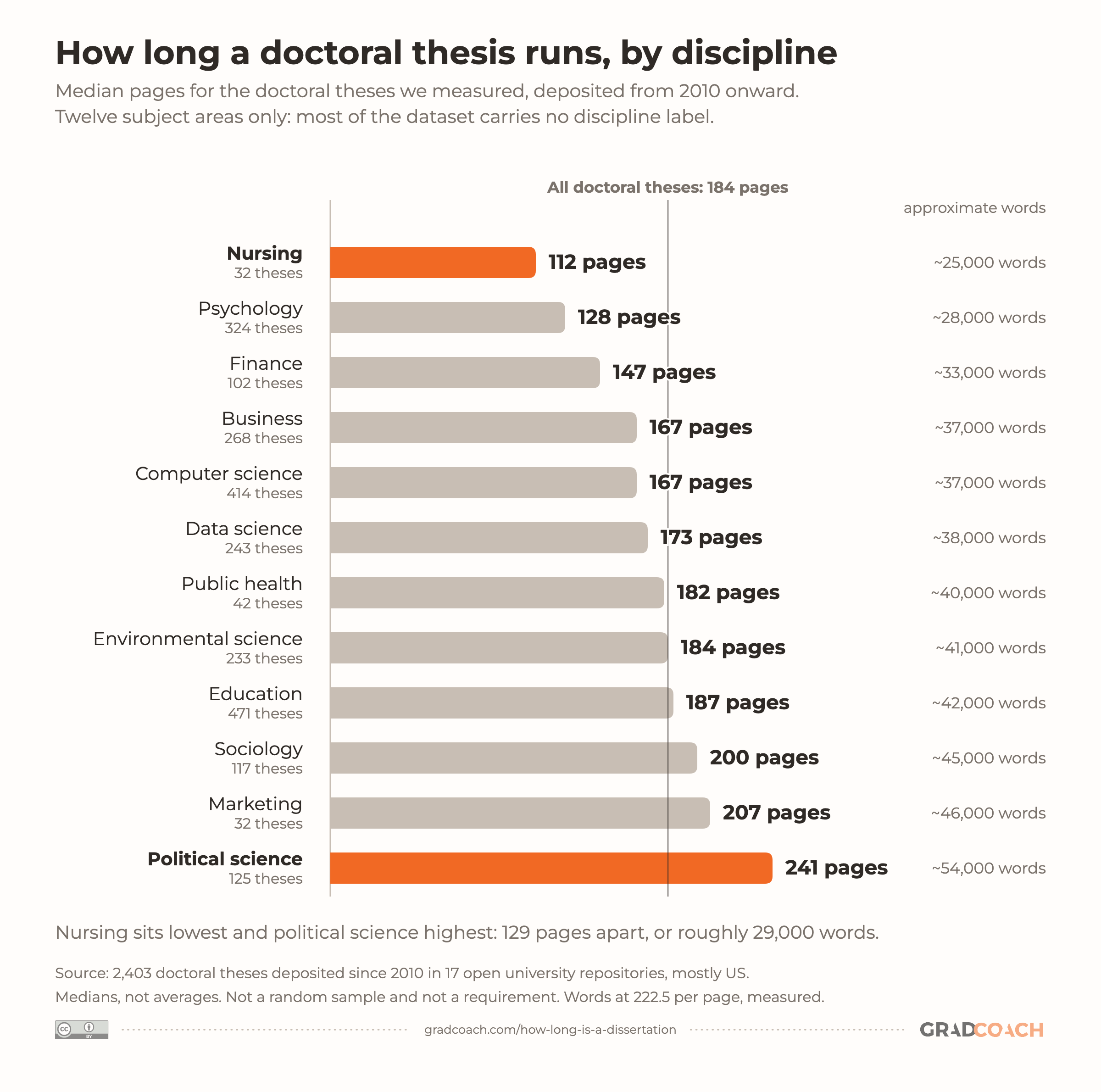
- Your field moves it more than anything except your handbook: a political science doctorate runs 241 pages at the middle against 112 for nursing, where much of the work is a clinical project rather than a research thesis.
- Budget by chapter before you write. Literature review and discussion are usually the longest chapters; methodology and results are typically shorter.
Work out your own ceiling before you plan anything against ours. Find your handbook's limit, check what it excludes, then read the word budget section below and split it across your chapters.
Navigate
How long should a dissertation be?
Somebody asks this question because they need a number to plan against, and every answer they find is a range somebody made up.
So we went and counted.
Across the 19,762 dissertations we measured at seventeen universities in 2026, the median doctoral thesis runs 184 pages, or roughly 41,000 words. The median master’s is 75 pages, about 17,000 words. The median undergraduate dissertation is 49 pages, about 11,000 words.

Now the part that matters more: none of those numbers is the one you are marked against.
Your handbook already decided
Before you plan a single chapter, find your institution’s stated limit.
It exists, it is usually expressed in words rather than pages, and it may be more restrictive than you think.
Across a sample of 800+ students we have worked with, about 11% arrived with a word or page cap that made the work they had been asked to do impossible to fit. Not difficult. Impossible. A literature review capped at 1,000 words. A whole dissertation capped at 6,000. A 10,000-word limit that counted the abstract inside it. A five-page ceiling on appendices, with tables counted against the main text.
One student worked out that once her literature review, methodology, abstract and conclusion were accounted for, her limit left roughly 2,000 to 2,500 words for the results and discussion combined. That is the heart of the thing she had spent a year collecting, in about the space of this article’s first two sections. Another had to cut 300 words while simultaneously adding the sampling detail her marker had demanded.
The limits are not only tight. They disagree with each other in ways that would be funny if they were not being applied to your work.
Take Cambridge, whose rules are public. The PhD limit is 80,000 words. In Social Anthropology that excludes the bibliography and the appendices. In Business and Management it excludes the bibliography but includes the appendices. Same university, same number, two Degree Committees. A student who moves a 6,000-word appendix from one of those rulebooks to the other changes their word count by 6,000 without writing or deleting a single sentence.
Essex sets 80,000 for a PhD, 50,000 for an MPhil and 30,000 for a master’s by dissertation, and excludes footnotes “as long as the latter do not contain substantive argument.” Read that again. Whether your footnotes count depends on a judgment somebody else makes about them, after you submit.
So the first practical answer to how long a dissertation should be is: exactly as long as your handbook says, counted the way your handbook counts. Everything below is context for that number, not a substitute for it.
What 19,762 dissertations run to
We read the page count each library recorded for 19,762 dissertations at seventeen universities, screened from 144,386 catalog records.
Most are American, ranging from the Ivy League to regional state universities, alongside substantial collections in Bangladesh and Spain and smaller ones from Canada, Argentina, Colombia and New Zealand. It is not a random sample of higher education, and Cornell and MIT between them account for a third of the rows.
Key statistics from the Grad Coach dissertation length study (2026):
- The median doctoral thesis runs 184 pages, about 41,000 words, across 7,749 doctoral theses at 17 universities.
- Half of those 7,749 doctoral theses fall between 140 and 250 pages, or 31,000 to 56,000 words.
- Seven universities with 50 or more doctoral theses each land between 159 and 215 pages.
- The median master’s thesis runs 75 pages, about 17,000 words, across 8,032 master’s theses at the same universities, though six of those universities run from 59 to 91 pages.
- The median undergraduate dissertation runs 49 pages, about 11,000 words, across 3,981 undergraduate dissertations.
- A dissertation page holds about 222 words, measured across 67 dissertations, against the 250 usually quoted.
These figures describe what was deposited at seventeen universities, not a standard anyone is marked against.
Data collected September 2026. Source: Grad Coach dissertation length study (2026), 19,762 dissertations at 17 universities.

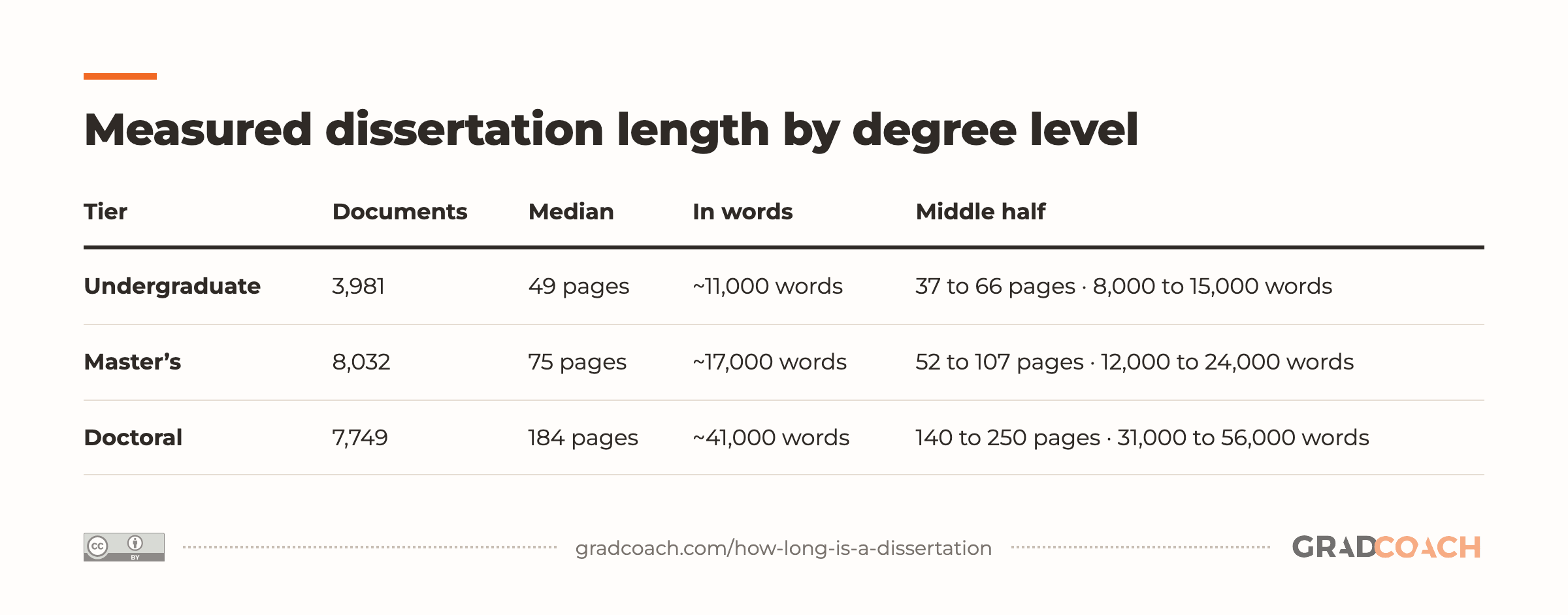
| Tier | Documents | Median | In words | Middle half |
|---|---|---|---|---|
| Undergraduate | 3,981 | 49 pages | ~11,000 words | 37 to 66 pages · 8,000 to 15,000 words |
| Master’s | 8,032 | 75 pages | ~17,000 words | 52 to 107 pages · 12,000 to 24,000 words |
| Doctoral | 7,749 | 184 pages | ~41,000 words | 140 to 250 pages · 31,000 to 56,000 words |
The median is the column people quote and the middle half is the one that helps. Half the doctoral theses we measured sit between 140 and 250 pages, or 31,000 to 56,000 words. That is a hundred-page window, and it is where you are. The shortest doctoral document in the set is 40 pages and the longest is 1,073.
The word figures come from counting the words in 67 dissertations we host and dividing by their page counts, which gives 222 words per page. Everybody quotes 250 and some sources say 300, so the received figure is about 13% too high. Use it to convert a rough total, not to plan a chapter: the real range runs from 128 words per page in a nursing project full of tables to 391 in an education thesis of dense prose.
Doctoral is stable. Master’s is not.
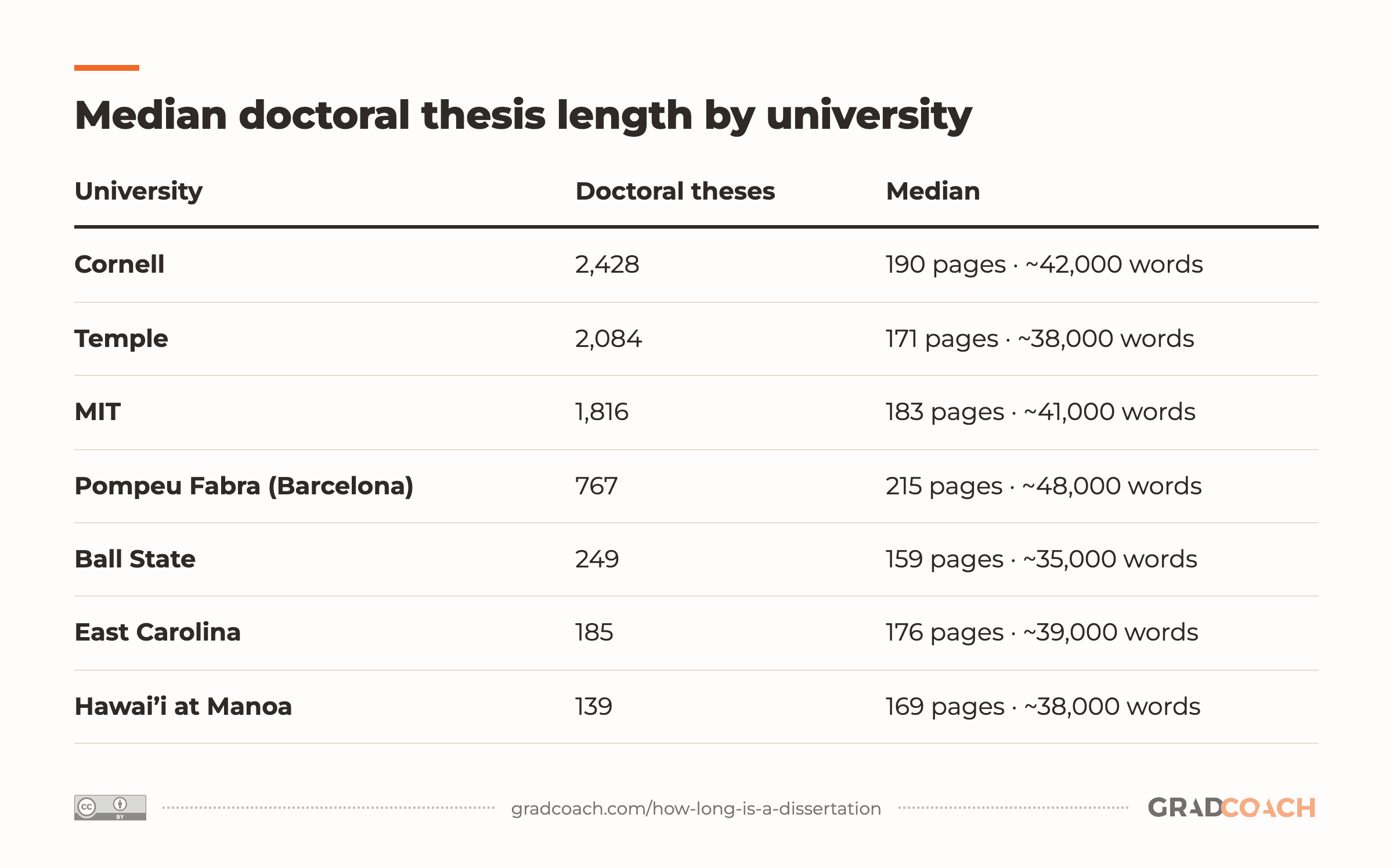
Every institution with at least fifty doctoral theses in our sample lands between 159 and 215 pages, so none sits more than 17% either side of the overall median of 184:
| University | Doctoral theses | Median |
|---|---|---|
| Cornell | 2,428 | 190 pages · ~42,000 words |
| Temple | 2,084 | 171 pages · ~38,000 words |
| MIT | 1,816 | 183 pages · ~41,000 words |
| Pompeu Fabra (Barcelona) | 767 | 215 pages · ~48,000 words |
| Ball State | 249 | 159 pages · ~35,000 words |
| East Carolina | 185 | 176 pages · ~39,000 words |
| Hawai’i at Manoa | 139 | 169 pages · ~38,000 words |
An Ivy, a technical institute, three regional public universities, a campus in Hawai’i and a Spanish university, arriving at the same answer independently. The doctorate appears to have a real customary length, somewhere close to 180 pages, that survives moving between institutions and countries.
Master’s theses do not.
The same six institutions run from 59 pages to 91, roughly 13,000 to 20,000 words, a spread half again as wide as the doctoral one. MIT’s master’s theses have a median of 91 pages and Ball State’s 59, and neither is wrong.
So the two rows in that first table are not the same kind of number. The doctoral median is a real central tendency you can plan against. The master’s median is the midpoint of a genuine disagreement, which means your own institution’s expectation matters more than any benchmark, including ours.
Does your field change it?
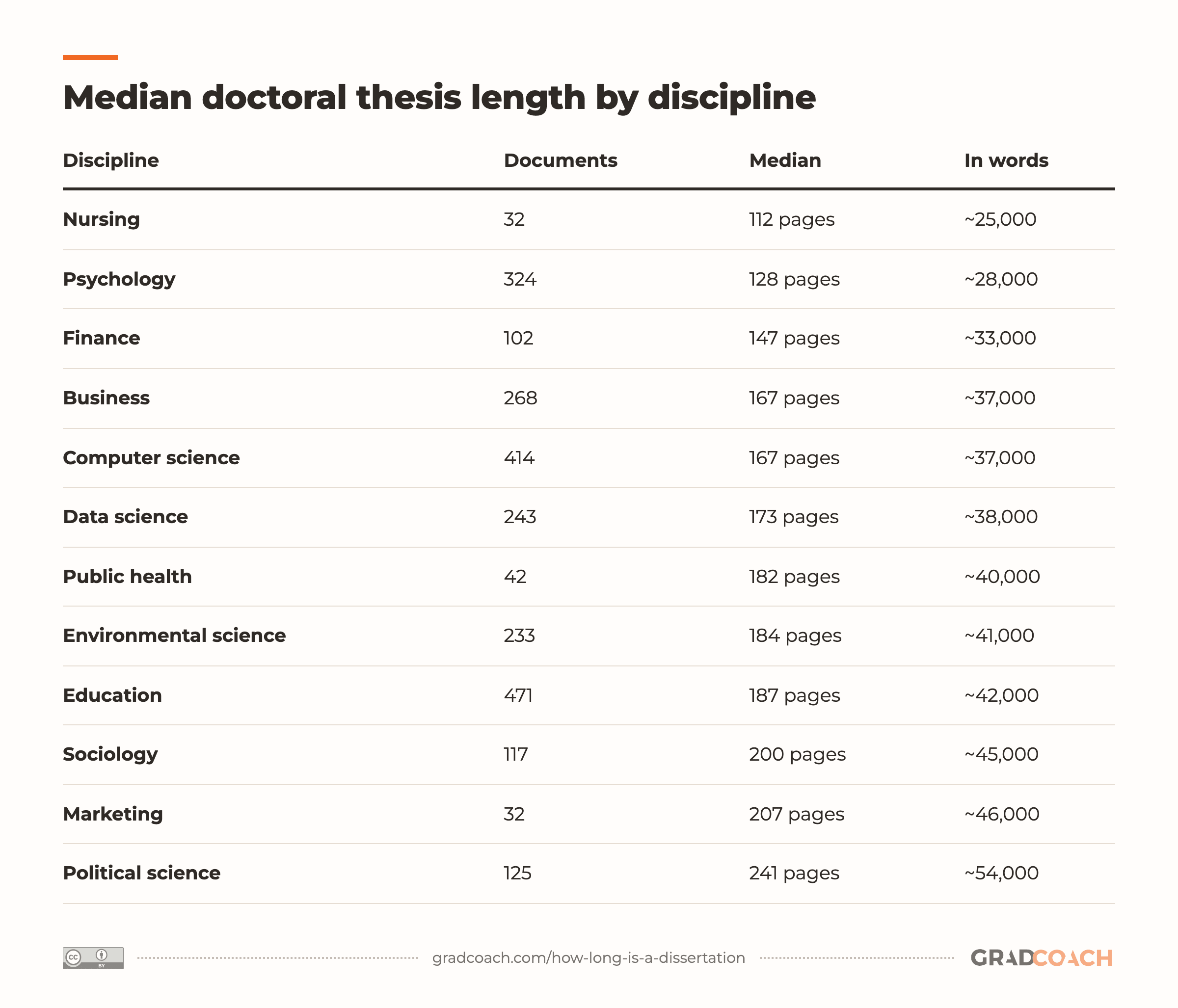
Within the doctoral theses deposited since 2010, more than you might expect.

| Discipline | Documents | Median | In words |
|---|---|---|---|
| Nursing | 32 | 112 pages | ~25,000 |
| Psychology | 324 | 128 pages | ~28,000 |
| Finance | 102 | 147 pages | ~33,000 |
| Business | 268 | 167 pages | ~37,000 |
| Computer science | 414 | 167 pages | ~37,000 |
| Data science | 243 | 173 pages | ~38,000 |
| Public health | 42 | 182 pages | ~40,000 |
| Environmental science | 233 | 184 pages | ~41,000 |
| Education | 471 | 187 pages | ~42,000 |
| Sociology | 117 | 200 pages | ~45,000 |
| Marketing | 32 | 207 pages | ~46,000 |
| Political science | 125 | 241 pages | ~54,000 |
Your field matters more than the overall median suggests. A political science doctorate runs to 241 pages at the middle and a nursing doctorate to 112, which is less than half. Nursing is the clearest case of why: much of the doctoral work deposited in nursing is the Doctor of Nursing Practice, a clinical project rather than a research thesis, and it is a genuinely shorter document rather than a thinner one.
Still, your handbook beats this table. A discipline median moves the expectation by tens of pages; a stated word limit decides it.
A caution about these rows in particular. Our discipline routing covers twelve subject areas, and the universities in this sample deposit far beyond them, so most documents carry no discipline label and are counted in the totals above but not here. Read this table as indicative rather than as a ranking of fields.
How UK numbers differ
We measured 383 doctoral theses deposited since 2015 at Edinburgh and Manchester. The median is 71,000 words, with half falling between 51,000 and 97,000, which is longer than the American theses above at roughly 41,000 words in the middle.
Treat the size of that gap loosely. The two samples are measured differently, the UK figure counts references and appendices that most word limits exclude, and Edinburgh and Manchester themselves disagree by 19,000 words. But the direction fits the rules: a Cambridge or Essex PhD is capped at 80,000 words and people write toward a cap, while American universities mostly set no limit at all.
Budgeting words by chapter
This is the section that answers what most people mean by the question. Not “how long is a dissertation” but “how long should my literature review be”.
Check your handbook first, because some programs answer it for you and set a word count per section or per chapter. If yours does, that is your answer and the rest of this section is just a way of checking the arithmetic adds up.
If it does not, the honest answer is that it is however much of your total you decide to spend. A word limit is a budget, and once you accept that, the question stops being about norms and becomes arithmetic you control.
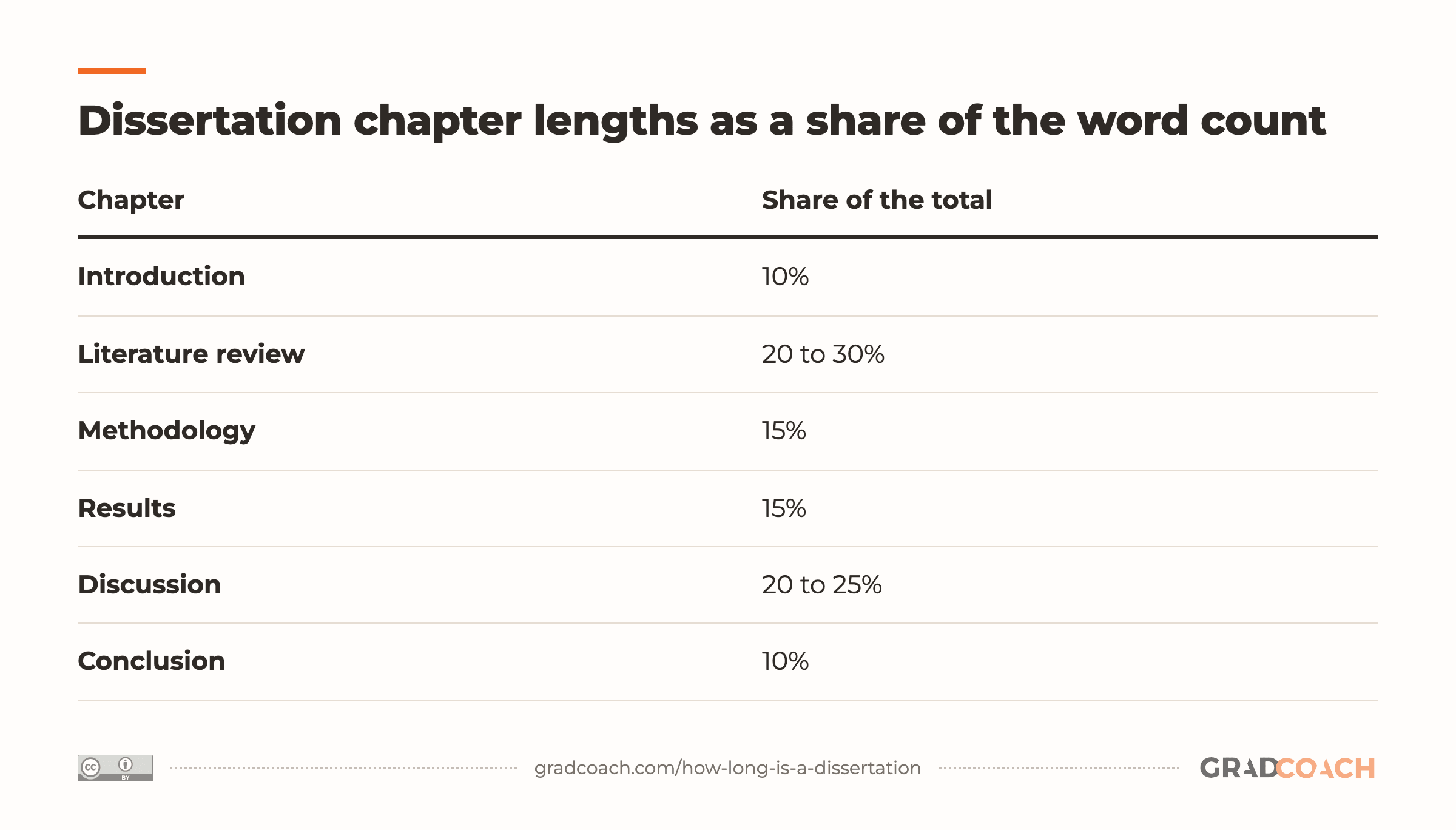
Our coaches often use these proportions as a starting point. They are rules of thumb from coaching rather than a standard, and the ranges will not add to exactly 100%, which is the point: you balance them against each other until they do.
| Chapter | Share of the total |
|---|---|
| Introduction | 10% |
| Literature review | 20 to 30% |
| Methodology | 15% |
| Results | 15% |
| Discussion | 20 to 25% |
| Conclusion | 10% |
So how long should a dissertation introduction be? On a 15,000-word limit, about 1,500 words. How long should a literature review be? Between 3,000 and 4,500. The percentages travel; the totals do not.
The pattern behind them matters more than the numbers. The literature review and the discussion are usually the longest chapters. Methodology and results are typically shorter. Introduction and conclusion sit in between. Methodology and results feel long to write because they are fiddly and detailed, which is why people routinely overspend on them and arrive at the discussion with no room left to say what any of it meant.
How many sources that implies
A word budget answers a second question people ask separately. Our coaches size a reading list from it directly: roughly one citation per 100 to 150 words.
So a 4,000-word literature review needs somewhere between 27 and 40 sources, and double that if you want two citations behind each claim. That is a sanity check rather than a target, and it works in both directions. If you have 200 papers for a 4,000-word review you are not being thorough, you are collecting instead of writing.
That last point is why the budget matters more than any benchmark.
The students we see in trouble on word counts are almost never people who wrote a bad chapter. They are people who wrote a good chapter that was 40% of their total, and then had to dismantle it.
One client skipped writing a conclusion to her findings chapter entirely, because by the time she reached it she had already exceeded her limit. The chapter is not missing because she did not know it was needed.
If you are already over, cut in this order: appendices first if they are excluded from your count, then repetition between the literature review and the discussion, then background that any examiner in your field already knows. Cut the conclusion last. It is the part that carries your argument.
How long does it take to write a dissertation?
Nobody measures this, and it is worth saying plainly before quoting anything at you. Universities record when you enroll and when you submit. Nobody records the day you started writing chapter one, so there is no official figure for the writing phase itself.
What is measured is the whole degree, and those numbers are solid.
In the United States, the median research doctorate takes 5.7 years from starting the doctoral program and 7.3 years from starting graduate school, across all 58,131 people who earned one in 2024. That comes from the Survey of Earned Doctorates, the federal census of everyone who finishes. In the UK, ESRC funds a full-time PhD for 3.5 to 4.5 years, which is a designed length rather than an observed one.
Both figures include coursework, comprehensive exams, ethics approval, data collection and the defense, or viva as the UK calls it. The writing is a fraction of them, and which fraction depends entirely on your project.
For a taught master’s, the dissertation is normally one term or semester alongside other work, and the deadline is fixed by the academic calendar rather than by your progress.
Estimating your own project timeline
Since nobody publishes a writing-phase figure, the only honest estimate is one built from your own pace rather than somebody else’s average.
Measure it for a week. Note the words you draft in each writing session and the hours it took. Most people find their real rate is well below what they assumed, and the gap is the whole problem: a plan built on an imagined rate fails quietly for months before anyone notices.
Then divide your remaining word budget by that rate, and add the parts that are not writing, which are covered in the next section and consume more calendar than most plans allow.
Budget the analysis separately from the writing, because it is the step people underestimate most. If you are learning NVivo, SPSS or R from scratch, the learning is the project for a while, and it happens at exactly the point in the calendar where there is least room for it.
One number worth borrowing: set your own final-draft date about three weeks before the university’s submission deadline. That absorbs defense scheduling, formatting corrections, printing and binding, and the administrative delays nobody budgets for and everybody meets.
The things that often cause delays
About one student in ten asks us how long it will take, unprompted. What we can tell them is where the time actually goes, because it is rarely the writing.
Ethics approval is a fixed cost and people forget to budget it. Find your institution’s stated review turnaround, in weeks, and put it in your plan as a block you cannot compress. A resubmission after a rejected application can cost a month on its own.
Data collection expands, and the analysis expands with it. One student had worked through four of her twelve data sources and already had over 400 extracts. The arithmetic said roughly three times that was coming, and every one of those extracts still had to be coded, compared and written up. Collection feels like the milestone, but it is the analysis behind it that sets the real timeline, and that is a problem to solve before the data arrives rather than after.
Supervisor turnaround is not your time and you cannot compress it either. If your supervisor takes three weeks with a chapter, three rounds of feedback is nine weeks of calendar in which you must be doing something else.
Revision is a phase, not a tidy-up. Nearly every plan we see allocates too little to it.
Working backwards from the deadline
The method our coaches use in a first session is to start at the submission date and plot everything in reverse. Fixed deadline, then a buffer, then submission, then proofreading, then the date writing must be complete, then each chapter backwards from there.
The reason to build it backwards rather than forwards is that a forward plan tells you when you might finish, which is a wish. A backward plan tells you what has to be true this week, which is a fact you can check on Friday.
Our dissertation project plan is the template we build it on, laid out against a real calendar.
Planning backwards is uncomfortable, which is the point of doing it early. “Do you think we’re going to make it?” is a question clients often ask us in live sessions, and it is much easier to answer honestly in month two than in month ten.
Still have questions?
How many pages is a dissertation?
Across the 19,762 we measured at seventeen universities, the median doctoral thesis is 184 pages, or roughly 41,000 words. The median master’s is 75 pages, about 17,000 words, and the median undergraduate dissertation is 49 pages, about 11,000 words. Treat those as the middle of a wide range rather than a target: half of the doctoral theses fall between 140 and 250 pages, which is 31,000 to 56,000 words.
How long is a master’s thesis?
Across the 8,032 master’s theses we measured at seventeen universities in 2026, the median is 75 pages, roughly 17,000 words, with half falling between 52 and 107 pages or 12,000 to 24,000 words. This is the figure institutions disagree most about: the six universities with enough master’s theses to measure run from 59 pages to 91.
In word terms, UK institutions that publish limits commonly set 30,000 words for a master’s by dissertation and 50,000 for an MPhil, though taught master’s dissertations are frequently capped far lower, often between 10,000 and 20,000 words.
How long is a doctoral dissertation?
For a PhD or other research doctorate, 184 pages, or roughly 41,000 words, is the median of the 7,749 doctoral documents we measured, and the middle half runs from 140 to 250 pages or 31,000 to 56,000 words. Seven universities in our sample all land between 159 and 215 pages, which is a tight enough band to be worth trusting. In the UK the common stated ceiling is 80,000 words, with several Cambridge committees setting 60,000 instead.
How long should my literature review be?
There is no external answer, which is why the question is so frustrating. It is a share of your total budget, and 20% to 30% is a reasonable starting point that you should then adjust for what your dissertation actually argues. A synthesis-heavy project earns more; a methods-led one earns less.
Does the page count include references and appendices?
That depends entirely on your institution and it is the single most common thing people get wrong. Some limits exclude both, some exclude the bibliography but count appendices, and at least one university we checked applies different rules in different departments. Check your own handbook rather than assuming.
How long does it take to write a dissertation?
Nobody measures the writing phase separately, so there is no published figure for it. What is measured is the whole degree: a median of 5.7 years from starting a US doctoral program, and a designed 3.5 to 4.5 years for a full-time UK PhD.
For your own project, estimate the drafting hours each remaining chapter needs, total them, and divide by the hours you realistically have each week. Then add your ethics turnaround, your supervisor’s feedback rounds and a genuine revision phase, because those consume more calendar than the writing does.
Is my dissertation too short?
Not by itself. Length is not a proxy for quality, and every figure on this page describes what other people wrote at seventeen universities rather than a standard anyone is held to. If you are inside your institution’s limit and you have answered your research question, you are the right length.
Can’t find your answer here? Ask a Grad Coach directly – the initial chat is free.
Speak with a friendly coach →


Found this helpful?
Keep us near the top of your Google results.