How Long Does a PhD Really Take?
The US median is 7.3 years, and that is only one of three clocks


The 30-second summary
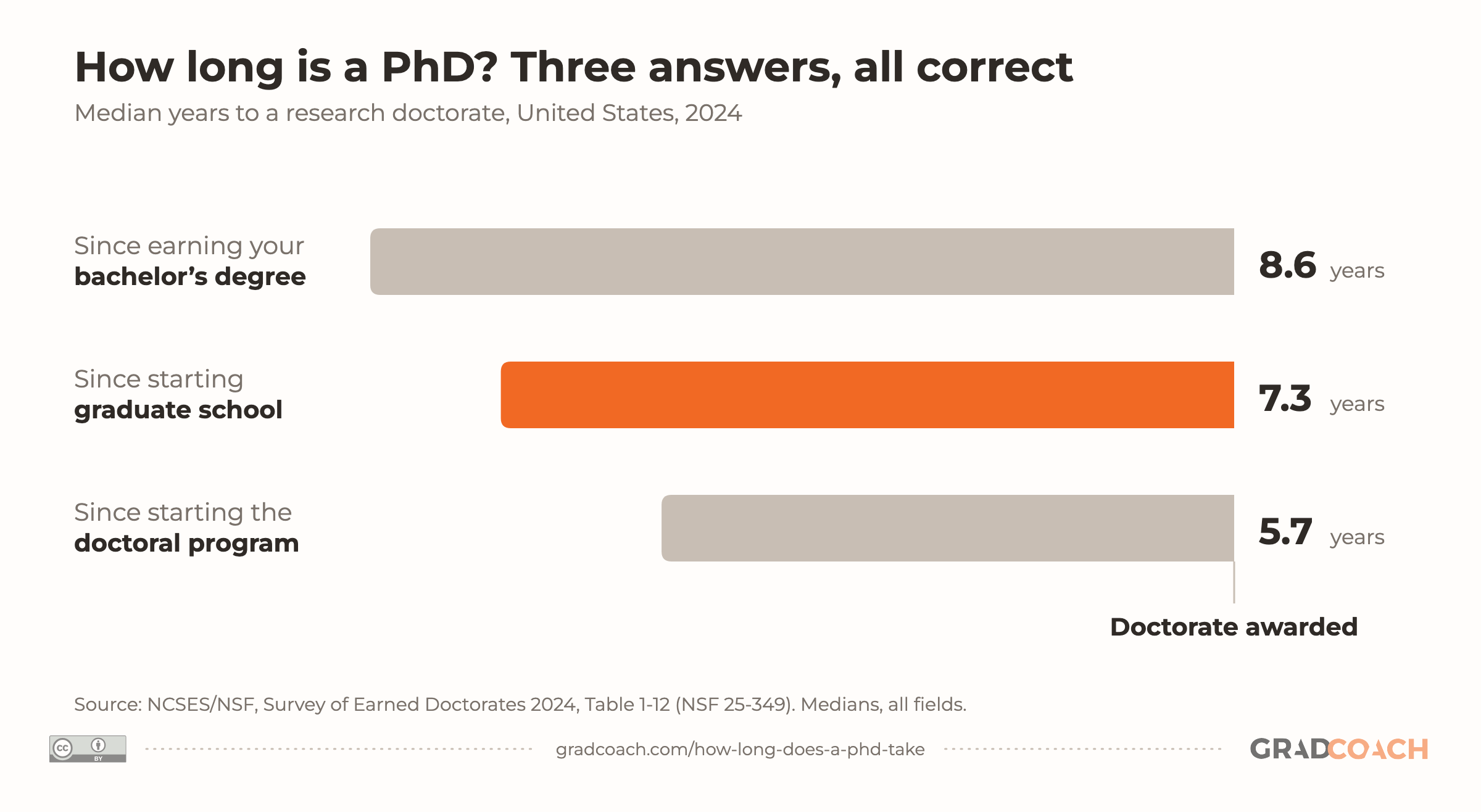
In the United States, the median research doctorate takes 7.3 years from starting graduate school. That is a median, not a target, and it is one of three different measures people quote interchangeably.
- Three clocks, three answers: 8.6 years since the bachelor's, 7.3 since starting graduate school, 5.7 since starting the doctoral program. All three are correct.
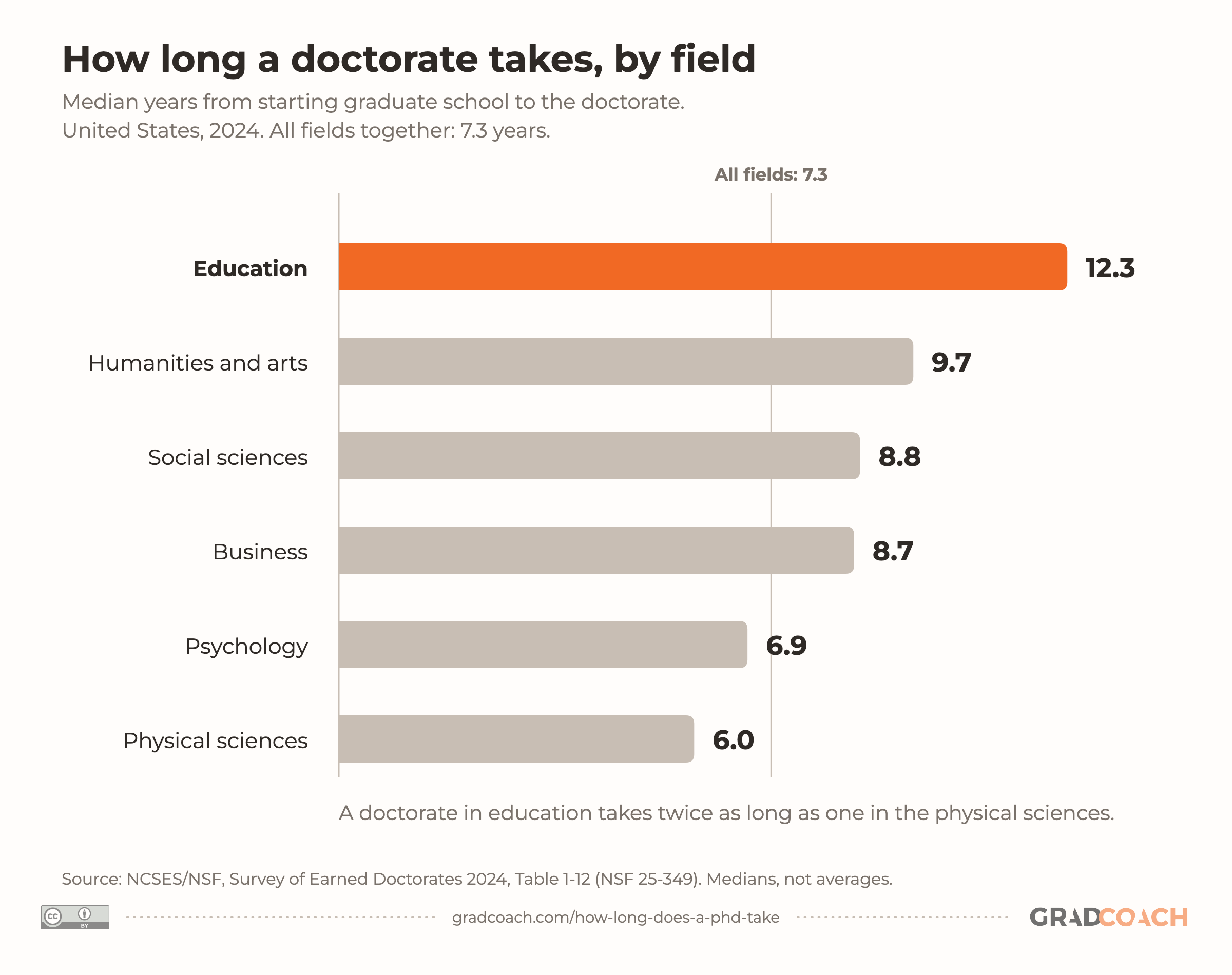
- Your field matters more than almost anything else: education runs to 12.3 years and the physical sciences to 6.0, measured the same way.
- Part-time is the mechanism, not slowness. A UK funder that pays 3.5 years for a full-time PhD pays seven for the same degree at half time.
- Roughly half of every cohort takes longer than its median. That is what a median is. Being past one is not a verdict on you.
These are US figures for research doctorates and they do not cover master's degrees. If you want to see where your own time is actually going, our dissertation project plan maps the whole project against a real calendar.
Navigate
Ask how long a PhD takes and you will get four different answers, delivered with equal confidence, three of which are right.
Here is the one that matters most. In the United States, the median research doctorate takes 7.3 years from the day you start graduate school. That covers every field and all 58,131 people who earned one in 2024, and it comes from the Survey of Earned Doctorates, the National Science Foundation’s annual census of everyone who finishes one.
The reason you have seen other numbers is not that anybody is lying. It is that the clock can start in three different places, and hardly anyone says which one they are using. Sort that out and most of the confusion goes with it.
Why there are three answers
Three clocks, one degree. Each of these is a published figure describing the same 2024 cohort:
- 8.6 years since the bachelor’s degree
- 7.3 years since starting graduate school
- 5.7 years since starting the doctoral program

Nearly three years separate the longest from the shortest, and none of that time is spent in the doctoral program. It is the master’s, the year out, the job that paid for the master’s, the application cycle that ran twice.
Which one you want depends on what you are asking.
- Already in the program and planning what is left? 5.7 is the relevant one.
- Deciding whether to start at all? 7.3 or 8.6 is closer to what you are actually signing up for.
- Comparing yourself to somebody else? Check you are both counting from the same place first. Most arguments about this turn out to be two people using two different clocks.
How long a doctorate takes, by field
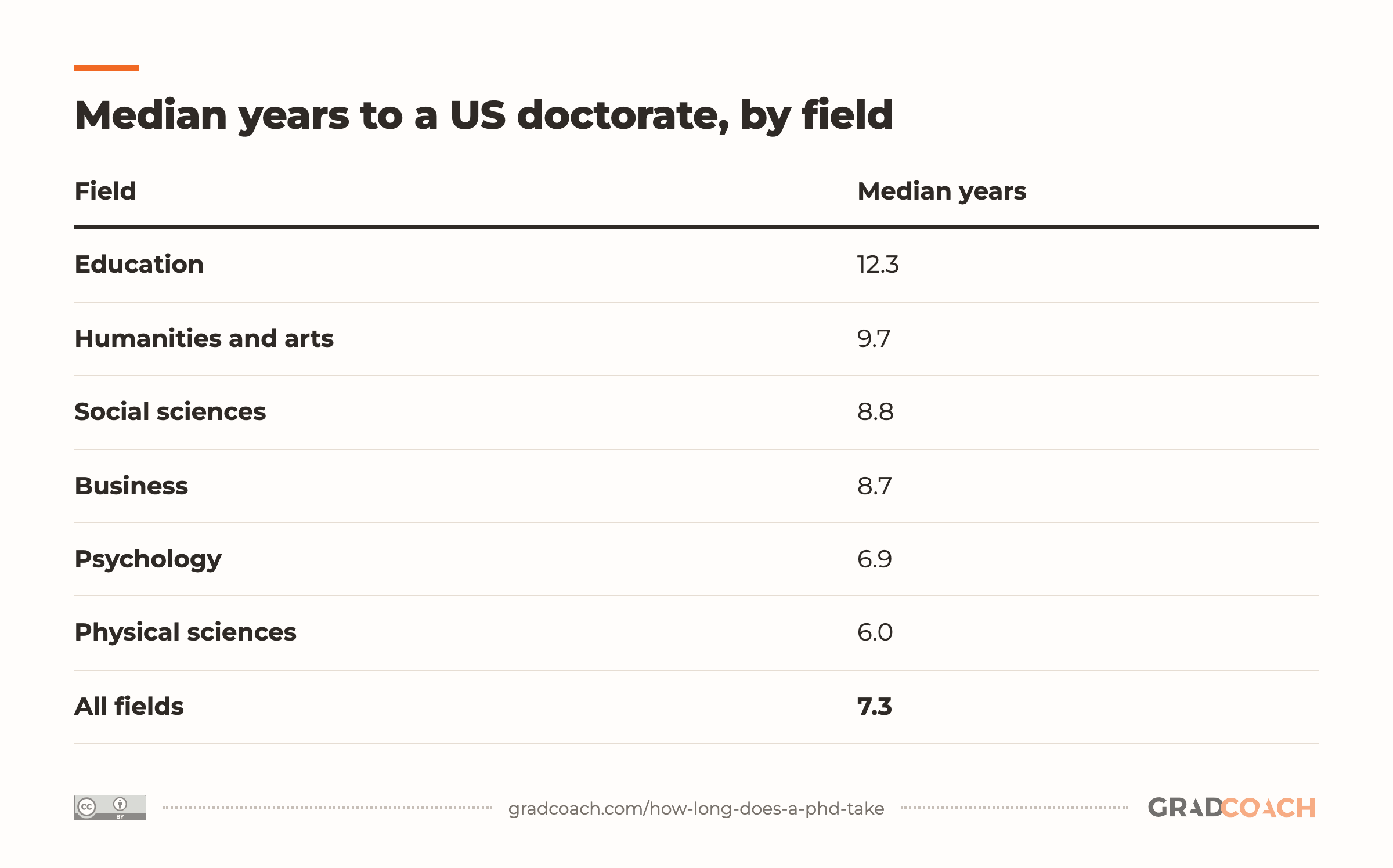
Your field matters more than almost anything else. These are all measured the same way, from starting graduate school, so they can be compared with each other directly.
| Field | Median years |
|---|---|
| Education | 12.3 |
| Humanities and arts | 9.7 |
| Social sciences | 8.8 |
| Business | 8.7 |
| Psychology | 6.9 |
| Physical sciences | 6.0 |
| All fields | 7.3 |

The spread is more than six years wide. An education doctorate takes twice as long as one in the physical sciences, 12.3 against 6.0, and the education figure stretches to 15.6 years when you measure from the bachelor’s instead.
What this table will not tell you is whether any of these numbers are moving, and that is worth a word of caution. The NSF rebuilt its field-of-study taxonomy in 2021, and says field data from before that point may not be comparable with what came after.
It does publish a harmonized set of trend fields to bridge the two, with limitations it states openly. So a claim that a particular field is speeding up or slowing down is a more careful exercise than it looks, and I would treat any confident version of it with suspicion unless it says which taxonomy it is built on.
Why does an education doctorate take twice as long?
The table shows the gap. It does not explain it, so here is what we see from the coaching side.
The education doctorates we work with are nearly always part-time, and the student is holding down a full-time job while they do it, usually in a school, a district or a university department. That stretches the calendar on its own. But the thing that actually drives a number like 12.3 is not the slower pace.
It is the stalls.
A part-time doctoral student who is also running a department has terms where the dissertation does not move at all. Not a slow month, a stopped one. Marking season arrives, or an inspection, or a restructure, and the thesis goes in a drawer. Then something clears and there is a burst of real progress, and the whole cycle repeats. The calendar counts the stopped terms at exactly the same rate as the productive ones.
At the other end of the table, a physical sciences doctorate is far more often a funded full-time position where the research is the job rather than something done around one. Same degree, completely different relationship with the clock.
That distinction matters more than the raw number does, because stopping and starting is a different problem from working slowly, and it does not respond to the same fixes. Left long enough, a stall stops being a stall and becomes all but dissertation.
How long does a PhD take in the UK?
Nobody publishes a median, and I am not going to estimate one.
Everything above is United States data. The UK does count its doctorates: HESA reports postgraduate research qualifications every year, and it even collects a PhD submission date from providers. What it does not publish is how long those degrees took. Search for a UK median anyway and you will find plenty of confident numbers on aggregator sites, none of which name a primary source. I would rather leave a gap here than fill it with something I cannot stand behind.
What the UK does publish is how long a PhD is designed to take. Different question, useful answer.
The Economic and Social Research Council, which funds social science doctorates, states in its postgraduate funding guide that “the funding for PhDs will be 3.5 years as standard and this includes funding for a 3-month placement.” Skip the placement and you do not get that extra quarter-year. Since October 2024 the council has costed its training grants across a spread of lengths, 3.5, 3.75, 4 and 4.5 years, and expects each doctoral training partnership to hand them out according to individual circumstances rather than in fixed proportions.
Then there is the number that ought to travel further than it does. The same guide says a student at 50% time commitment on a 3.5-year award “can receive a seven-year award.”
That is a funder’s own arithmetic, published in its own terms. Halve the time commitment and the designed length doubles. It lands on precisely the mechanism behind the American education figure, arriving from a completely different direction.
The Quality Assurance Agency’s characteristics statement for doctoral degrees adds the only other designed figure in it: integrated doctorates, which fold taught modules into the first year or two, “are often of four years’ duration, full-time.” It states no typical duration for an ordinary research PhD. Neither does UKRI, whose training grant terms leave a studentship’s length to “the awarding Council’s specifications” rather than setting one number across all of them.
Australia does have a real equivalent, and it is worth a mention because it lands on the same gap between what a doctorate is designed to take and what it takes. Marc Torka’s analysis of national completion data from the Australian Department of Education, published in the Australian Universities’ Review in 2020, found a median completion time of 4.8 to 5.0 years against an expected three to four.
I have kept that out of the table above on purpose: it runs to 2017 and it measures length of candidature, not time since starting graduate school. Setting it beside a 2024 American figure would be exactly the apples-to-oranges comparison this post exists to argue against.
For anywhere else, apply the test this section just applied. Does the page quoting a number name its source, and does that source still say it?
These are medians, not deadlines
Roughly half the people behind every median on this page took longer than it. That is what a median is.
Line up all 58,131 people who earned a research doctorate in 2024 by how long it took them, and 7.3 years is where the middle one lands. Close to half of them are on the far side of it. Some of them are years past it.
This is not a footnote. It is the single most misread thing about the whole topic. A median gets quoted as though it were a target, and then somebody at year eight reads it as a verdict on their work, their ability, or their seriousness. It is none of those things. You cannot be late against a median. Half the cohort is standing where you are, by construction.
Where these numbers genuinely help is in setting expectations before you start, arguing for realistic funding, and pushing back on an advisor or a family member who thinks three years is standard. Where they help not at all is in judging yourself against a middle you had no way of knowing about when you began.
One boundary worth stating plainly: this is research doctorate data. It says nothing about master’s degrees, and the figures above should not be scaled down to guess at one.
What actually changes how long yours takes
The medians describe cohorts. They do not describe you, and almost nothing that makes the difference for an individual shows up in a table.
From where we sit, the students who finish closest to their program’s designed length usually have three things going for them. A scope they settled early and then stopped renegotiating. An advisor relationship with an actual rhythm to it, rather than a series of silences broken by panic. And a plan with dates on it that survives a bad month.
The third one is the easiest to fix this week. Our dissertation project plan is a Google Sheet that lays the seven stages of a dissertation against a real calendar, from topic ideation through to the final edit. What it is genuinely good for is making a stalled month look like a stalled month, instead of a vague sense that things are slipping. That is the difference between noticing a stall in week three and noticing it in month five.
Still have questions?
How many years is a PhD?
It depends which clock you mean, which is the whole problem. In the United States the median is 7.3 years from starting graduate school and 5.7 years from starting the doctoral program itself. In the UK, ESRC-funded programs are designed to run 3.5 to 4.5 years full-time, though nobody publishes what they actually take.
How long is a PhD if you have a master’s?
The 5.7-year median is the one that describes the doctoral program on its own, so it is the closest answer for somebody who already holds a master’s and is starting the PhD itself. The 7.3-year and 8.6-year figures both have the master’s inside them, which is why they run longer. This is the single most common reason two people quote different numbers for the same degree.
How long is a PhD without a master’s?
The data on this page cannot split the two routes apart, so the honest answer is to pick the right measure rather than a different number. Use 8.6 years since the bachelor’s: it starts before the two paths diverge, so it treats them on the same footing. Comparing a straight-from-bachelor’s route on the 5.7-year clock against a post-master’s route on the 8.6-year one is the mistake this whole post is about.
How long does a part-time PhD take?
The designed length doubles, and that is arithmetic rather than pessimism. The ESRC funds a 3.5-year full-time award for seven years when the student is at 50% time commitment, which is a funder pricing the same degree at half pace. What nobody publishes is what part-time study actually takes: the US medians here are not split by mode, so part-time students sit inside them rather than beside them.
Am I in trouble if I have passed the median?
No, and the question is worth answering plainly because it gets asked so often. A median is the middle of a distribution, so roughly half of every cohort is past it by definition. It describes where a group landed. It says nothing about whether your work is good or whether you will finish.
How long does a master’s degree take?
These figures cannot tell you, and scaling them down would be inventing a number rather than reporting one. The NSF survey behind this post counts research doctorates only, so a master’s never appears in it as a degree in its own right. It appears only as time already spent, sitting inside two of the three measures above.
Can’t find your answer here? Ask a Grad Coach directly – the initial chat is free.
Speak with a friendly coach →


Found this helpful?
Keep us near the top of your Google results.