
Free download
Qualitative Codebook Template
Our trusted qualitative codebook, to keep your coding consistent. Free to use. Instant access.
Your template is ready
It opens in a new tab, so this page stays right where it is.
Open your template


Developed by Grad Coach's Doctoral-Qualified Team15 Million Downloads · Used by 500+ Universities
4.9 Stars
Client Satisfaction
10,000+
Students coached
100%
Client Pass Rate
15 Million
Video Lesson Downloads
What it covers
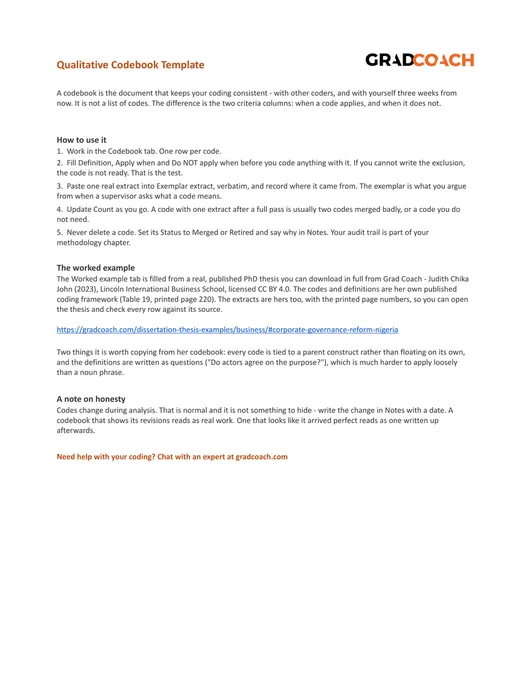
This free template gives you one row per code, with the two columns most code lists leave out, refined from coding work with 10,000+ students. Every code gets:
- CodeAnd the parent theme it sits under
- DefinitionWhat this code captures, in one sentence
- Apply whenYour inclusion criteria
- Do NOT apply whenYour exclusion criteria, and the code it's confused with
- What it tells youWhy it earns its place against your research question
- Exemplar extractOne real quote, verbatim
- SourceWhich transcript, which page or line
- CountHow often it came up
- StatusDraft, Agreed, Merged or Retired
- NotesIncluding what you changed, and when
The Google Sheet can be copied to your Google Drive or downloaded as a fully editable MS Excel file (XLSX format).
Includes real sample codes
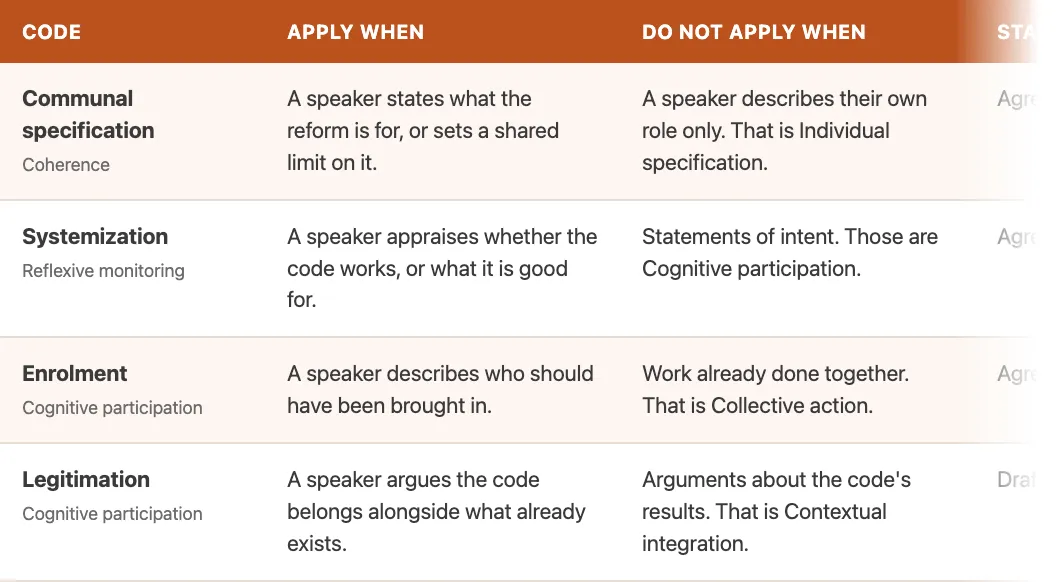
The second tab is a worked example, and it’s a real one. It’s filled from a published PhD thesis you can download in full from this site: Judith Chika John’s 2023 study of corporate governance reform, licensed CC BY 4.0.
The codes and definitions are her own published coding framework. The extracts are her participants’ words, with the printed page numbers, so you can open the thesis and check every row against its source.
One row is left as Draft, because the boundary between two of her codes is genuinely arguable. That’s what an open coding decision looks like before a second coder settles it, and it’s the part an invented example would never show you.
Frequently asked questions
Do I need NVivo, ATLAS.ti or Dedoose to use this?
No. This works alongside any of them, and it works perfectly well on its own. Coding software stores your codes, but most packages won’t make you write inclusion and exclusion criteria, which is the part that actually keeps your coding consistent. Plenty of good qualitative research has been coded in a spreadsheet.
Is this template for thematic analysis specifically?
It suits thematic analysis, content analysis, framework analysis and most other codebook-driven approaches. It’s a poor fit for grounded theory in its purest form, where the categories are meant to emerge without a prior structure, although even there most people keep a record of what each code came to mean.
Should I build the codebook before or after I start coding?
Both, and that’s not a dodge. Start it with whatever codes your research questions and framework already imply, then add to it as new codes come out of the data. What matters is that a code gets its definition and criteria written before you apply it across the rest of your transcripts.
What if my codes change halfway through?
They will. Change them, and record the change in the Notes column with a date. Don’t delete a code. Set its Status to Merged or Retired and say what happened to it.
That record is worth marks. Your methodology chapter has to explain how your coding developed, and a codebook that shows its revisions is evidence you did the work. One that looks like it arrived perfect is much harder to defend.
How many codes should I end up with?
There’s no right number, and it depends on your data and your approach. The more useful signal is the shape. If a code has one extract after a full pass through your data, it’s usually either two codes that were split too finely, or a code you don’t need.
Can I use this for a second coder or intercoder reliability?
Yes. That’s what the criteria columns are for. Hand the codebook to your second coder before they start, have them code a sample independently, then compare. Where you disagree, the fix is almost always a sharper exclusion criterion rather than a longer definition.
Is this for undergrad, Master or PhD-level projects?
It can be used at any level of study. Doctoral projects usually carry more codes and more detail in the criteria columns, but the structure stays the same.
Why are her definitions written as questions?
It’s worth copying. “Do actors agree on the purpose?” is harder to apply loosely than a noun phrase like “purpose alignment,” because you have to answer yes or no against the transcript in front of you.
Can I share this template with my friends/colleagues?
Yes, you’re welcome to share it in its original format (no editing allowed). If you want to post about it on your blog or social media, all we ask is that you reference this page as your source.
Do you have templates for the other dissertation chapters?
Yes, we do. You can find our full collection of templates here.
Can Grad Coach help me with my qualitative analysis?
Yes. You’re welcome to explore our qualitative data coding service if you’d like the coding done with you, or our private coaching if you’d rather work through it yourself with support.
Get your copy, now.
Your template is ready
It opens in a new tab, so this page stays right where it is.
Open your template