
APA Format 7th Edition:
How to Set up Your Paper
APA 7 student-paper rules, checked against APA's own 2026 guidance


The 30-second summary
To format a student paper in APA 7, use one-inch margins, a legible font and double spacing throughout, with a page number top right on every page. Then four rules cover the rest:
- A title page with the bold title, your name, affiliation, course, instructor and due date, all centered.
- An abstract only if your instructor asks for one, usually of no more than 250 words.
- Author-date citations in the text, such as (Jansen, 2023) or Jansen (2023).
- References on a new page, alphabetical, with half-inch hanging indents.
Want it done for you? The free APA 7 template comes with the layout preformatted.
Navigate
APA formatting is where students lose easy points for small slips. A title page missing its page number, an “Introduction” heading APA tells you to leave out, or a narrative citation with the year in the wrong place tells your instructor you skimmed the rules before they’ve read your argument.
In this post, I’ll walk you through the APA 7 rules every student paper needs, from the title page to the last reference, with examples you can copy. It comes from the team that has coached 10,000+ students through their research writing, and if you’d rather skip the setup, our free APA 7 template comes preformatted.
Student vs professional papers
APA 7th edition has two versions of a paper: student papers and professional papers, meaning manuscripts submitted to a journal. This post covers the student version, which is what course assignments use. Dissertations and theses follow your university’s own guidelines on top of APA, so check those first.
The differences are small, and most of them show on the title page:

In practice, that means your paper carries no running head and no author note unless your instructor asks for them.
Structure and layout
An APA student paper generally has a title page, the text and a reference list. Everything else depends on your assignment. When they’re included, the pages run in this order:
- Title page
- Abstract, only if your instructor asks for one
- The text, starting on a new page
- References, starting on a new page
- Footnotes, if you used any
- Tables and figures, if you placed them at the end rather than in the text
- Appendices, if you have any
On tables and figures, you have a choice. APA lets you either embed each one in the text after you first mention it, or put each on its own page after the references. Embedding is usually easier for a reader to follow, but check whether your instructor prefers one or the other.
APA page setup: margins, font and spacing
Set your document up before you start writing, because fixing spacing and page numbers in a finished paper is tedious. Here’s every page-level setting in one place:
| Setting | APA 7 rule |
|---|---|
| Margins | 1 inch on all sides |
| Font | A legible font, such as 12-point Times New Roman or Aptos, 11-point Calibri, Arial or Georgia, 10-point Lucida Sans Unicode, or your word processor’s default |
| Line spacing | Double spacing throughout, title page and references included |
| Paragraph spacing | No extra space before or after paragraphs |
| Paragraph indent | First line indented 0.5 inch |
| Alignment | Flush left with a ragged right edge, never justified |
| Page header | The page number, top right, on every page from the title page on |
APA’s font page (last updated February 2026) explicitly allows your word processor’s default font and lists Aptos among its examples. Whichever font you choose, use it throughout. The exceptions are text inside figures, which should be a sans serif font between 8 and 14 points; computer code, which takes a monospace font such as 10-point Courier New; and footnotes, which can keep your word processor’s default settings.
Double spacing has a few exceptions too. The cells of a table and the words inside a figure image can be single-, one-and-a-half- or double-spaced, whichever is clearest, and footnotes can stay at their default spacing. And if you’re writing a thesis that will be printed and bound, your university will probably want a wider left margin, so its formatting guide wins there.
The title page
Your title page is the first thing your instructor sees, so it’s worth getting exactly right. Everything on it is centered and double-spaced:
- Your title, three to four lines down from the top, in bold and title case. A subtitle can go on its own line below it.
- Your full name, after one blank double-spaced line.
- Your affiliation: your department and university, separated by a comma.
- The course number and name, separated by a colon (for example, MGT301: Human Resource Management).
- Your instructor’s name, in the form your course materials use.
- The due date, in the date format normally used in your country.
The page number 1 sits in the top-right corner, as it does on every page after it. Compare your page against the student version in the figure near the top of this post; if your instructor wants the professional version, the same figure shows what changes.
The abstract
Most student papers don’t need an abstract. APA only expects one in a student paper if your instructor asks for it. If yours does, set it up like this:
- Start the abstract on a new page, after the title page.
- Write the label “Abstract” at the top, centered and bold.
- Write the abstract itself as a single paragraph with no first-line indent, usually in no more than 250 words unless your instructor sets another limit.
- On a new line, indented half an inch, type Keywords: in italics, followed by three to five keywords in lowercase (proper nouns keep their capitals), separated by commas.
In the template’s abstract below, compare the paragraph’s left edge with the keywords line:
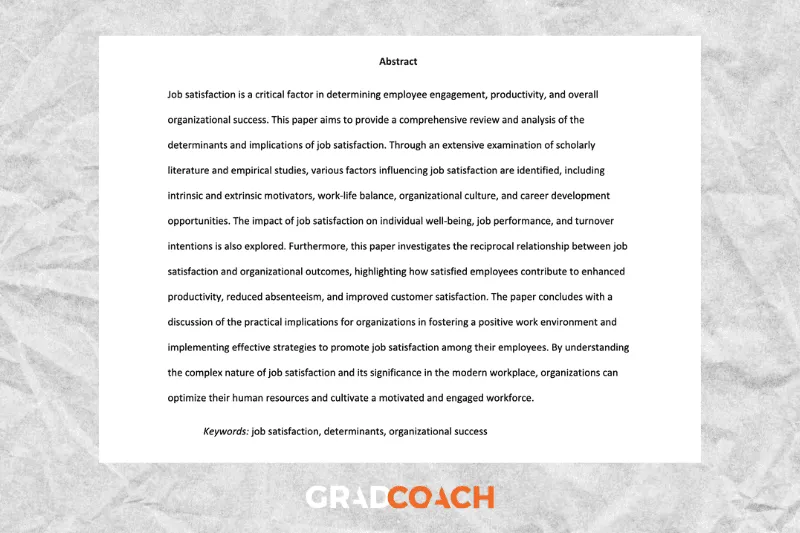
The abstract paragraph starts flush left while the keywords line is indented, the reverse of every other paragraph in your paper.
The main body
The text starts on a new page, after the title page or abstract. Repeat your paper’s title at the top of that page, centered and bold, then begin your first paragraph on the next line.
Don’t add an “Introduction” heading. APA treats your opening paragraphs as the introduction by default, with the paper title acting as their heading.
APA headings
Many short papers need no headings at all. If yours does, APA has five levels, and you use them in order, starting from Level 1:
| Level | Format |
|---|---|
| 1 | Centered, bold, title case; text starts on a new paragraph |
| 2 | Flush left, bold, title case; text starts on a new paragraph |
| 3 | Flush left, bold italic, title case; text starts on a new paragraph |
| 4 | Indented, bold, title case, ending with a period; text continues on the same line |
| 5 | Indented, bold italic, title case, ending with a period; text continues on the same line |
Three more rules trip people up. Don’t number or letter your headings. If you use a Level 2 heading in a section, use at least two. And don’t add blank lines above or below headings; they’re double-spaced like everything else.
Numbers, punctuation and language
APA has style rules for the writing itself, not just the layout. These are the ones that come up in nearly every student paper:
- Numbers: words for zero to nine, numerals for 10 and above. Ages, percentages, money, times, dates, decimals and numbers before a unit of measurement (5 mg) take numerals even below 10, unless the number starts a sentence, and common fractions take words (two thirds).
- Spacing: one space after a period at the end of a sentence.
- Commas: use the serial comma before “and” in a list of three or more.
- Voice: use the active voice where you can, especially when describing what people did.
- Tense: keep the same verb tense through a paragraph and the ones around it.
- Bias-free language: APA has detailed guidance on writing about people respectfully and precisely.
In my experience, numbers cause the most corrections, because the exceptions (ages, percentages, money) are exactly the numbers a research paper is full of.
APA in-text citations
APA uses an author-date system: each citation gives the author’s last name and the year of publication, and every work you cite needs a matching reference entry (personal communications, such as emails or lectures, are the exception: they’re cited in the text only). You can write a citation two ways.
A parenthetical citation puts the author and year in parentheses, separated by a comma:
APA 7th edition is easy to grasp once you know its core rules (Jansen, 2023).
A narrative citation names the author in your sentence, with the year in parentheses straight after the name:
Jansen (2023) states that APA 7th edition is easy to grasp once you know its core rules.
I’d use a mix of the two. A narrative citation suits a sentence where the author’s identity matters to your point; a parenthetical one keeps the focus on the idea.
A few situations change the format:
- Two authors are joined by ”&” inside parentheses (Jansen & Warren, 2023), and by “and” in a narrative citation: Jansen and Warren (2023).
- Three or more authors shorten to the first author plus “et al.” every time, even the first: (Jansen et al., 2023).
- Direct quotations add the page number after the year: (Jansen, 2023, p. 45). Note the space after “p.”
- Long quotations of 40 words or more become a block quotation: its own paragraph, indented half an inch, with no quotation marks, and the citation, (Jansen, 2023, p. 45), after the final period.
The full details for each of these go in your reference list, set up as below.
The reference list
The reference list starts on a new page after the text, under the label References, centered and bold (not “Works Cited” or “Bibliography”). Set the list up like this:
- Double-space everything, within entries and between them.
- Alphabetize by the first word of each entry, usually the first author’s last name.
- Use hanging indents of half an inch, so the first line of each entry sits at the margin and the lines below it are indented.
- Include every work you cited in the text, except personal communications, and nothing you didn’t.
Each entry answers four questions in this order: who wrote it (author), when (date), what it’s called (title) and where to find it (source). Here’s how that looks for the three kinds of source you’ll cite most, starting with a book. All three are real.
A journal article adds the journal’s name and volume in italics, the issue number, the page range and the DOI as a full link:
A web page names the website after its title, unless the author and site share a name. Here the site, APA Style, is named differently from its author, so it stays:
APA uses initials for authors’ first names and sentence case for article and book titles, with only the first word, the first word after a colon and proper nouns capitalized. Journal names keep title case. In my experience, those two details are where most hand-built entries go wrong.
Pro tip: Don’t build your reference list entirely by hand. A reference manager such as Mendeley or Zotero formats every entry for you and keeps your citations and list in sync, and both are free. If you haven’t used one before, this walkthrough of Mendeley gets you started:
Whichever tool you use, check its output against the examples above before you submit, because the details a reference manager imports are often incomplete, and title case slips through constantly.
The appendix
An appendix holds material that supports your paper but would interrupt the text: a survey instrument, interview questions, detailed tables or extra figures. Appendices are optional, so only add one if your material needs it and your instructor allows it. If you do:
- Start each appendix on a new page, after the references (and any footnotes, tables and figures placed at the end).
- Label it “Appendix” if there’s only one, or “Appendix A”, “Appendix B” and so on if there are several, centered and bold.
- On the next line, give it a descriptive title, also centered and bold.
- Start the content below, with indented paragraphs like the rest of your paper.
Then refer to every appendix in your text, for example “(see Appendix A)”, and do it in order, so Appendix A is mentioned before Appendix B. A few more rules apply inside the appendix itself:
- Page numbers carry on in the top-right corner, through every appendix page.
- Any source you cite in an appendix goes in your main reference list.
- A table or figure inside an appendix takes the appendix’s letter, as in Table A1 or Figure B2, with no period between them.
- An appendix that is a single table or figure uses the appendix label and title in place of a table number and title.
Here’s an APA appendix example from our template, with the label and title stacked, both bold and centered:
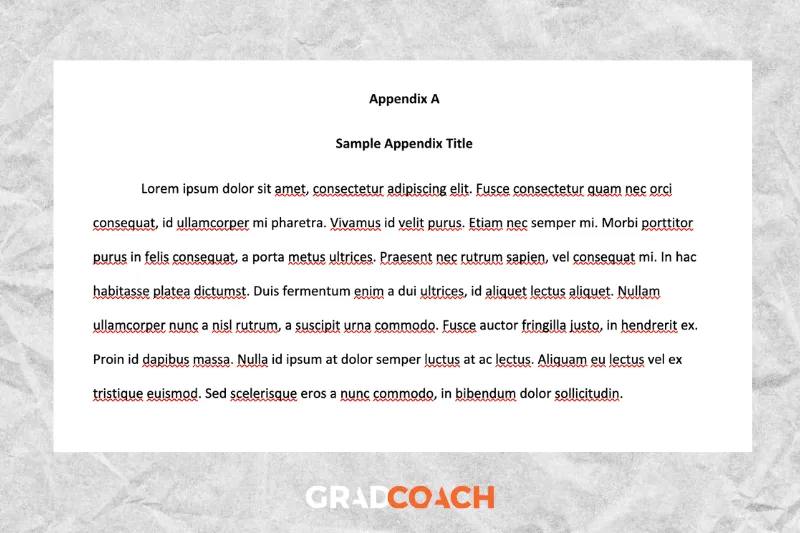
One thing worth knowing from experience: graders rarely give points for the appendix itself. It earns its place by supporting the claims in your text, so anything essential to your argument belongs in the body.
Still have questions?
Do student papers need an abstract in APA 7?
Usually not. APA says student papers generally don’t include an abstract unless the instructor asks for one. If yours does, it goes on its own page after the title page, under a centered, bold label, usually in no more than 250 words unless your instructor sets another limit.
What font does APA 7 require?
None in particular. APA accepts any legible font used consistently, including your word processor’s default. Its examples include 12-point Times New Roman and Aptos, 11-point Calibri, Arial and Georgia, and 10-point Lucida Sans Unicode. Text inside figures should be a sans serif font between 8 and 14 points.
Is APA 7 double spaced?
Yes, throughout: the title page, abstract, text, block quotations and the reference list, within and between entries. The exceptions are table cells and the words inside figure images, which can be single- or one-and-a-half-spaced if that’s clearer, and footnotes, which can keep your word processor’s default spacing.
Does an APA student paper need a running head?
Not usually. Since the seventh edition, a student paper’s page header is just the page number, in the top-right corner. The running head, a shortened title in capitals at the top left, is for professional papers, so only add one if your instructor or institution asks for it.
Can you use “I” in an APA paper?
Yes. APA 7 asks you to use first-person pronouns to describe your own work: “I” if you wrote the paper alone, “we” if you have co-authors. It specifically advises against calling yourself “the author” or “the researcher”, which can leave readers unsure who did what. Some instructors still prefer the third person, so follow yours if they say so.
How do you format a dissertation in APA?
Follow APA 7 for the formatting and citations, then layer your university’s thesis guidelines on top. Graduate schools usually add their own requirements, such as wider binding margins, specific front matter and a set order of chapters. Where the two disagree, your university’s guide wins. Our dissertation structure guide covers the chapters themselves.
What’s the difference between APA and MLA?
APA cites by author and year, (Jansen, 2023), plus a page number for quotations, while MLA cites by author and page number, (Jansen 13). APA uses a title page and a References list; MLA usually needs no title page and calls its list Works Cited. APA is mostly used in the social sciences, MLA in the humanities. Our MLA formatting guide walks through MLA the same way.
Should I use APA 6 or APA 7?
APA 7. The seventh edition of the APA Publication Manual has been the current edition since 2019, and it changed several rules, including using “et al.” from the first citation of a work with three or more authors. Only use APA 6 if your instructor or institution specifically requires it.
Can’t find your answer here? Ask a Grad Coach directly – the initial chat is free.
Speak with a friendly coach →


Found this helpful?
One click keeps us near the top of your Google results.