Real Literature Review Examples
Four A-grade literature review examples, with comments


The 30-second summary
If you’re new to literature reviews, seeing real examples from a successful dissertation helps you understand what a strong chapter looks like. Here are four, annotated with our comments on what each one does well.
- Example 1 is how the chapter opens: the job, the map, and a reason for leaving some literature out.
- Example 2 is a section that argues. Three sources, two of them disagreeing, and an author who says which side his case falls on.
- Example 3 is the same passage twice, once with its critical sentences removed. Two sentences are the whole difference between a summary and an argument.
- Example 4 is where the gap gets proved, by counting what 47 papers had in common. Not by announcing that little research exists.
- Critique should carry roughly half the words in a section. You can measure that on your own draft in about two minutes.
All four examples come from one distinction-grade Master's dissertation, and there's a free chapter template to go with them.
Navigate
We’ve coached thousands of students through their literature reviews, and I’ve watched a lot of them read an excellent example, nod, and then go back to their own chapter and write exactly what they were writing before. Not because the example was bad. Because nobody told them what to look at in it.
So, here we’ll walk you through four sample literature review sections, annotated with our comments to help you see what makes them tick. They come from one Master’s dissertation that was awarded a distinction, a study of what makes customers trust a company they only ever deal with online. The wording is as submitted, with the industry and country redacted in square brackets. The comments are the same read our coaches do on every Chapter 2.
Example 1: How the chapter opens
Nobody ever knows how to start this chapter. Here is what a distinction-grade opening looks like, and it is shorter than most people expect.
Three short paragraphs, four distinct moves.
| The move | Where it happens |
|---|---|
| States the chapter’s job | “This chapter serves to establish a theoretical background… by identifying, evaluating, and comparing”. Three verbs, and none of them is describe. The chapter announces on line one that it intends to argue. |
| Says where it ends up | “will lead to the development of nine hypotheses… thereby laying the foundation for the theoretical framework”. The reader knows the destination before the first source appears. |
| Maps the route | “The chapter begins by… This is followed by…”. Two sentences of signposting. An examiner who knows where they are being taken can follow the argument. |
| Justifies what is in and what is out | “it principally draws on academic literature due to a general lack of practitioner research” that meets the standards of scientific quality he then lists. |
That last one is the move worth stealing. Most openings say what the chapter covers; this one says what it excludes and why, and the reason is a criticism of an entire body of literature. Critique starts in the first three paragraphs.
Notice also what is missing. There is no paragraph explaining that trust is an important topic in business today, and no potted history of the field. The chapter starts working immediately.
Example 2: A section that argues
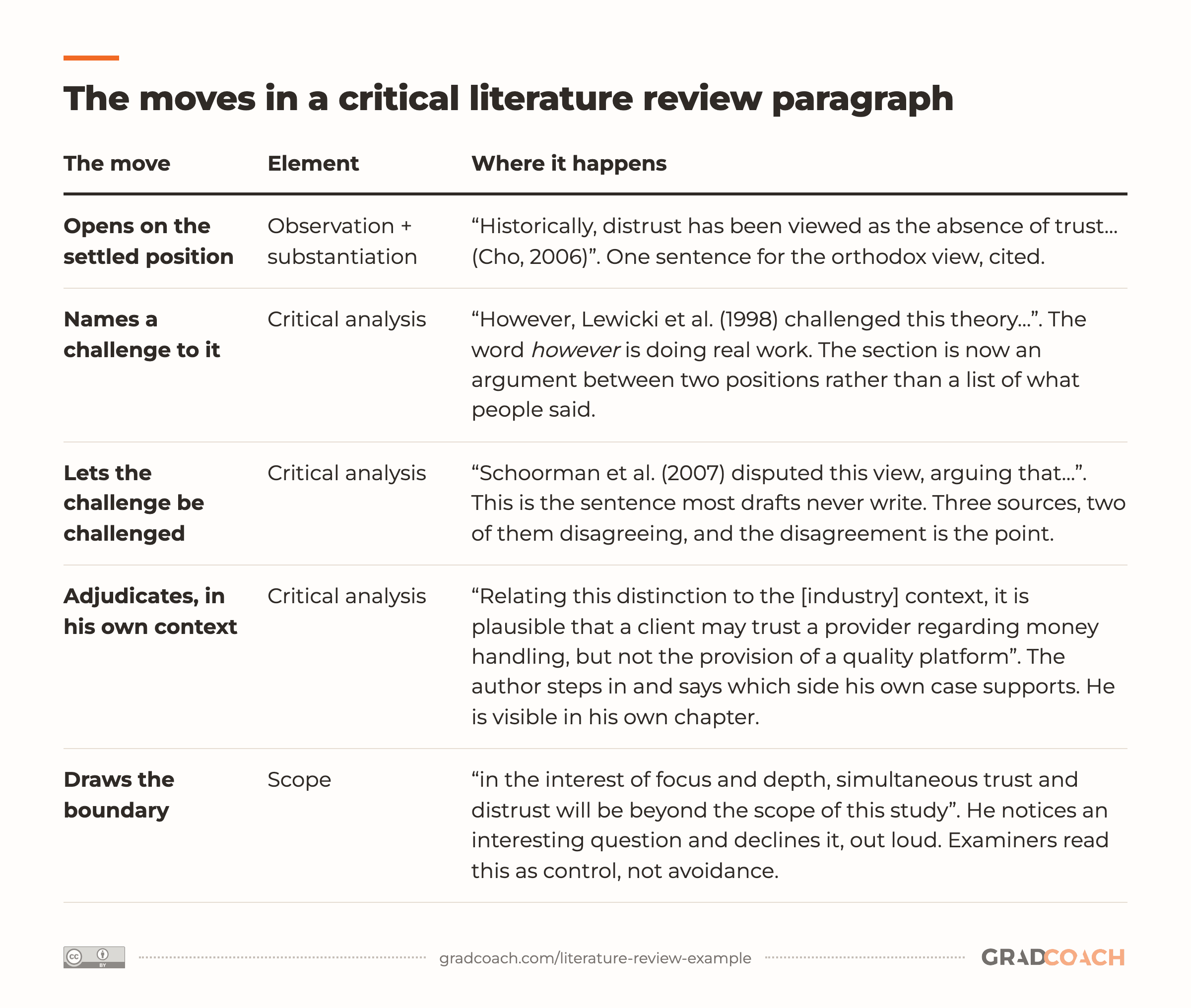
Watch what happens here in the space of four sentences. A settled position, someone who challenges it, someone who challenges the challenger, and then the author stepping in to say which side his own case falls on. That last move is the one most drafts never make.
| The move | Element | Where it happens |
|---|---|---|
| Opens on the settled position | Observation + substantiation | “Historically, distrust has been viewed as the absence of trust… (Cho, 2006)”. One sentence for the orthodox view, cited. |
| Names a challenge to it | Critical analysis | “However, Lewicki et al. (1998) challenged this theory…”. The word however is doing real work. The section is now an argument between two positions rather than a list of what people said. |
| Lets the challenge be challenged | Critical analysis | “Schoorman et al. (2007) disputed this view, arguing that…”. This is the sentence most drafts never write. Three sources, two of them disagreeing, and the disagreement is the point. |
| Adjudicates, in his own context | Critical analysis | “Relating this distinction to the [industry] context, it is plausible that a client may trust a provider regarding money handling, but not the provision of a quality platform”. The author steps in and says which side his own case supports. He is visible in his own chapter. |
| Draws the boundary | Scope | “in the interest of focus and depth, simultaneous trust and distrust will be beyond the scope of this study”. He notices an interesting question and declines it, out loud. Examiners read this as control, not avoidance. |
Two things are worth noticing about what is not there. There is no sentence summarizing what each author’s paper was about, and there is no closing line announcing a gap. The disagreement between Lewicki and Schoorman is the substance, and the boundary decision is the conclusion.
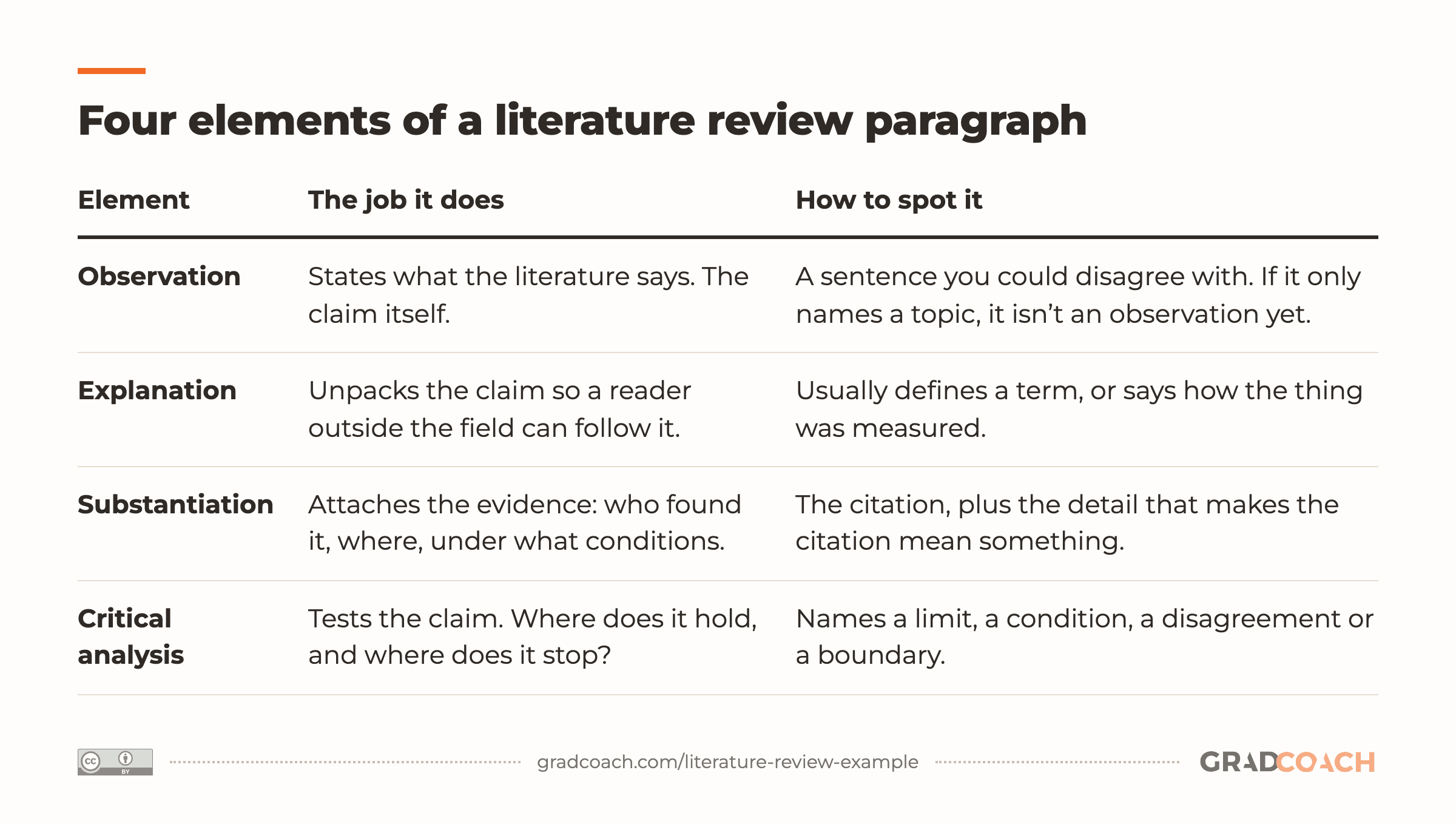
That middle column is a system, and it works on any paragraph. Read enough strong literature reviews and the same four jobs keep appearing. Not in a fixed order, and not one sentence each: these are categories of sentence, and a good paragraph will spend several on some and skip lightly over others.
| Element | The job it does | How to spot it |
|---|---|---|
| Observation | States what the literature says. The claim itself. | A sentence you could disagree with. If it only names a topic, it isn’t an observation yet. |
| Explanation | Unpacks the claim so a reader outside the field can follow it. | Usually defines a term, or says how the thing was measured. |
| Substantiation | Attaches the evidence: who found it, where, under what conditions. | The citation, plus the detail that makes the citation mean something. |
| Critical analysis | Tests the claim. Where does it hold, and where does it stop? | Names a limit, a condition, a disagreement or a boundary. |
Three of the four come naturally to most people. Critical analysis is the one that separates a pass from a distinction, and it is the one almost everybody underweights. Look back at the extract above: of its five moves, three are critical analysis. That is not an accident.
Here’s the proportion worth remembering. In a well-built section, about half the words are critical analysis. When one of our coaches sits down with a draft that came back marked “not critical enough”, it is usually nearer a fifth, and most of that fifth is tacked on at the end.
Example 3: Description vs argument
The feedback everyone gets is “be more critical”, which is useless on its own because it names the fault and not the fix. So here is a third section from the same chapter, shown twice.
It is about a person’s propensity to trust, abbreviated to PTT: how willing someone is to trust others in general, before they know anything in particular about who they are dealing with. The first version below is what most drafts look like. I produced it by taking the real paragraph and deleting only its critical sentences. Nothing was added.
Accurate. Well cited. Eight sources in three sentences, and whoever grades it would still call it a book report, because every source agrees with every other source and the author has no view.
Now the same passage as it was actually submitted.
Two restored sentences and a closing one. That is the entire difference, and it turns a summary into an argument with a destination.
Look at what those sentences do. The first finds two studies that disagree with the four already cited, and it neither resolves the disagreement nor hides it. The second names a pattern across the whole set: the relationships vary in direction, not just in size. The third takes that disagreement, adds one feature of the author’s own context, and turns them into a reason for the study to exist.
And notice where the gap sentence sits. It is not a standalone claim at the end of the chapter that “little research exists in this area”. It is the last sentence of a specific argument about specific contested findings, which is what makes it credible. A gap announced on its own invites the reader to wonder whether the gap is real or whether you simply did not search hard enough.
When you cannot think of anything critical to say, and almost everyone gets stuck here, take the claim you have just written down and interrogate it:
- Where? What setting produced this finding (a lab, a school, a workplace, one country)? Does your context share it?
- When? How old is the finding, and has the thing it measures changed since? A 2015 study of workplace communication predates a lot.
- Who? Who was in the sample, and who wasn’t? Sample size, sector, seniority, and everything the authors didn’t record.
- How? What method produced it? Self-report and observation frequently disagree, and the disagreement is usually interesting.
- Why? Why did the authors expect this, and what would have counted as a result against them?
Most claims will give you something on at least two of the five. The most reliable is the gap between a narrow sample and sweeping wording: a paper studies 200 people in one sector and writes its conclusion as though it applies to everyone, everywhere. Say so. That’s not nitpicking, it’s the job.
One thing worth saying plainly, because it stops a lot of people: being published does not make a claim true, and criticizing a professor’s work is not rude. “Be more critical” is not just permission to criticize established researchers. It’s an instruction to.
Example 4: Critiquing the whole field
The first three examples work at the level of a paragraph or a section. This one zooms out, and it is where the gap the whole chapter has been building toward finally gets proven. It is also the single most useful thing on this page for anyone whose feedback said their review “doesn’t lead anywhere”.
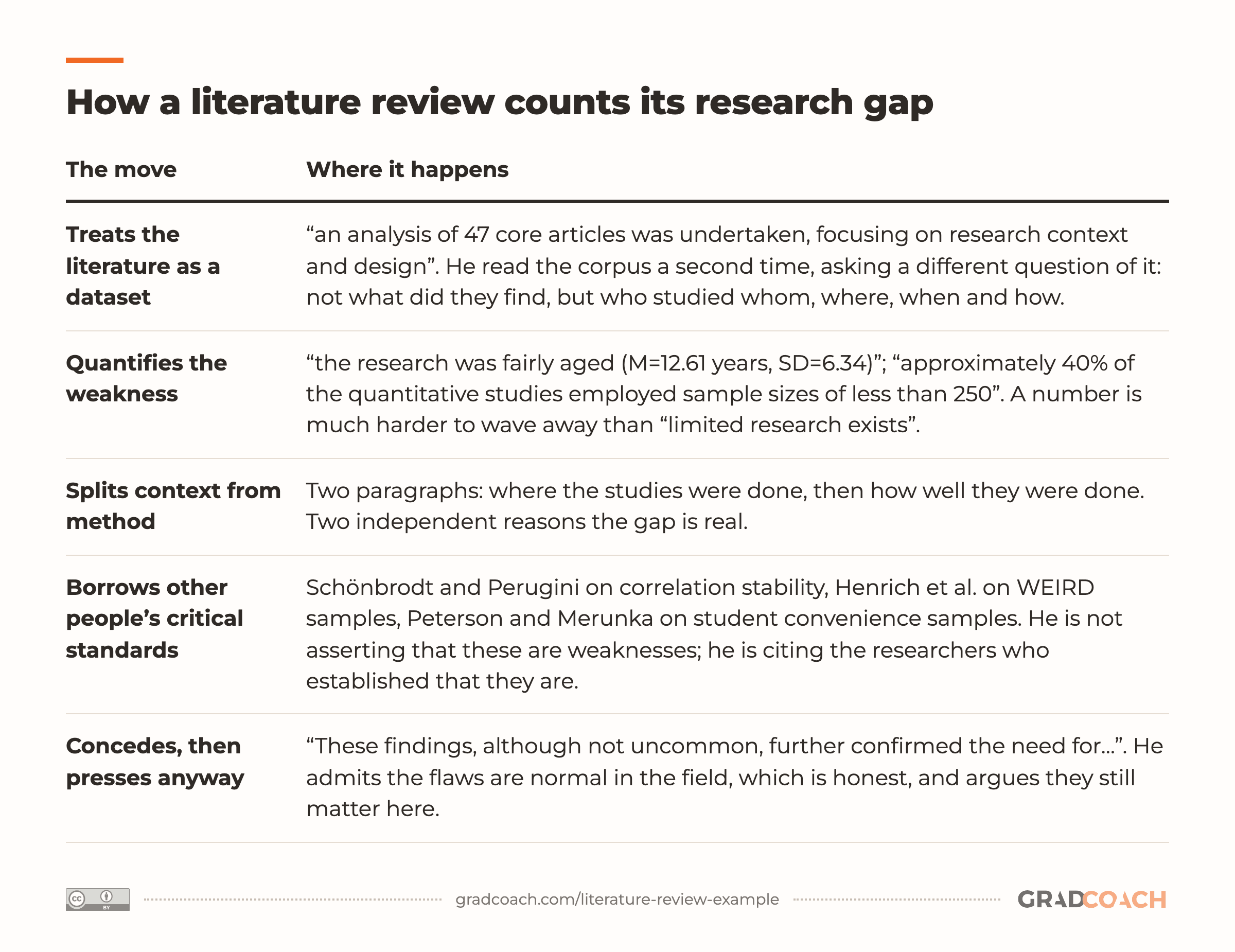
The reason this works is that the gap is counted, not claimed.
| The move | Where it happens |
|---|---|
| Treats the literature as a dataset | “an analysis of 47 core articles was undertaken, focusing on research context and design”. He read the corpus a second time, asking a different question of it: not what did they find, but who studied whom, where, when and how. |
| Quantifies the weakness | “the research was fairly aged (M=12.61 years, SD=6.34)”; “approximately 40% of the quantitative studies employed sample sizes of less than 250”. A number is much harder to wave away than “limited research exists”. |
| Splits context from method | Two paragraphs: where the studies were done, then how well they were done. Two independent reasons the gap is real. |
| Borrows other people’s critical standards | Schönbrodt and Perugini on correlation stability, Henrich et al. on WEIRD samples, Peterson and Merunka on student convenience samples. He is not asserting that these are weaknesses; he is citing the researchers who established that they are. |
| Concedes, then presses anyway | “These findings, although not uncommon, further confirmed the need for…”. He admits the flaws are normal in the field, which is honest, and argues they still matter here. |
That fourth move is the one to copy if you copy nothing else. Criticizing a study’s sample size sounds like an opinion until you attach it to a methodologist who has written about why that sample size is a problem. Then it is an argument.
And the last one matters more than it looks. Conceding that a weakness is common across the field costs nothing and buys a lot of credibility, because the alternative reads as though you believe you are the first person to notice.
Run the test on your own draft
Two minutes, one section of your draft, no software.
- Take that section, start to finish.
- Highlight every sentence that tests a claim rather than reporting one. Anything that names a limit, a condition, a disagreement, or a boundary.
- Word-count the highlights, and compare that against the section’s total.
If you’re near half, you’re in good shape. If you’re under a quarter, you have a descriptive chapter, and the fix isn’t more reading. It’s going back through what you already have with the five questions above.
The other tell takes ten seconds: look at where your critical sentences sit. If they’re clustered in the last paragraph of each section, you’ve quarantined your critique. Distribute it, and something quietly satisfying happens: the summary sentence at the end of the section often becomes unnecessary, because the argument has already been made.
Where to find more literature review examples
Two things worth knowing before you go looking. Most “sample literature review” pages are university library link lists, and a lot of those links are dead, so everything below was opened and read rather than just pinged. And your own department’s repository beats any celebrated example from elsewhere, because requirements vary more than students expect. Ask your advisor for two theses they rated.
Where to actually get them:
- The Grad Coach Research Toolkit. Start here. It’s our own free collection, and the part that matters for this page is the dissertation sample library: complete, real dissertations you can open and read the Chapter 2 of, rather than an extract somebody chose for you. The literature review template linked above lives there too.
- CORE. 452 million open access papers aggregated from university repositories worldwide, including a large number of full theses. The widest net of the open academic aggregators, and the one to try when your topic is niche.
- EThOS. The British Library’s UK doctoral thesis service, back online after its restoration work. Essential if you’re at a UK institution.
- Open Access Theses and Dissertations (OATD). An index of open access graduate theses from institutions worldwide.
- ProQuest Dissertations & Theses. The largest collection there is, but a subscription database. Check whether your university library already gives you access; most do.
When you open a thesis, the literature review is usually Chapter 2, and it is usually 20 to 40 pages. Don’t read it end to end. Find a section on a topic you know something about, and run the four-element test on two of its paragraphs. You’ll learn more from that than from reading three complete chapters.
Still have questions?
Are these literature review examples real?
Yes. All four examples come from a Master’s-level dissertation for an MBA program that was awarded a distinction. The wording is as submitted, with two changes made for privacy and marked in square brackets: the industry and the country have been redacted. Nothing has been added, tidied or improved, and the annotations sit alongside the text rather than inside it. It is written in UK English, which is left as the author wrote it.
What is an example of a good literature review?
A good one is recognizable by what it does rather than what it covers: it groups sources by theme rather than marching through them one per paragraph, it tests the claims it reports, and it arrives at a gap that follows from the criticisms it has already made. Examples 2 and 3 show the second, and Example 4 shows the third.
Can I replicate this literature review for my dissertation?
Not directly, and you shouldn’t want to. Every literature review differs with the university’s requirements and the nature of the research itself. Use it for the structure and the moves, not the content, and check your own institution’s guidelines before you finalize anything. If you want the underlying structure as something you can write into, the free literature review template is the same shape.
How long should a literature review chapter be?
For a Master’s-level dissertation, usually 2,000 to 3,000 words. Doctoral projects can run to several times that. Your university’s requirements override any rule of thumb here, so check them.
Can I use ChatGPT to write my literature review?
For finding and summarizing sources, it can save you real time. For the writing, be careful: the thing a language model is best at is producing exactly the fluent, descriptive summary that gets a chapter marked down. Critique is the part that has to come from you, because it depends on your study and your context. Check your university’s policy too; they vary widely and the penalties don’t.
Where can I find more examples of literature reviews?
Your own university’s repository first, then the collections listed above. Full dissertations are a better source than curated “sample” pages, because you get the whole chapter in context rather than an extract someone chose.
Can’t find your answer here? Ask a Grad Coach directly – the initial chat is free.
Speak with a friendly coach →


Found this helpful?
Keep us near the top of your Google results.